
Look at what people actually type into Google when a bearing fails: “15 x 32 x 9 bearing.” “id 45 od 100 bearing number.” “21308 bearing dimensions.” Nobody searches for a catalog. They search with a caliper reading in one hand and a dead machine behind them.
So here’s the useful version: a bearing size chart for the most common deep groove ball bearings, how to read the number in your hand, and what to do when the number’s gone and all you have is the size.
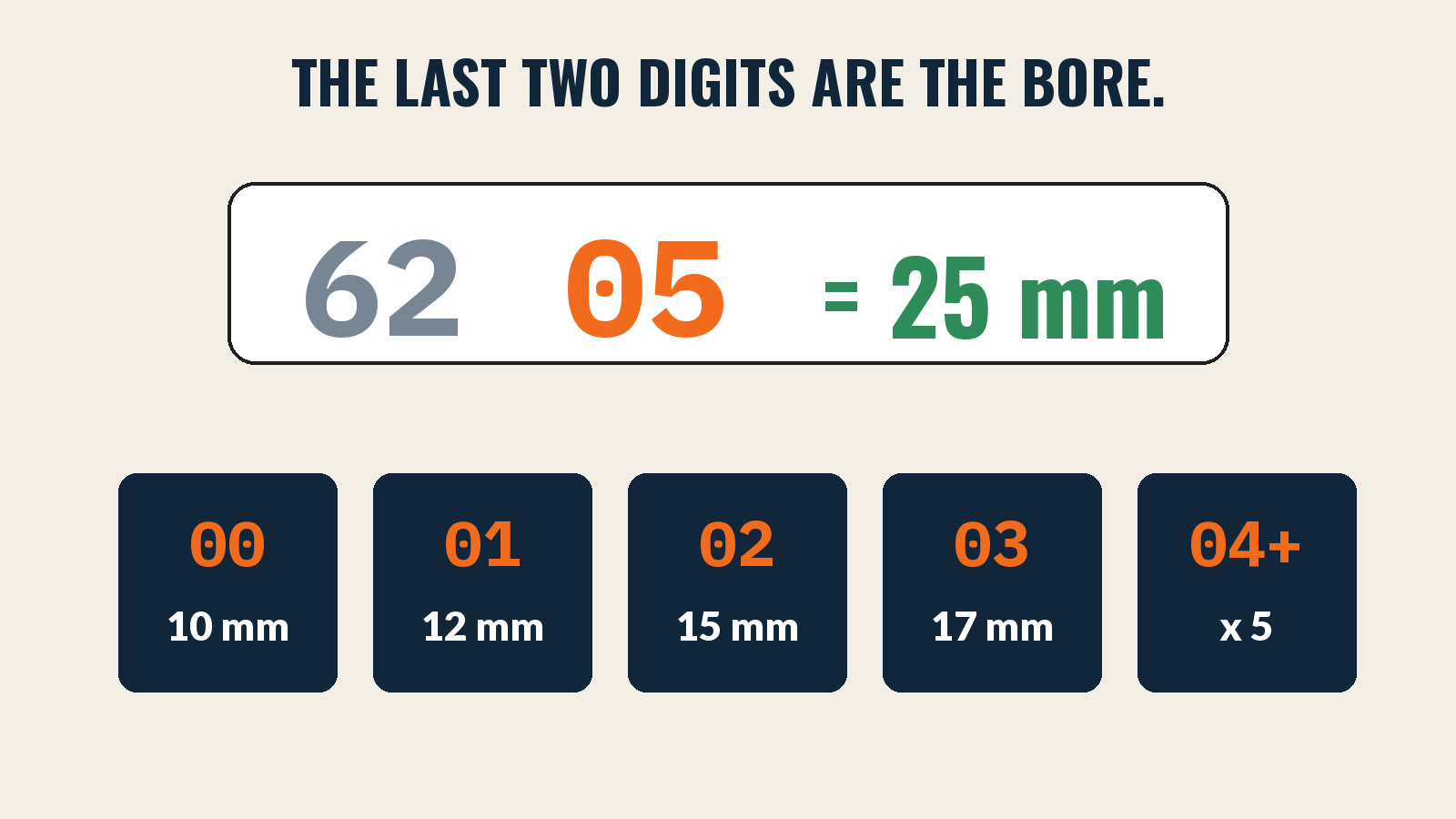
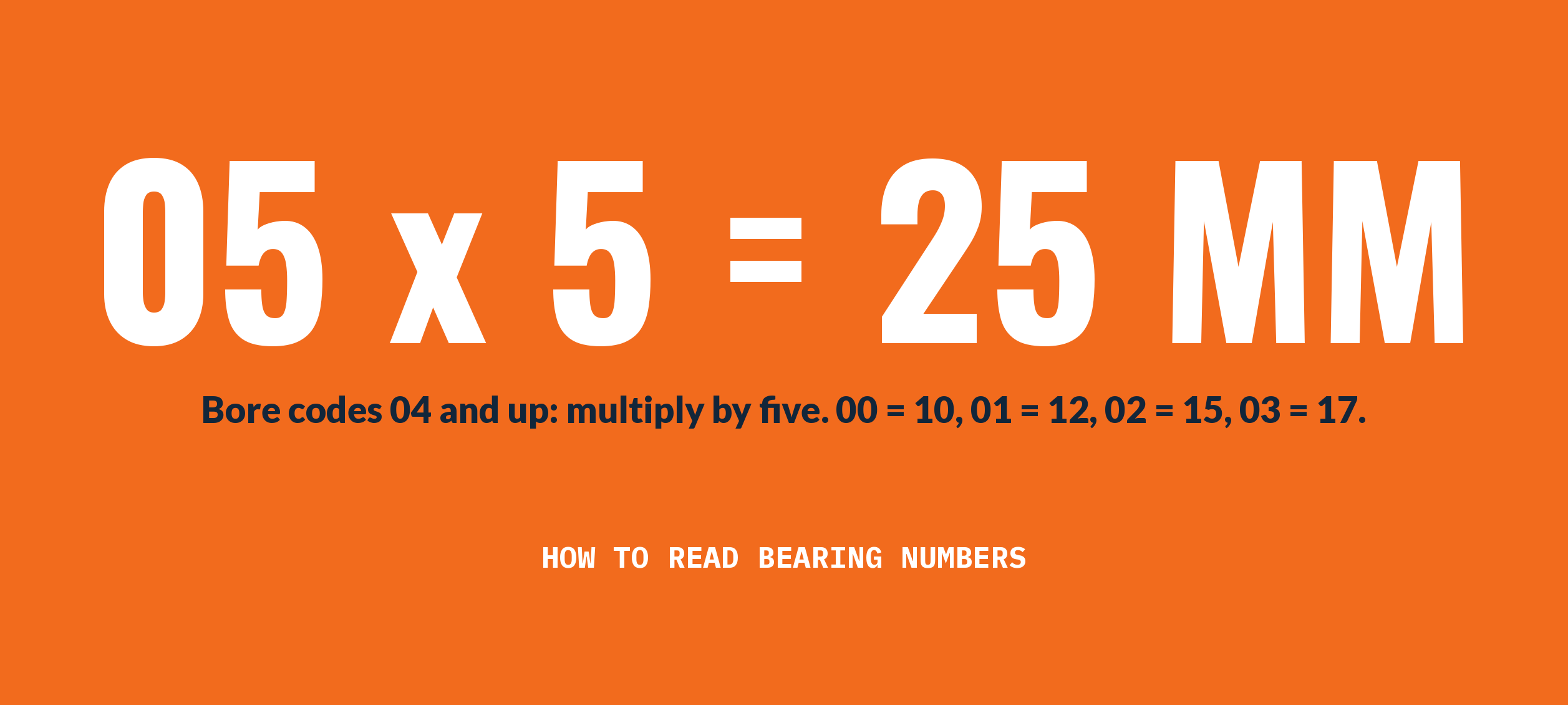
For most metric ball and roller bearings, the last two digits of the basic number are the bore code. Learn how to read bearing numbers once and you’ll never need the chart for the bore again:
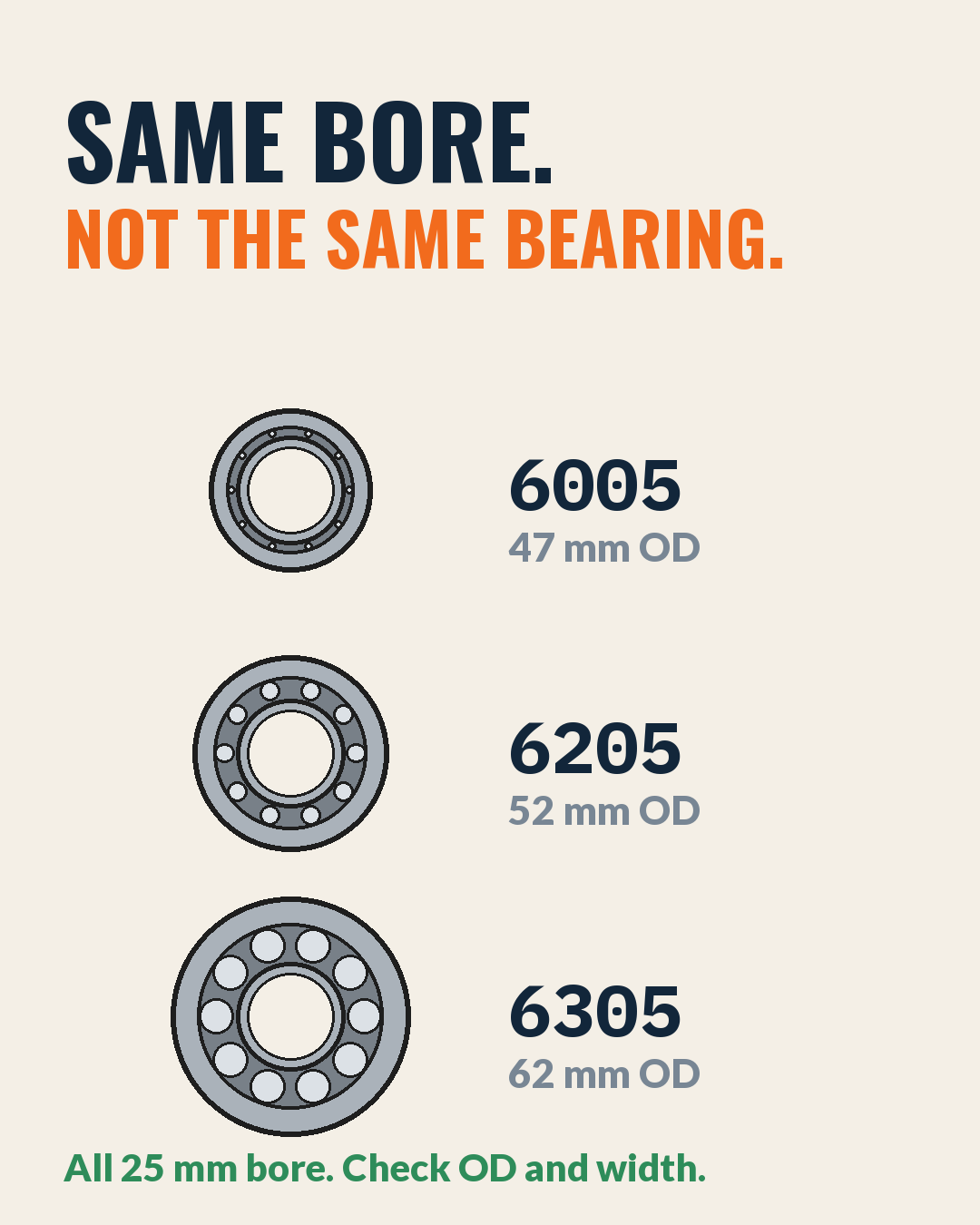
The digits in front tell you the series, which sets the outside diameter and width for that bore. A 6005, 6205 and 6305 all have a 25 mm bore, but they get progressively bigger and heavier: 47, 52 and 62 mm OD. That’s why the bore alone never identifies a bearing. You need bore, OD and width together.
The same bore-code logic carries into spherical rollers, cylindrical rollers and self-aligning bearings. A 21308 is a 40 mm bore spherical roller bearing; a 2211 is a 55 mm bore self-aligning ball bearing. The series digits change, the bore code doesn’t.
Dimensions below are the standard boundary dimensions shared across major manufacturers for these basic numbers. Where we have a matching size on the shelf right now, the link goes straight to it. Brand and suffix vary by listing, so check seals, shields and clearance on the product page.
| Basic number | Bore (ID) mm | OD mm | Width mm | Central Surplus |
|---|---|---|---|---|
| 6000 | 10 | 26 | 8 | Search by size |
| 6001 | 12 | 28 | 8 | Search by size |
| 6002 | 15 | 32 | 9 | In stock |
| 6003 | 17 | 35 | 10 | Search by size |
| 6004 | 20 | 42 | 12 | In stock |
| 6005 | 25 | 47 | 12 | Search by size |
| 6006 | 30 | 55 | 13 | In stock |
| 6007 | 35 | 62 | 14 | In stock |
| 6008 | 40 | 68 | 15 | In stock |
| 6009 | 45 | 75 | 16 | In stock |
| 6010 | 50 | 80 | 16 | In stock |
| 6200 | 10 | 30 | 9 | In stock |
| 6201 | 12 | 32 | 10 | In stock |
| 6202 | 15 | 35 | 11 | Search by size |
| 6203 | 17 | 40 | 12 | In stock |
| 6204 | 20 | 47 | 14 | In stock |
| 6205 | 25 | 52 | 15 | In stock |
| 6206 | 30 | 62 | 16 | In stock |
| 6207 | 35 | 72 | 17 | In stock |
| 6208 | 40 | 80 | 18 | In stock |
| 6209 | 45 | 85 | 19 | In stock |
| 6210 | 50 | 90 | 20 | In stock |
| 6211 | 55 | 100 | 21 | In stock |
| 6213 | 65 | 120 | 23 | In stock |
| 6215 | 75 | 130 | 25 | In stock |
| 6304 | 20 | 52 | 15 | In stock |
| 6305 | 25 | 62 | 17 | In stock |
| 6306 | 30 | 72 | 19 | In stock |
| 6307 | 35 | 80 | 21 | In stock |
| 6308 | 40 | 90 | 23 | In stock |
| 6309 | 45 | 100 | 25 | In stock |
| 6310 | 50 | 110 | 27 | In stock |
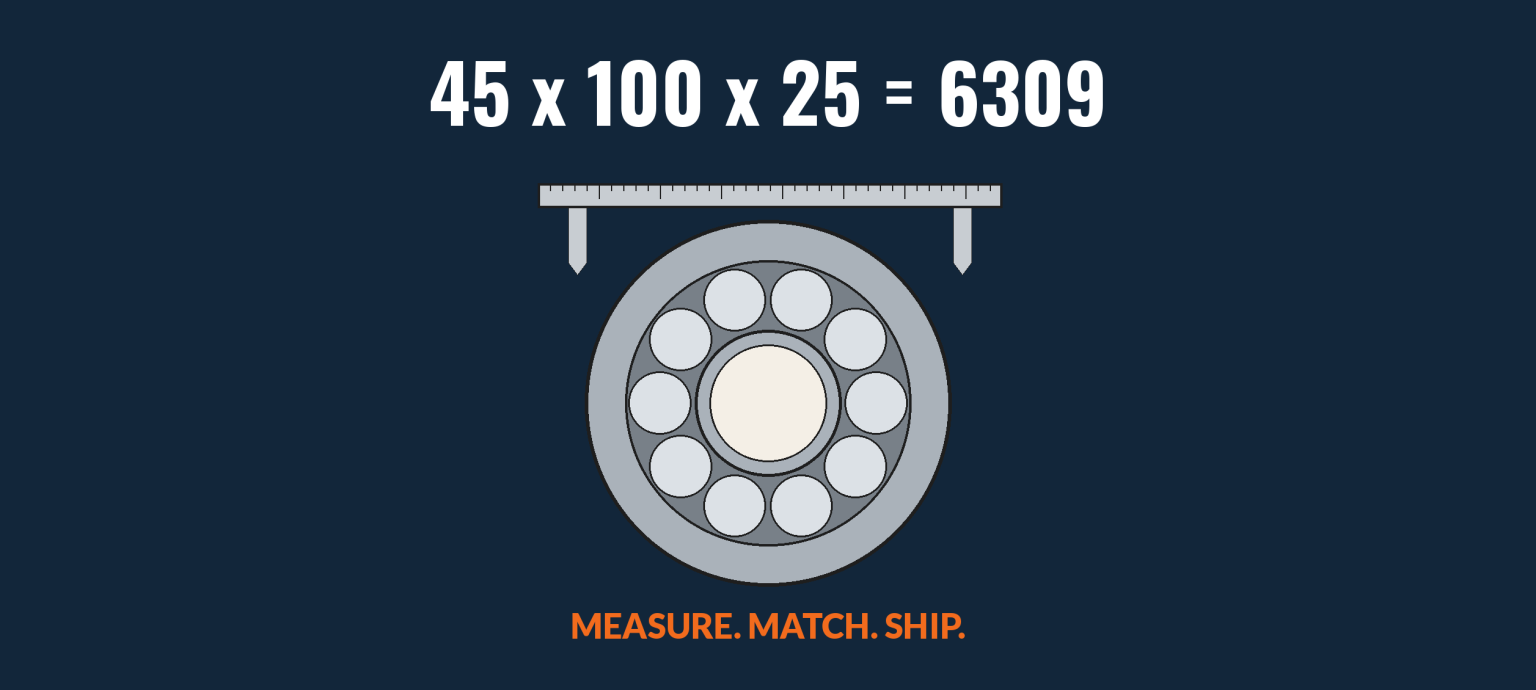
Use this bearing size chart to go from a measurement to a number, or from a number to a measurement. If your old bearing reads 45 x 100 x 25, that’s a 6309 envelope. If it’s 15 x 32 x 9, that’s a 6002 (if its a radial type ball bearing, multiple sizes carry across product families.)
Worn, painted over, or never readable to begin with. It happens. To identify it from size:
Those three numbers plus the type will find the bearing on any bearing size chart, ours included.
Here’s where people get stuck. MRC, Fafnir and other older brands used their own numbering. An MRC 208 and a 6208 are the same size. A Fafnir 209 is a 6209 envelope. That’s not a trick; it’s history, and it’s exactly what a bearing cross reference chart sorts out. You’ll see plenty of MRC and Fafnir listings in the chart links above for that reason: the size is what matters.
After the size matches, match the suffix. Shields versus seals, normal versus C3 clearance, precision class, cage type, preload, contact angle. Those details decide whether a same-size bearing is actually a drop-in. If the manufacturer has dropped the number entirely, here’s how to replace a discontinued bearing by size.
The chart covers the 60, 62 and 63 series because they’re the most common. Heavier loads move you into roller bearings: cylindrical roller bearings for high radial loads, and tapered roller bearing cones and cups where thrust and radial loads combine. The same bore-code rules apply.
Spindles are their own world. Machine tool spindles run angular contact bearings, often super precision pairs where the precision class matters as much as the size. A size chart gets you the envelope; the suffix gets you the right bearing.
25 mm bore, 52 mm OD, 15 mm wide.
A 6309 deep groove ball bearing envelope. Several other types share that size, so confirm whether yours has balls or rollers.
For standard metric basic numbers, yes. The boundary dimensions are standardized; what changes between brands is the suffix, other nomenclature and internal design.
Measure it, find it on the bearing size chart, and if the link says in stock, it ships same day.
Got a size and no number? Make it easy. → Shop Bearings


Our team can locate, cross-reference, and source all parts.
Our team can locate, cross-reference, and source all parts.