
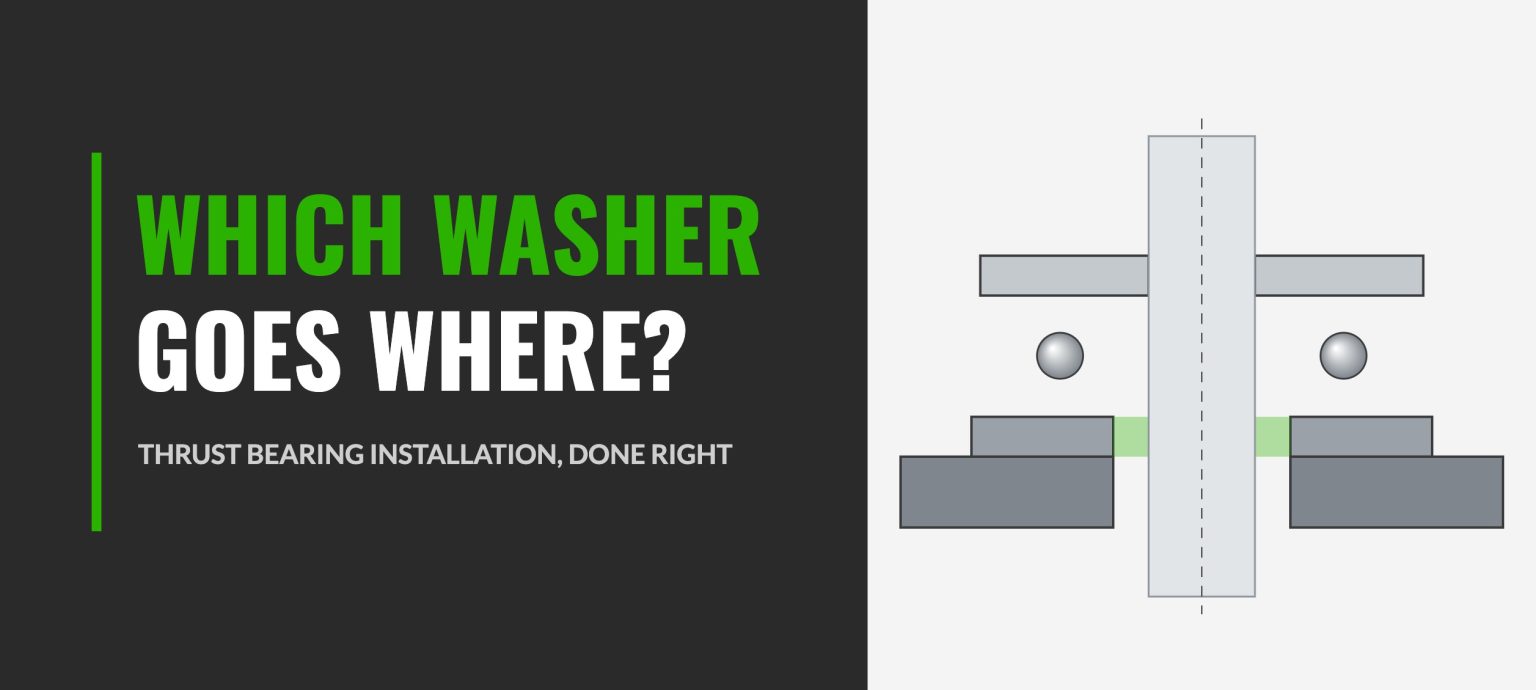
Pull a single-direction thrust ball bearing out of the box and you get three pieces: two flat steel washers with a ball-and-cage ring between them. The washers look identical. They aren’t, and swapping them is one of the most common reasons a new thrust bearing fails within weeks. Get the thrust bearing installation right and a cheap part runs for years. This guide covers how to do that. For the bigger picture of the types and where they’re used, see our thrust bearing guide.
The shaft washer turns with the shaft. Its bore is ground to fit the shaft snugly, often with a light interference fit. The housing washer sits still against the housing. Its bore is turned and always larger than the shaft washer’s, so it clears the rotating shaft (SKF’s description of the 512 series).
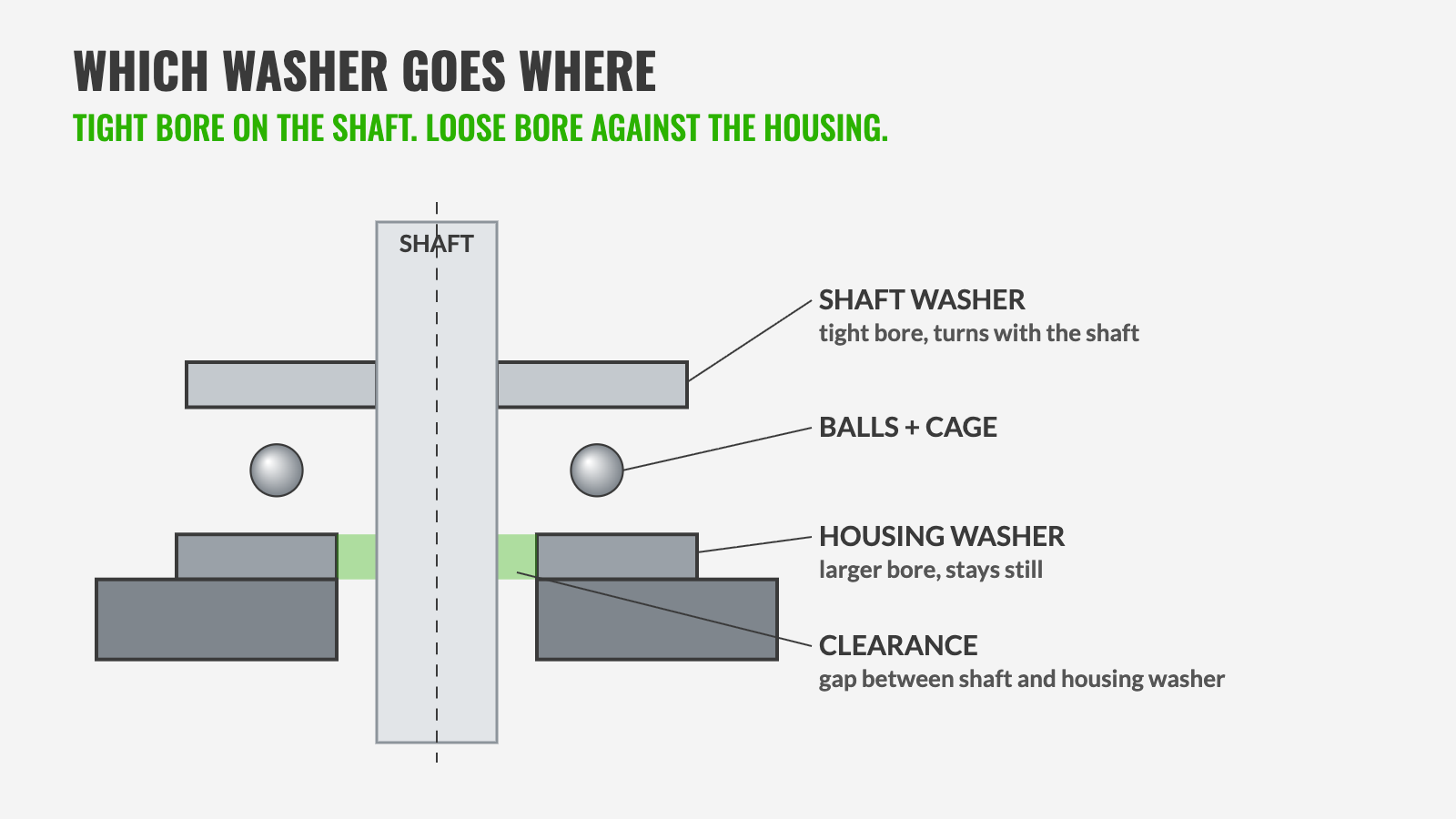
The quick test: slide each washer onto the shaft. The one that’s a close fit is the shaft washer. The one with daylight around the shaft is the housing washer. Some brands also mark the faces, but don’t rely on it. If the housing washer ends up on the shaft, it rubs, heats up and wears through, and the bore of the “loose” washer becomes the bearing.
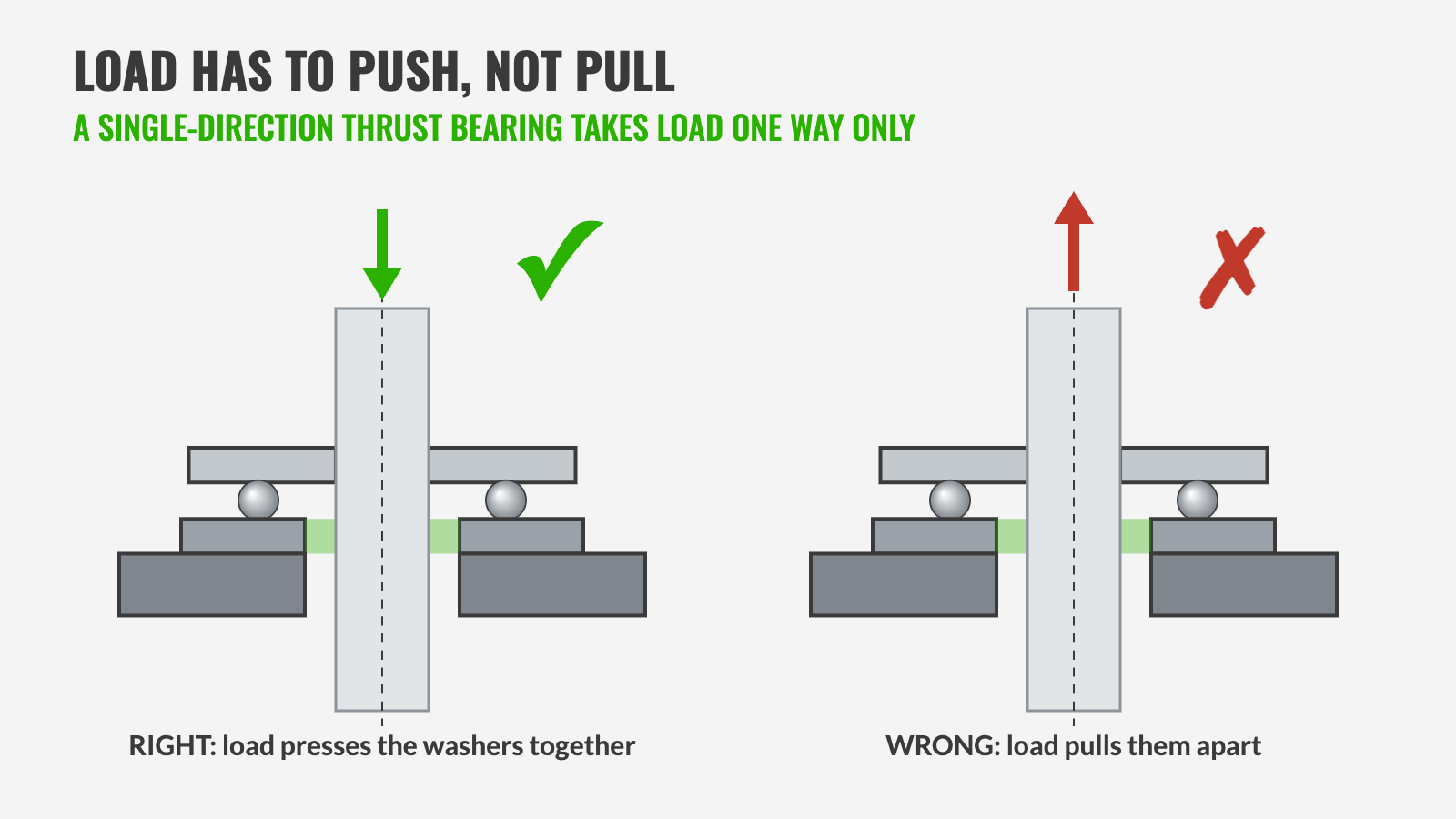
Thrust ball bearings need a minimum axial load at all times. Without it, the balls skid instead of rolling, especially at speed, and the races smear. SKF publishes a minimum load factor for each bearing so designers can check it. If the machine can run with the thrust load near zero, it usually needs spring preload or a different bearing. Watch for this on equipment that reverses or idles.
Two more rules. Thrust ball bearings carry no radial load: the shaft needs a separate radial bearing to locate it. And they don’t tolerate misalignment, unless you use a version with a sphered housing washer and a matching seat washer.
A double-direction thrust bearing (the 522 series, for example) has one shaft washer in the middle and a housing washer on each side, so it holds the shaft both ways. The same rule applies: the middle washer’s bore is the tight one.
Cylindrical roller thrust bearings take heavier loads at lower speeds and are just as picky about square seats. Spherical roller thrust bearings take heavy thrust with some radial load and self-align, but most run on oil, not grease. Check the lube type before you start. Needle roller thrust bearings are thin enough to use the machine’s own hardened faces as races, so those surfaces have to be in good shape.
The old bearing tells you what went wrong, so look before you toss it. A worn, polished bore on one washer means it was on the shaft when it should have been on the housing. A ball track running off-center or wider on one side points to an out-of-square seat. Smeared, streaky races with no real wear mean the balls skidded under too little load. Heat discoloration, straw to blue, means lubrication failed or the bearing was overloaded. Fix the cause, or the replacement fails the same way.
A clean bench, a press or a sleeve that pushes only on the washer, a square or dial indicator to check the seat, and the right lubricant. No hammers on the cage.
The washer with the smaller, tighter bore. That’s the shaft washer. The washer with the larger bore goes against the housing.
Yes. Thrust ball bearings carry axial load only. Use a separate radial bearing to locate the shaft.
Most often the washers were swapped, the load was too light, or the seat wasn’t square.
Replace the full set. Worn washers ruin new balls and cages fast.
Central Surplus stocks thrust bearings in ball, cylindrical roller, spherical roller and needle styles, ships same day on orders placed before 6:00 p.m. Eastern, and typically prices below the big distributors. Send the number off the washer, or the bore, OD and height, and we’ll match it. Our bearing cross-reference covers the common series. Can’t find it? Tell us what you need.
Need a thrust bearing? Make it easy. Shop Bearings


Our team can locate, cross-reference, and source all parts.
Our team can locate, cross-reference, and source all parts.