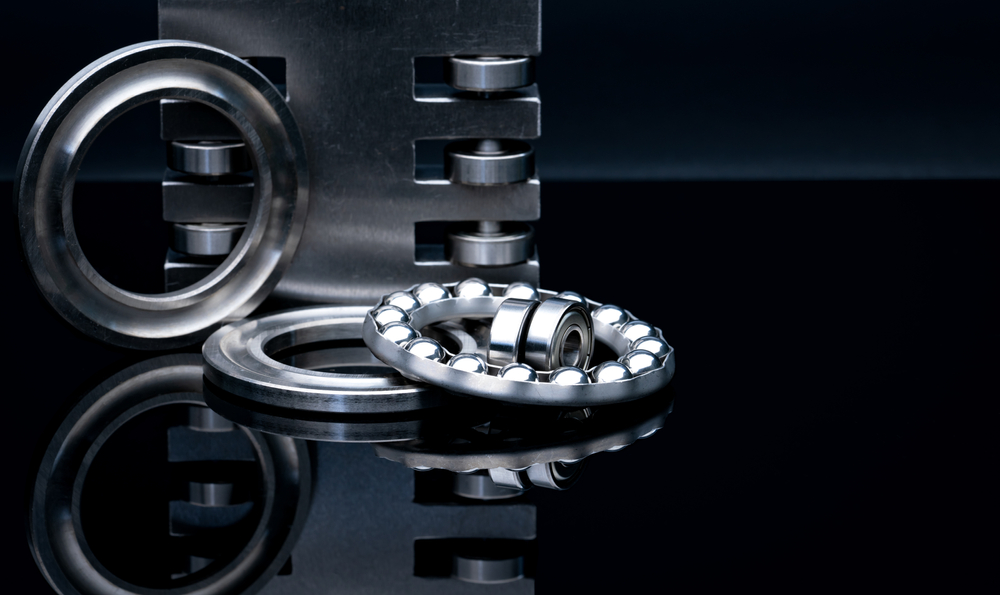
Every rotating machine handles two types of force: radial load (perpendicular to the shaft) and axial load (along the shaft). Most bearings are built for radial load. Thrust bearings are built for the latter. If you operate a pump, gearbox, conveyor drive, or any shaft that moves axially, a thrust bearing absorbs that force. Selecting the wrong type, improper installation, or exceeding service life can result in equipment failure and unplanned downtime. This thrust bearing guide explains the main types of thrust bearings, their typical applications, and how to identify warning signs before a bearing failure escalates.
A thrust bearing is a type of rotary bearing specifically designed to handle axial (thrust) loads. Unlike radial bearings, which support loads perpendicular to the shaft, thrust bearings manage forces that run parallel to the shaft’s axis.
Thrust bearings are used whenever a shaft must resist axial movement. This includes applications with constant push or pull, reversing the direction of force, or combined radial and axial loads.
Thrust bearings are not interchangeable by variation. Each type manages loads differently, operates at specific speed ranges, and fits particular housing configurations.
Ball thrust bearings utilize balls between two grooved washers (races) to carry axial loads.
Common applications include drilling equipment, milling machines, gearboxes, and vertical shafts where gravity creates a consistent downward axial load.
Limitation: Ball thrust bearings are not suitable for combined radial and axial loads. For significant radial loads, select a different bearing type.
A specialized variation of the standard thrust bearing, designed with a metal “band” or “shell” that encapsulates the assembly. The engineering provides several functional benefits for specific industrial environments.
The full-envelope construction also ensures that the internal geometry remains perfectly aligned under axial loads. Variations allow for a max type with no cage for heavier loads, making them an ideal choice for automotive steering pivots and heavy-duty agricultural equipment.
Tapered roller thrust bearings are designed to handle both radial and axial loads simultaneously. The tapered rolling elements contact the raceways at a cone angle, efficiently distributing combined forces.
They are commonly used in drilling swivels, heavy-duty gearboxes, and power transmission shafts where loads are applied from multiple directions.
Cylindrical roller thrust bearings support high axial loads at relatively low speeds. The rollers make line contact with the raceways, distributing load over a larger surface area than ball-type bearings.
They are commonly used in crane hooks, heavy presses, and industrial pumps, where high axial load capacity is more important than speed.
Spherical roller thrust bearings are designed for heavy combined loads and can accommodate shaft misalignment. The barrel-shaped rollers enable self-alignment within the housing, making them suitable for applications where perfect alignment is challenging to maintain.
Typical applications include large pumps, compressors, mining equipment, and environments where you need maximum power in a limited space, like heavy-duty gearboxes.
Also known as Dual Axial/Double Direction, Angular Contact thrust bearings are intended for applications with simultaneous axial and radial loads in a consistent direction. Although they are used primarily for high-precision axial loads with limited radial capacity.
The contact angle determines the ratio of axial to radial load capacity.
Higher contact angles support greater axial loads, while lower angles favor radial loads. For reversing thrust forces, the angular contact thrust bearings are assembled or mounted as a pair, sometimes back-to-back.
Bearing comparison:
| Bearing Type | Axial Load Capacity | Best For |
| Ball Thrust | Low to Moderate | Light axial load, vertical shafts, low speed |
| Banded Ball | Moderate | Heavy-duty steering pivots, high-vibration equipment |
| Tapered Roller | High (combined loads) | Gearboxes, wheel hubs, and combined load apps |
| Cylindrical Roller | Very High | Presses, cranes, slow-speed heavy axial load |
| Spherical Roller | High (+ misalignment) | Pumps, compressors, misaligned shafts |
| Angular Thrust | Moderate to High | Bidirectional axial load, spindle applications |
Thrust bearings are used in a wide range of industrial and mechanical equipment. Common applications include:
Centrifugal pumps: the impeller generates significant axial thrust that must be absorbed to protect the shaft
Gearboxes and reducers: helical gears produce axial force as a byproduct of their tooth geometry
Power Generation & Energy: In large-scale energy production, massive spinning rotors generate axial force due to fluid or wind pressure
Machine tool spindles: precision thrust bearings maintain axial positioning under cutting forces
Vertical motors: gravity creates inherent axial load on any vertically oriented shaft
Marine propulsion: propeller thrust must be transferred to the hull without damaging the shaft
Oil, Gas, & Mining: These industries feature some of the most violent shock loads and high-tonnage requirements in the world
Manufacturing & Processing: Industrial manufacturing relies on extreme precision combined with brute force
Thrust bearing failures rarely occur without warning, but the signs are often mistaken for other issues. Watch for the following indicators:
| Warning Signs of Thrust Bearing FailureUnusual noise (grinding, clicking, or rumbling during operation) | Increased bearing heat or near the bearing housing | Vibration that wasn’t present before | Axial shaft movement or play | Visible wear, pitting, or surface damage on the raceway | Grease or oil contamination in the lubricant |
Excessive bearing temperature is often due to lubrication issues. Insufficient, incorrect, or contaminated lubricant accelerates wear and reduces load capacity. Verify lubrication intervals and grease type before replacing the bearing.
Axial play, or movement along the shaft axis, is a direct indicator of thrust bearing wear. If the shaft moves beyond specification, the bearing has likely lost its preload.
When replacing a thrust bearing, begin with the part number. Most thrust bearings use standardized numbering systems that specify bore size, outer diameter, width, and series. Cross-referencing between manufacturers is usually possible, and a reputable distributor can help identify equivalent replacements if the original brand is unavailable.
Central Surplus stocks thrust bearings from Timken, SKF, Timken, FAG, NTN, INA, NSK and other leading manufacturers. If you have a part number, we can typically source it. If not, please contact us with your shaft dimensions and application details, and we will help you find the appropriate bearing.
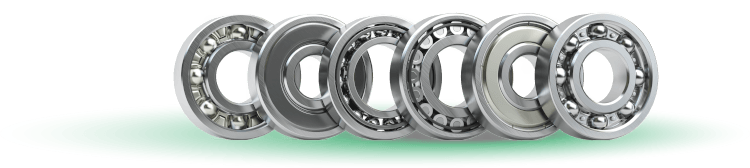
Our team can locate, cross-reference, and source all parts.
Our team can locate, cross-reference, and source all parts.