Belt drives may appear simple, consisting of two wheels and a belt for power transfer. Timing belt pulleys and V-belt sheaves are designed for fundamentally different belt types and are not interchangeable, even if their physical sizes are similar.
This guide explains how each system operates, how to distinguish between them, and how to specify a replacement to ensure compatibility with your existing belt. Both component types are available in our power transmission inventory.
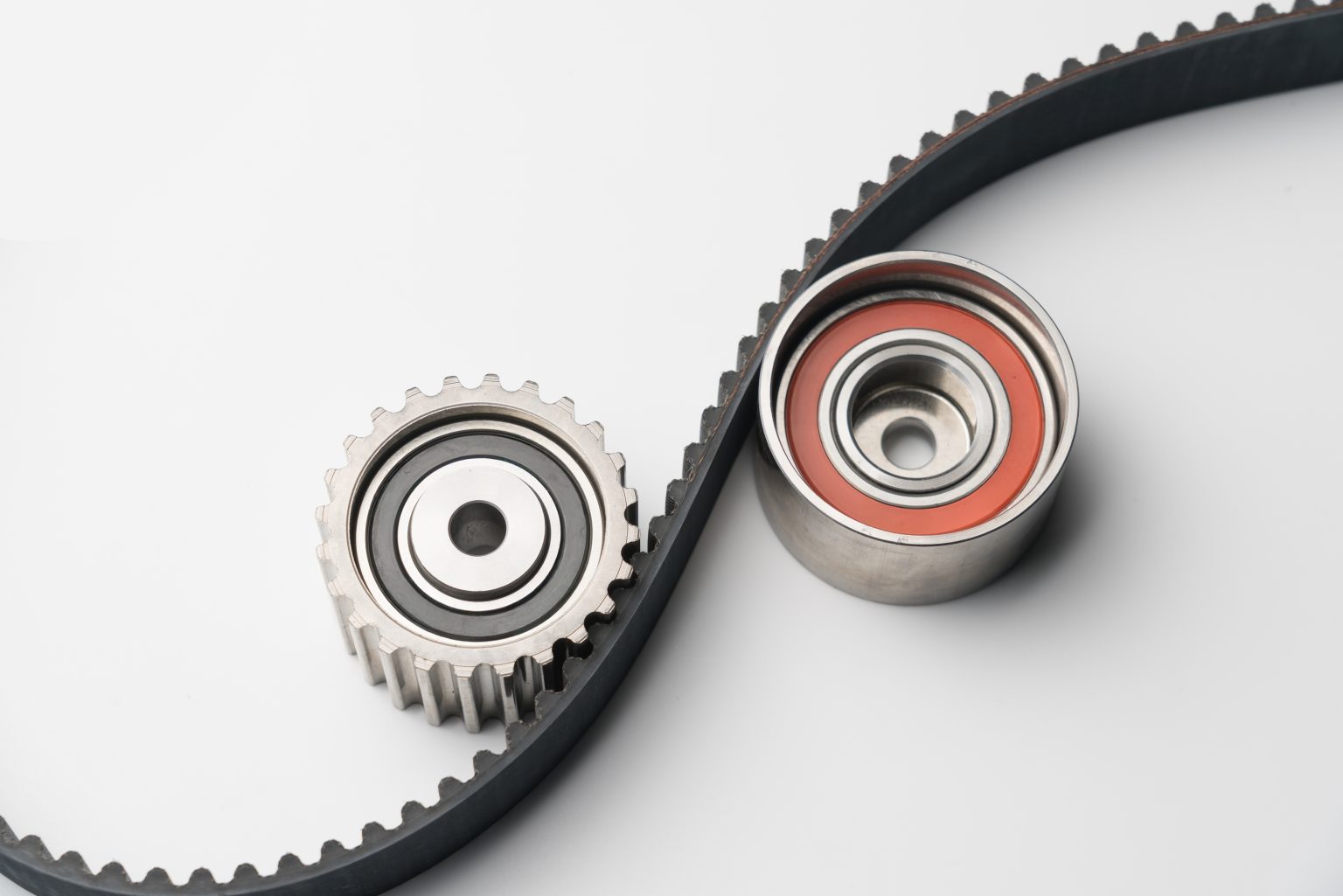
A timing belt pulley features teeth machined or molded into its outer surface that align with the teeth on the underside of a timing belt. This interlocking design prevents the belt from slipping relative to the pulley, unlike a friction-drive V-belt.
This positive engagement is the primary advantage of a timing belt system. With no slip, precise rotational position is maintained between the driving and driven shafts. Timing belts are commonly used in applications where shaft synchronization is critical, not just for power transfer.
A V-belt sheave, sometimes referred to as a pulley, features a grooved profile that matches the V-shaped cross-section of the belt. Unlike timing belts, V-belts transmit power through friction and wedging action within the groove, rather than mechanical tooth engagement.
Some slip is inherent in friction drives, although a properly tensioned V-belt system operates with minimal slip (typically 1% to 2%) under normal load. V-belt systems sacrifice precise synchronization but offer advantages in shock absorption, simplicity, and tolerance for minor shaft misalignment.
A common ordering mistake is assuming that pulleys and sheaves of similar diameter are interchangeable due to their appearance. They are not. A toothed timing belt will not seat properly in a V-groove, and a V-belt cannot engage the teeth of a timing pulley. Using mismatched components can quickly damage the belt and the pulley or sheave.
Another frequent mistake is replacing a tooth-profile pulley, such as an HTD profile, with a different tooth profile like XL or T-series, even if the tooth pitch looks similar. Small differences in tooth shape (e.g., trapezoidal vs. curvilinear profiles) prevent proper engagement, degrade power transfer capacity, and can lead to premature belt wear or tooth jumping (ratcheting) under load.
1. Identify which system you have: toothed pulley and toothed belt (timing), or grooved sheave and V-shaped belt cross-section (V-belt)
2. For timing systems, confirm the tooth profile and pitch from the belt or pulley markings, not just a visual tooth count (e.g., verify whether HTD, GT3, or trapezoidal profile is required)
3. For V-belt systems, confirm the belt cross-section (A, B, C, D, or metric equivalent) stamped on the belt itself (Classical A-D, Narrow 3V/5V/8V, or Cogged VX series)
4. Match bore size and keyway, or confirm the bushing type (QD vs. Taper-Lock vs. Split Taper) if the sheave uses a tapered bushing system
5. Check the driven and driving component together as a set. A mismatched pair, even if each half is individually correct, still won’t run properly
Bushing Hub Compatibility
Engineering Warning: Tapered Bushing Interchangeability
QD (Quick Detachable), Taper-Lock, and Split Taper bushings are not interchangeable, even if fitted to sheaves with the same pitch diameter and shaft bore. They utilize distinct taper angles, bolt circle dimensions, and mounting bolt orientations. When replacing a sheave, always confirm the hub geometry stamped on the casting (e.g., “SK” or “E” for QD; “2012” or “2517” for Taper-Lock).
Multi-Groove V-Belt Maintenance
MRO Best Practice: Replacing Multi-Groove Belts
Mixing new and used belts causes uneven load distribution because worn belts sit lower in the groove, overloading the new belt and triggering rapid failure. Always replace multi-groove drives as a factory-matched belt set or convert to a single banded (joined) V-belt
If you have a part number for either component, contact Central Surplus for an exact match or cross-reference sourcing. Belt drive misalignment and mismatch issues often occur alongside coupling problems, as discussed in our shaft coupling guide. If you are troubleshooting unusual wear patterns, it is advisable to check both components.
| Central Surplus Belt Drive Inventory We stock timing belt pulleys and V-belt sheaves from Martin, Browning, Dodge, and other major power transmission manufacturers. Contact us with your belt profile or pulley part number for sourcing help. |
Browse our pulleys and sheaves inventory or contact us for sourcing support.

Our team can locate, cross-reference, and source all parts.
Our team can locate, cross-reference, and source all parts.