Product Description
What it does
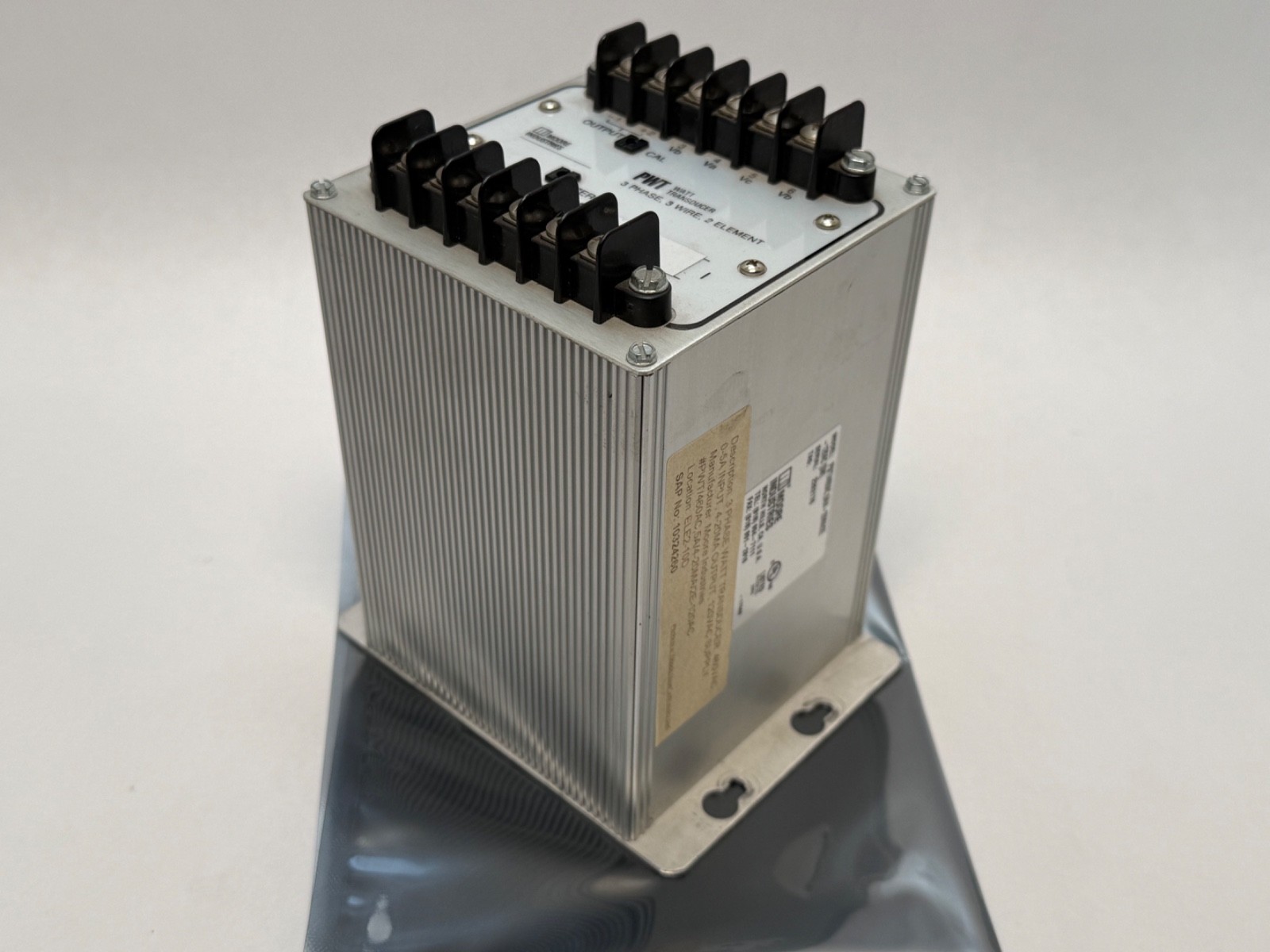
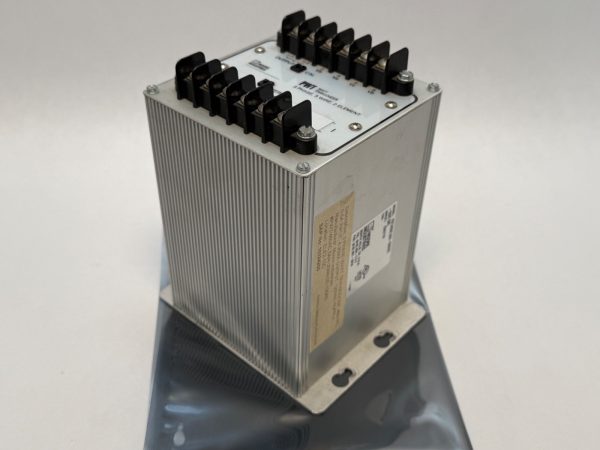
The PWT measures true RMS active power – real watts, with power factor accounted for – on an AC circuit and converts it to a linear isolated 4-20 mA signal. It is not a meter with a display; it is a transducer that hands a proportional current loop to a PLC, DCS, SCADA RTU, chart recorder or a trip relay. The classic use is exactly what Moore Industries pictures in their own datasheet: watching the load on a 460 V three-phase motor so that a rising or falling kW draw becomes an early warning of a fouled pump, a slipping belt, cavitation or a bearing going down – all of which show up in power draw well before they show up in amps alone.
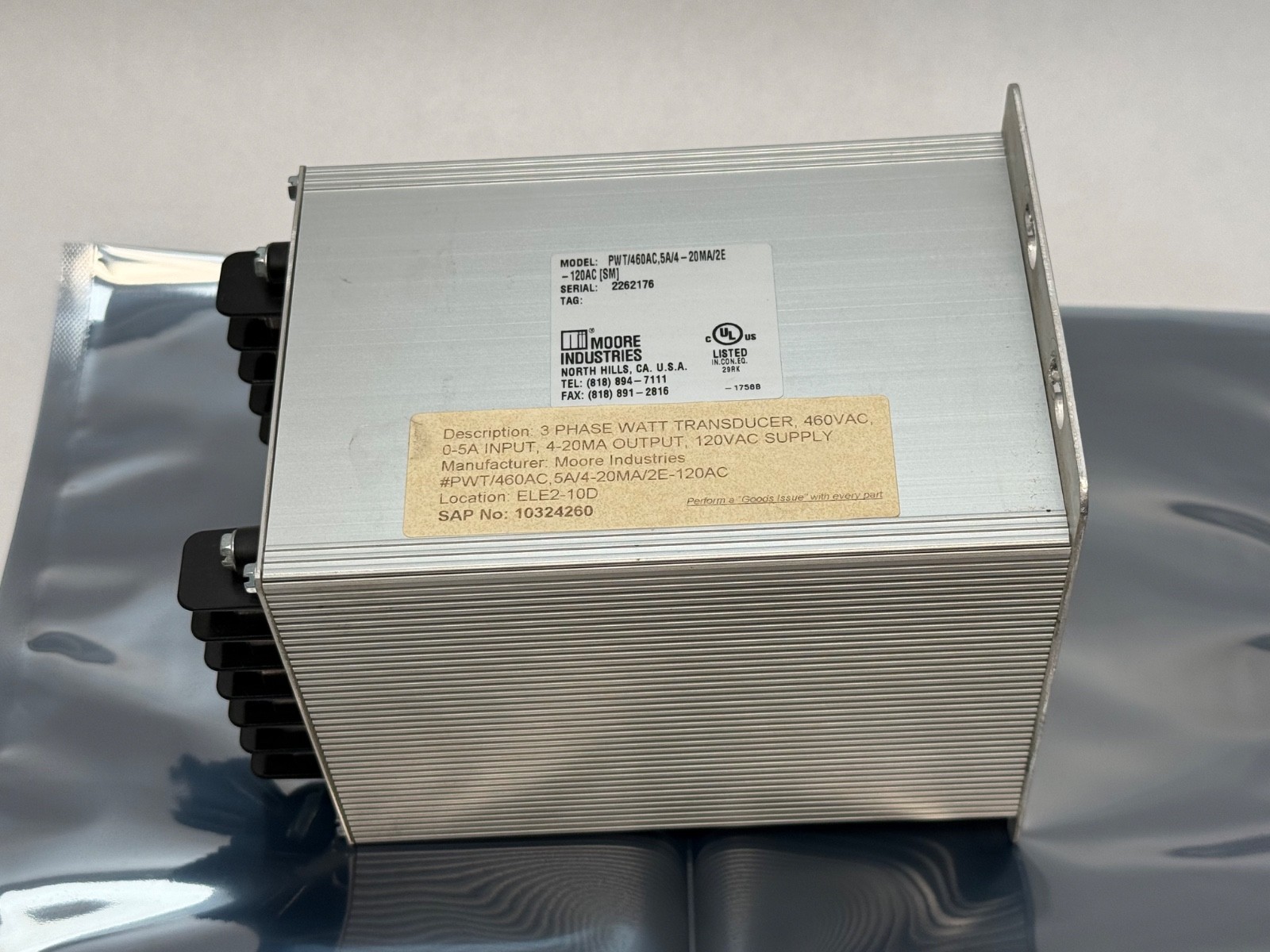
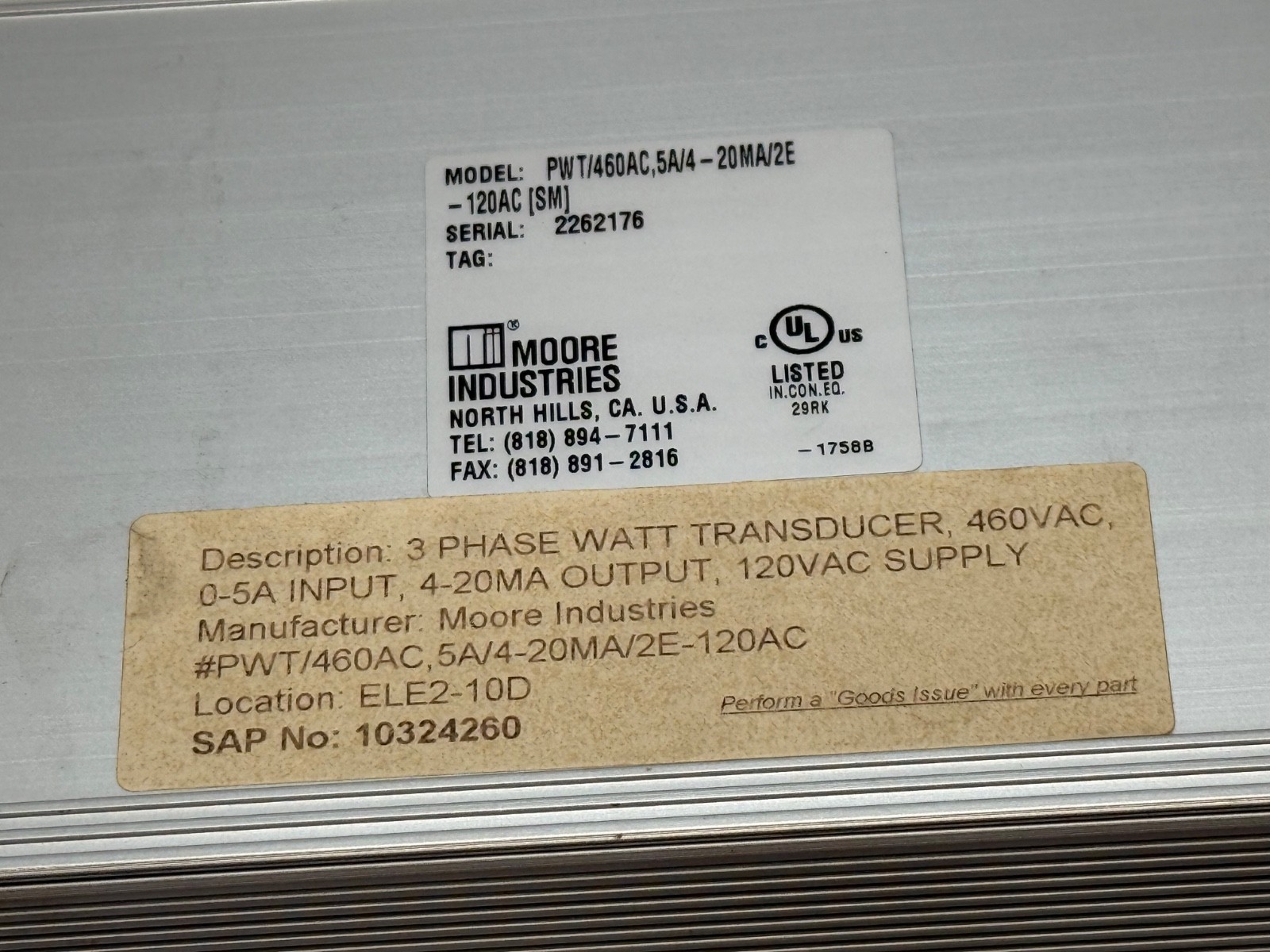
Decoding PWT/460AC,5A/4-20MA/2E
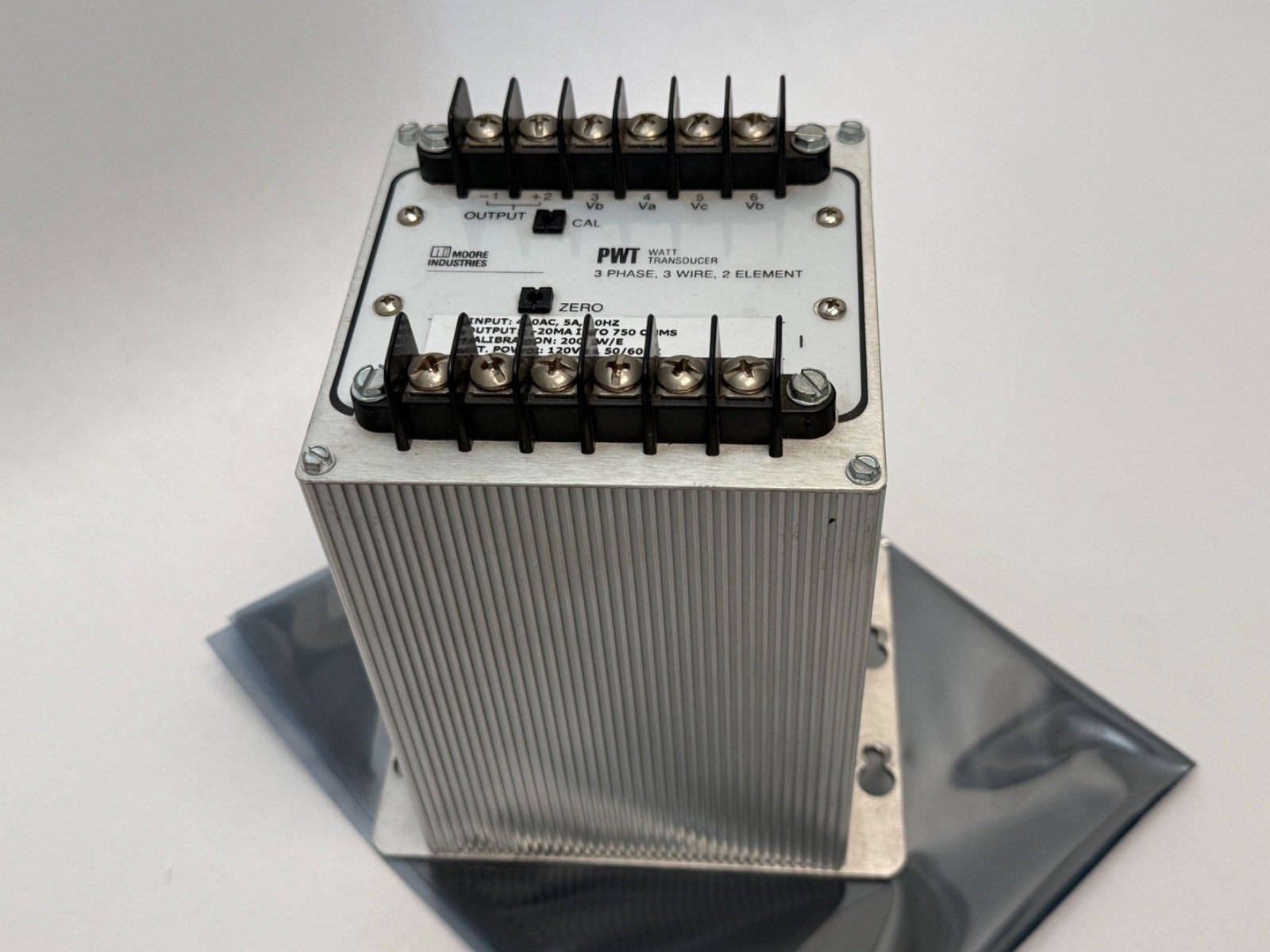
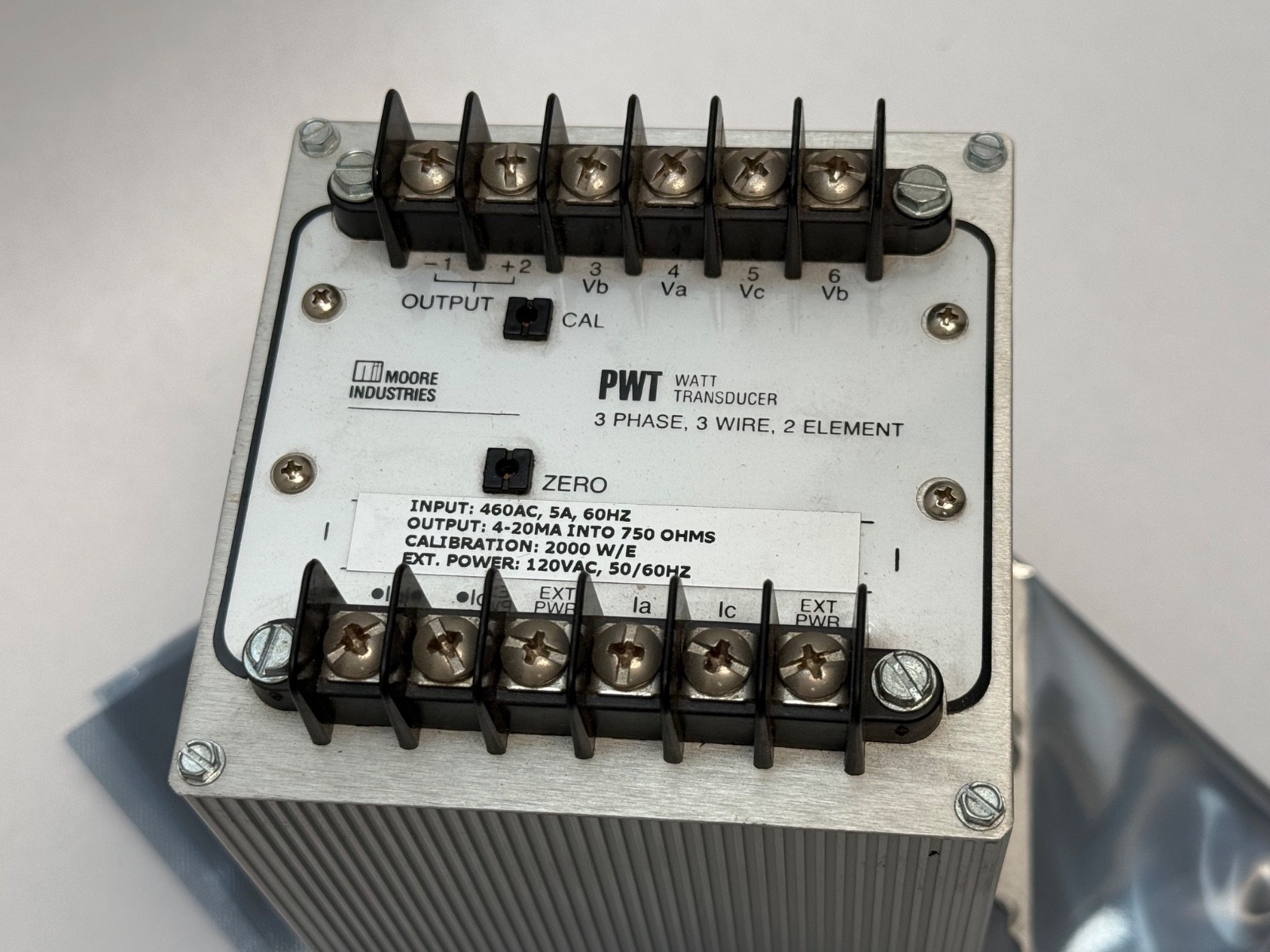
PWT – Watt transducer (the sister units are PVT for VARs and PWV for combined watts and VARs).460AC – nominal voltage input. Self-powered range 325-515 V AC; with auxiliary power the range widens to 0-575 V AC. Overload capability 1.5x nominal.5A – nominal current input, 0-5 A, i.e. the standard secondary of a 5 A CT. Maximum range 0-10 A. Overload 15 A continuous, 30 A for 10 s/hour, 250 A for 1 s/hour.4-20MA – output: 4-20 mA into 750 ohms, unidirectional, where 4 mA = 0 watts.2E – two-element configuration for a 3-phase 3-wire circuit. Two elements is the Blondel-correct arrangement for 3-wire: the third phase acts as the common voltage reference for both elements. Critically, the 2E build carries no balanced-voltage or balanced-load restriction – it reads correctly on unbalanced loads. The cheaper 1.5E build does not.No option suffix – no -120AC or -240AC auxiliary power code is present, so this is the self-powered build: it derives its own operating power from the measured voltage input. No separate supply to wire, one fewer thing to fail, but the unit adds about 4.0 VA to the voltage-input burden.
Full-scale range – the number most people need
Moore Industries’ standard calibration table sets 460AC with a 5A input at 2000 watts per element. On a two-element unit that means 20 mA represents 4000 watts at the transducer terminals. That is the transducer-level scaling; the actual plant kW full scale is 4000 W multiplied by your CT ratio (and by the PT ratio if potential transformers are used). For example with 100:5 CTs, 4000 W x 20 = 80 kW full scale. Get this arithmetic wrong and every number in the historian is wrong by a clean multiple – it is the single most common commissioning error on power transducers.
Published specification (Moore Industries PVT/PWT/PWV datasheet):
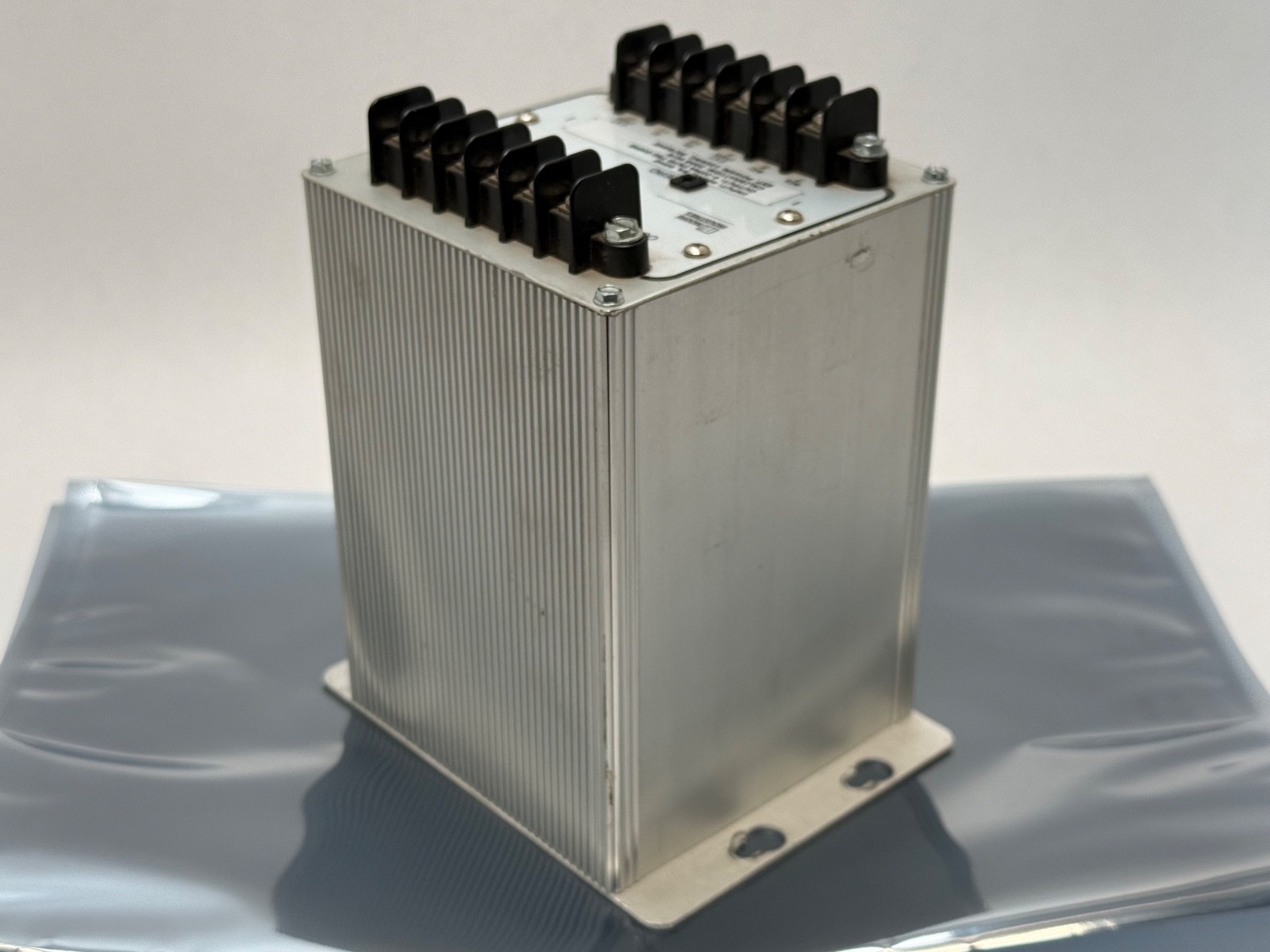
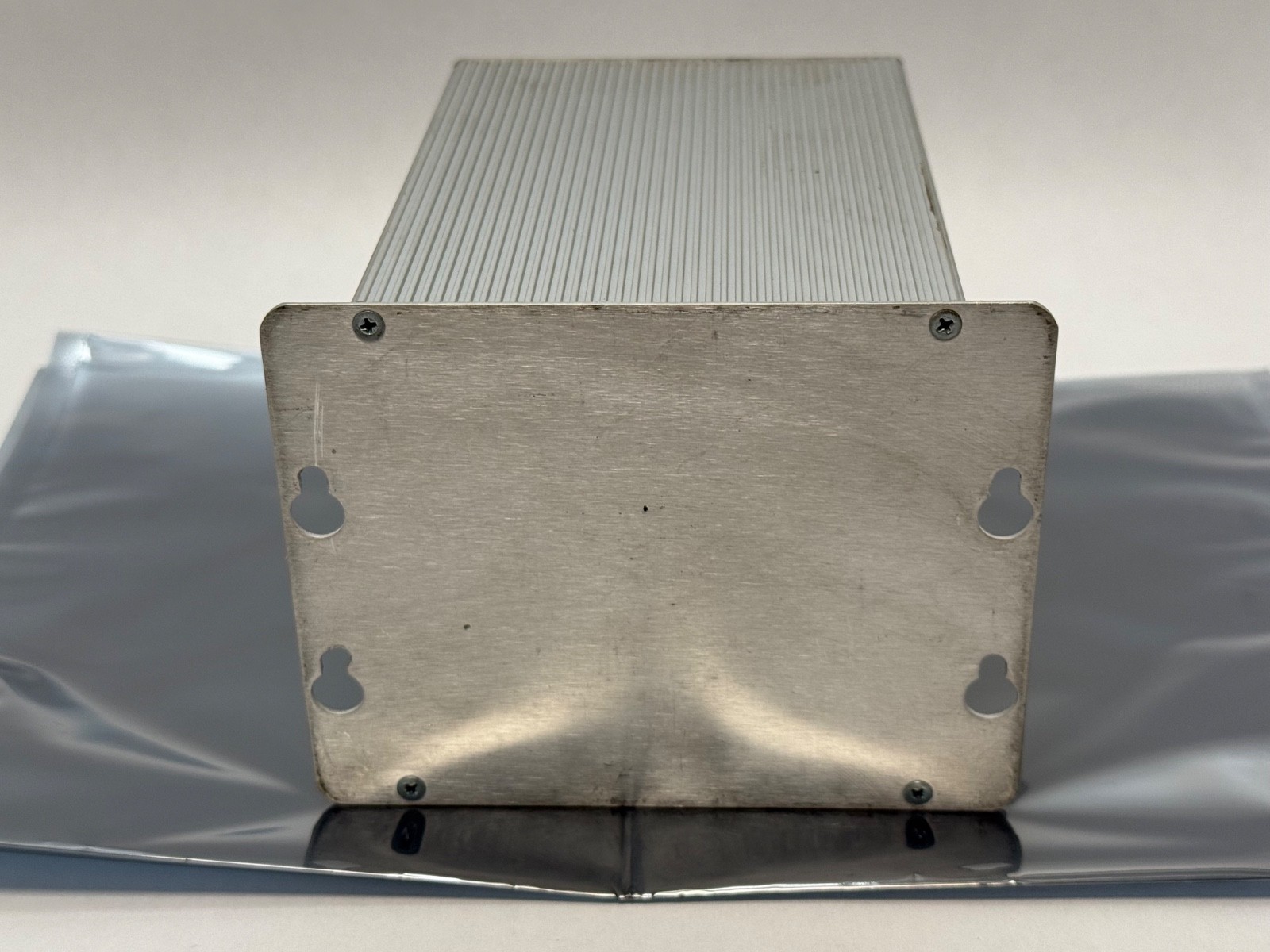
Accuracy at 25 C: 0.19% of reading / cos phi, plus 0.01% of full scale – i.e. 0.2% of reading classMeasurement: true RMS of both voltage and currentOperating frequency: 60 Hz standard (50 Hz and 400 Hz are the -50H and -400H options; neither is present on this unit, so treat it as a 60 Hz part)Output: 4-20 mA into 750 ohms max; output ripple less than 0.5% of full scaleResponse time: under 100 ms to 90%, under 200 ms to 99%Burden: current input 0.1 VA; voltage input 0.02 VA; add 4.0 VA for the self-powered PWTIsolation: full input/output isolation – eliminates ground-loop errorDielectric test: 2000 V RMS for one minuteSurge withstand: ANSI C37.90a-1974 (IEEE 472); BEAMA 219 special 5 kV; 0.6 kV BILAmbient temperature range: -20 C to +70 C (-4 F to +158 F)Ambient temperature effect: 0.005%/C (0.003%/F) typicalAdjustments: external multiturn potentiometers – span +/-10% of rated output, zero +/-2%. Zero never needs readjusting from the factory settingHousing: rugged rustproof extruded aluminium with keyhole-slotted mounting flanges; circuitry mounted to the front panel and slides out on full-length PCB guides for service without pulling the housingCertification: Underwriters Laboratories, General Location (this is NOT a hazardous-area rated device)Moore Industries factory warranty on new product: 36 months
Wiring reality check
On a two-element unit the terminal set is Va, Vc, Vb (reference), plus Ia and Ic with their polarity marks. Get a CT polarity dot backwards and the reading goes badly wrong rather than obviously dead – so verify polarity marks against the datasheet terminal diagram, not by feel. The output is unidirectional (4 mA = 0 W), which means it will not read reverse power flow; if the application is regeneration, cogeneration or a four-quadrant drive, you want the bidirectional 4-20MAB build (12 mA = 0 W) instead.
Why 2E and not 3E
Two elements is correct for 3-phase 3-wire – delta, or wye with no neutral connection, which is the most common arrangement in process plants and covers virtually every 460 V motor feeder. If your circuit is 3-phase 4-wire with a neutral carrying current, this is the wrong configuration and you need a 3E unit; a 2E on a 4-wire load will under- or over-read depending on the neutral current. Also note the 460AC voltage code is a line-to-line figure here; on 3-phase 4-wire circuits Moore Industries instructs you to specify the line-to-neutral voltage instead (240AC for a 480Y277 system).
Interchange and lineage
Moore Industries-International is still an independent company and the PWT is a current catalogue product, so a like-for-like replacement can be ordered new by repeating this model string – a real advantage over most instrumentation of this vintage. Sister models: PVT (VAR transducer, same envelope) and PWV (combined watt and VAR, dual output). The functional modern alternative if you want digital output rather than 4-20 mA is a power monitor with Modbus, but that is a different install, not a drop-in.
Condition
Used, made in USA, good condition. Quantity 1. The housing code (SM surface mount or DM DIN-rail mount) is not stated in the model string as listed and is not asserted here – check the photos and the unit’s own label.




 store
store