
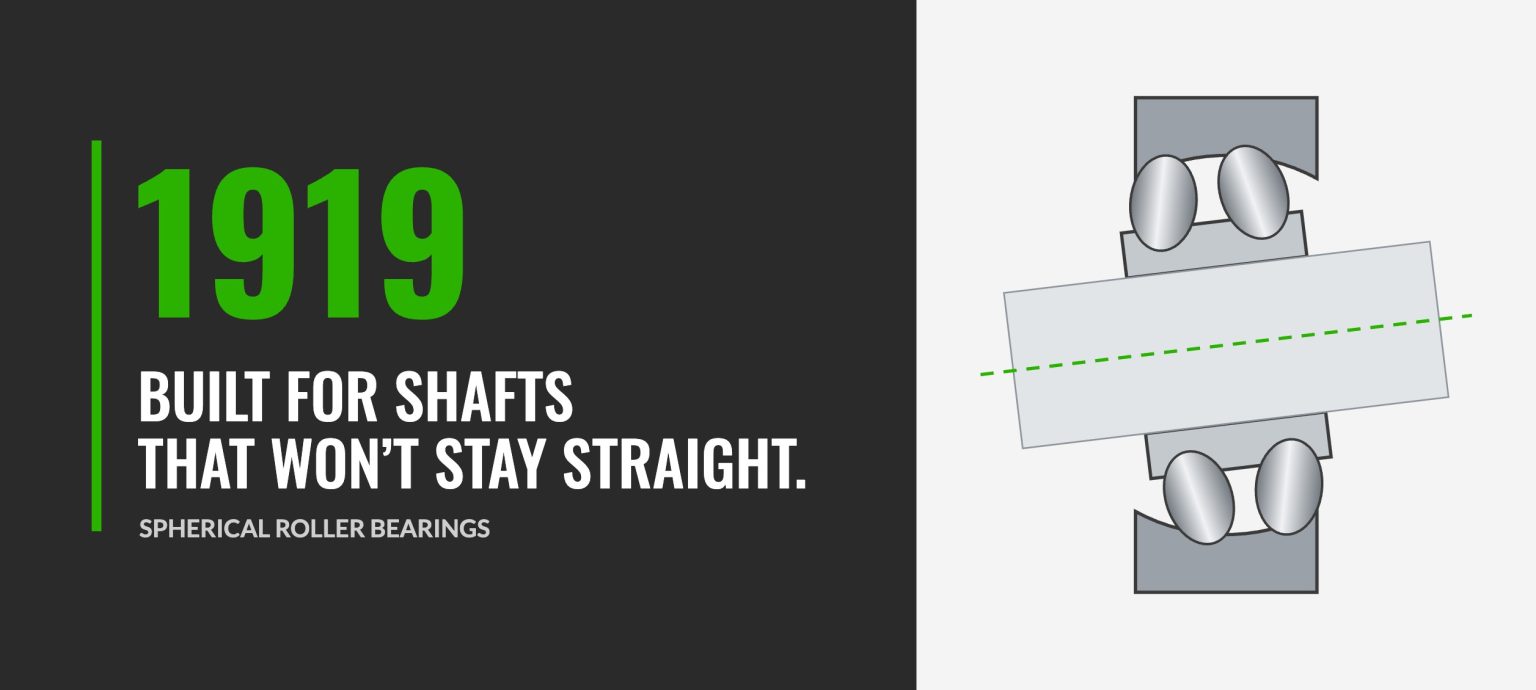
Shafts bend. Frames flex. Housings get bored a hair off. In 1919, SKF engineer Arvid Palmgren designed a bearing that simply accepts that, and a century later spherical roller bearings are still the default wherever heavy load meets imperfect alignment (Design World on the SRB’s 100th year).
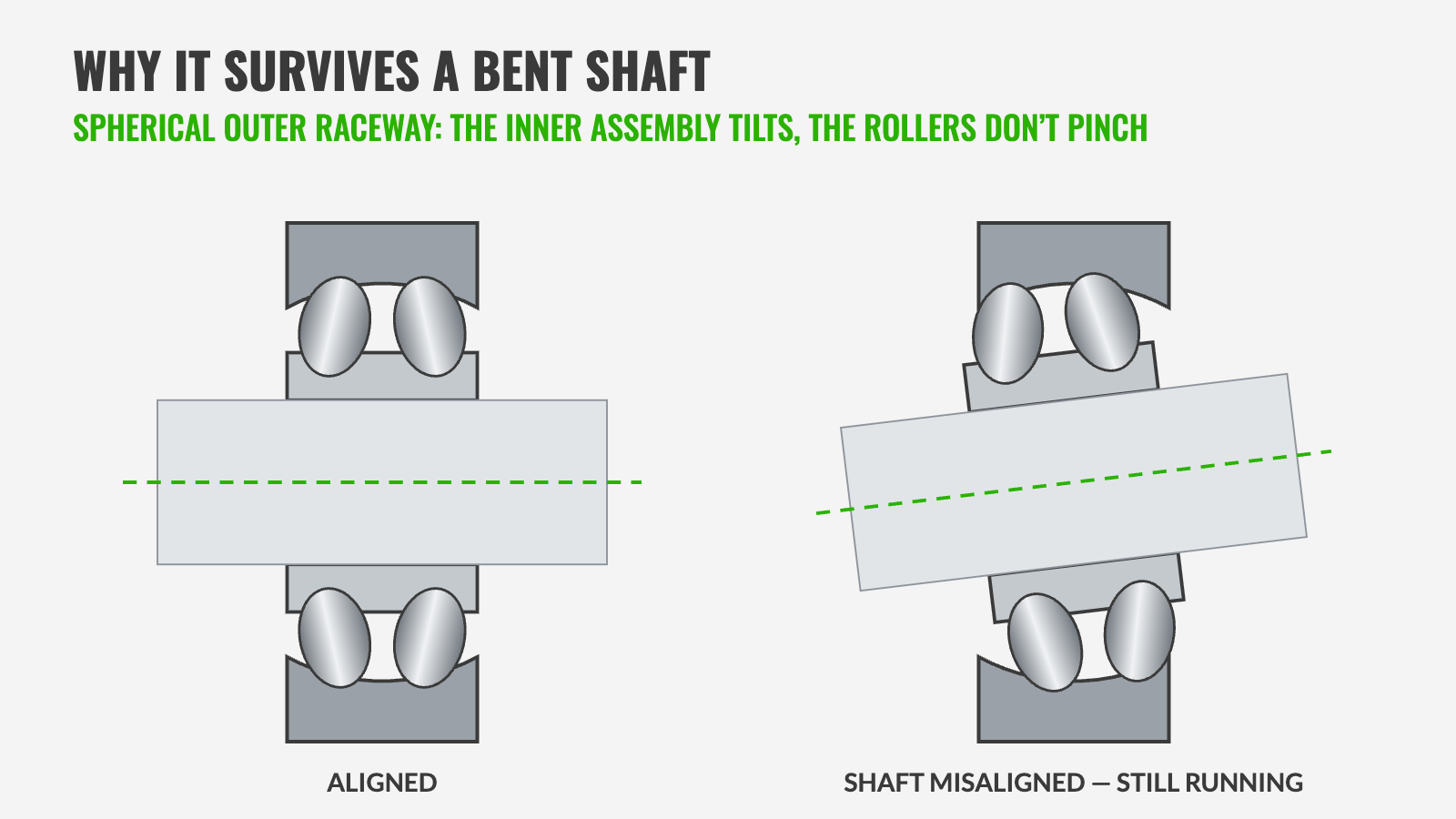
The trick is in the outer ring. Its raceway is ground as part of a sphere, and two rows of barrel-shaped rollers ride inside it. The inner ring, rollers and cage can tilt as a unit against the outer ring without pinching the rollers. A cylindrical or tapered roller under the same misalignment edge-loads, heats up and dies early. Spherical roller bearings carry heavy radial load plus moderate thrust in both directions while they flex. Here is what to check before you order one.
The workhorse: two roller rows, a cage, and a straight bore pressed or slid onto a stepped shaft. Most catalog numbers in the 222xx and 223xx series fall here, often with a lubrication groove and holes in the outer ring (the “W33” suffix on many brands) so grease reaches the rollers from the housing.
Seals on both faces, factory greased. In dirty or wet service they earn their keep: SKF reports sealed spherical roller bearings have stretched rating life up to four times in contaminated heavy-industry applications. The trade-off is that a sealed bearing can’t be flushed or easily regreased, and its width may not match the open version, so check the housing.
The bore tapers 1:12, and the bearing mounts on an adapter or withdrawal sleeve over a plain shaft. That is the standard arrangement in pillow block housings on conveyors and fans. Drive the bearing up the taper and you set the fit and reduce internal clearance in one step. Measure the clearance with feeler gauges as you go, and don’t push past the manufacturer’s reduction figure.
Bore, OD and width have to match, and load ratings tell you how much the bearing can carry. Clearance is where good replacements go bad.
Put a CN where the machine needs C3 and the bearing can run out of clearance once it’s hot. That shows up as heat, then noise, then a seized bearing. Match the original suffix or the OEM’s spec, not just the dimensions.
The pattern is the same everywhere: big load, long shafts, and alignment that won’t survive the first year of operation. If your problem is pure thrust, look at thrust bearings instead. If it’s combined load with good alignment, tapered rollers may fit better.
A spherical roller bearing forgives misalignment, not abuse. Most early failures trace back to a short list:
Rising temperature and a change in sound usually arrive weeks before failure. Trend both, and order the replacement while the old bearing is still turning.
The problem is rarely finding a spherical roller bearing. It’s finding the one the machine was built with after the number has been superseded or the old one comes out unreadable.
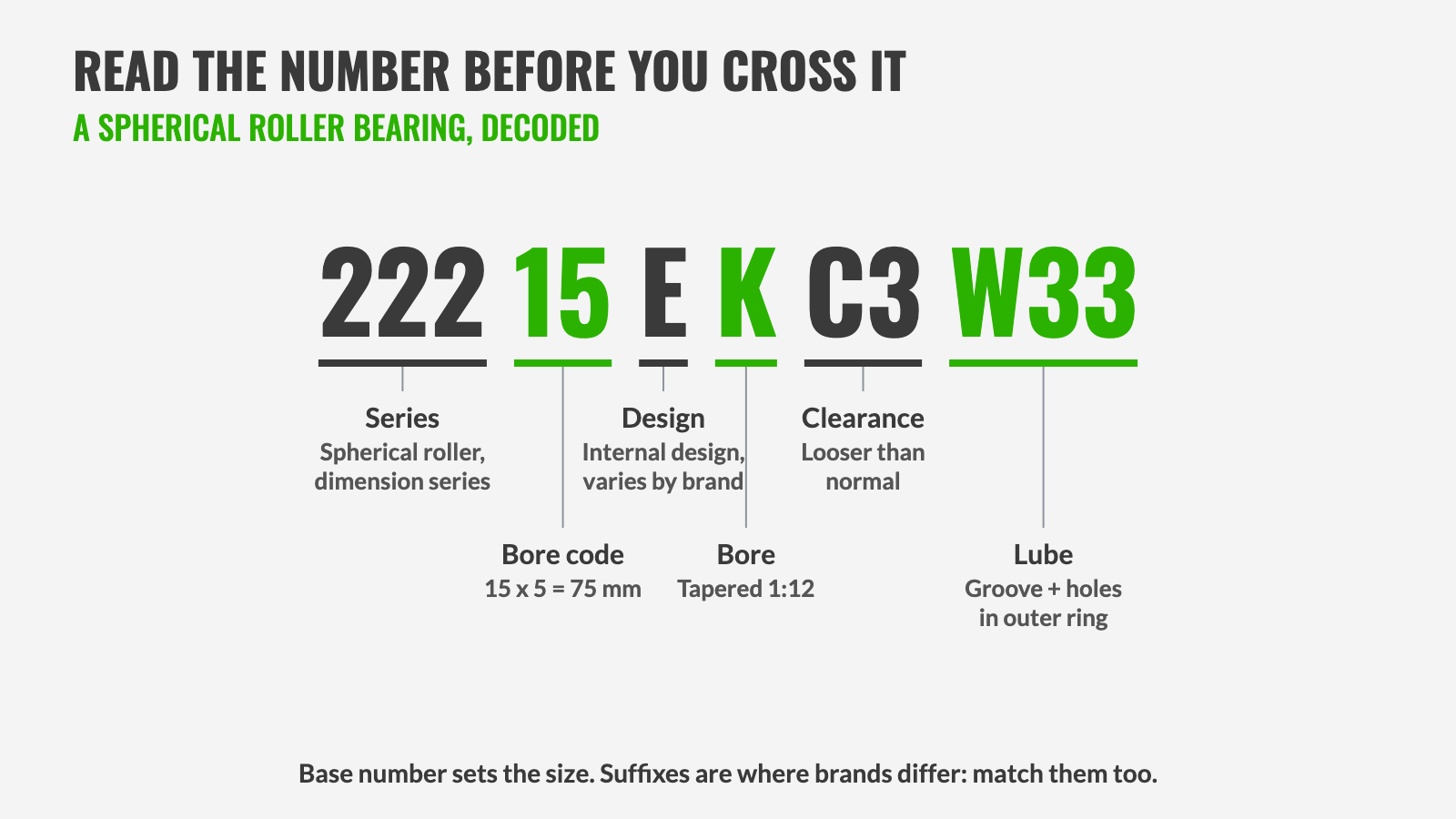
Interchange works by reading the number in parts. The base number (22215, for example) sets the dimensions and is close to universal across SKF, NSK, Timken and NTN. The suffixes carry the cage, bore, clearance, lube features and seals, and every brand writes them differently. “Same base number” isn’t “same bearing” until the suffixes line up. Our bearing cross-reference covers the common equivalents. For the rest, send us the number or the dimensions and we’ll match it.
Heavy radial loads with some thrust where the shaft or housing can’t be held perfectly aligned, such as conveyors, crushers, screens, fans and gearboxes.
A tapered (1:12) bore, mounted on an adapter or withdrawal sleeve.
Match the original. C3 is the common default; C4 is for hotter running or heavier interference fits.
Moderate thrust in both directions, yes. For mostly axial load, a thrust bearing is the better choice.
A conveyor with a failed pulley bearing doesn’t wait for lead times. Central Surplus stocks spherical roller bearings in open, sealed and tapered-bore versions and ships same day on orders placed before 6:00 p.m. Eastern. Because our stock comes from surplus rather than a distributor chain, pricing typically lands below the big distributors. Doing a shutdown? Send the full list of part numbers and get one quote instead of twenty.
Need a bearing? Make it easy. Shop Bearings

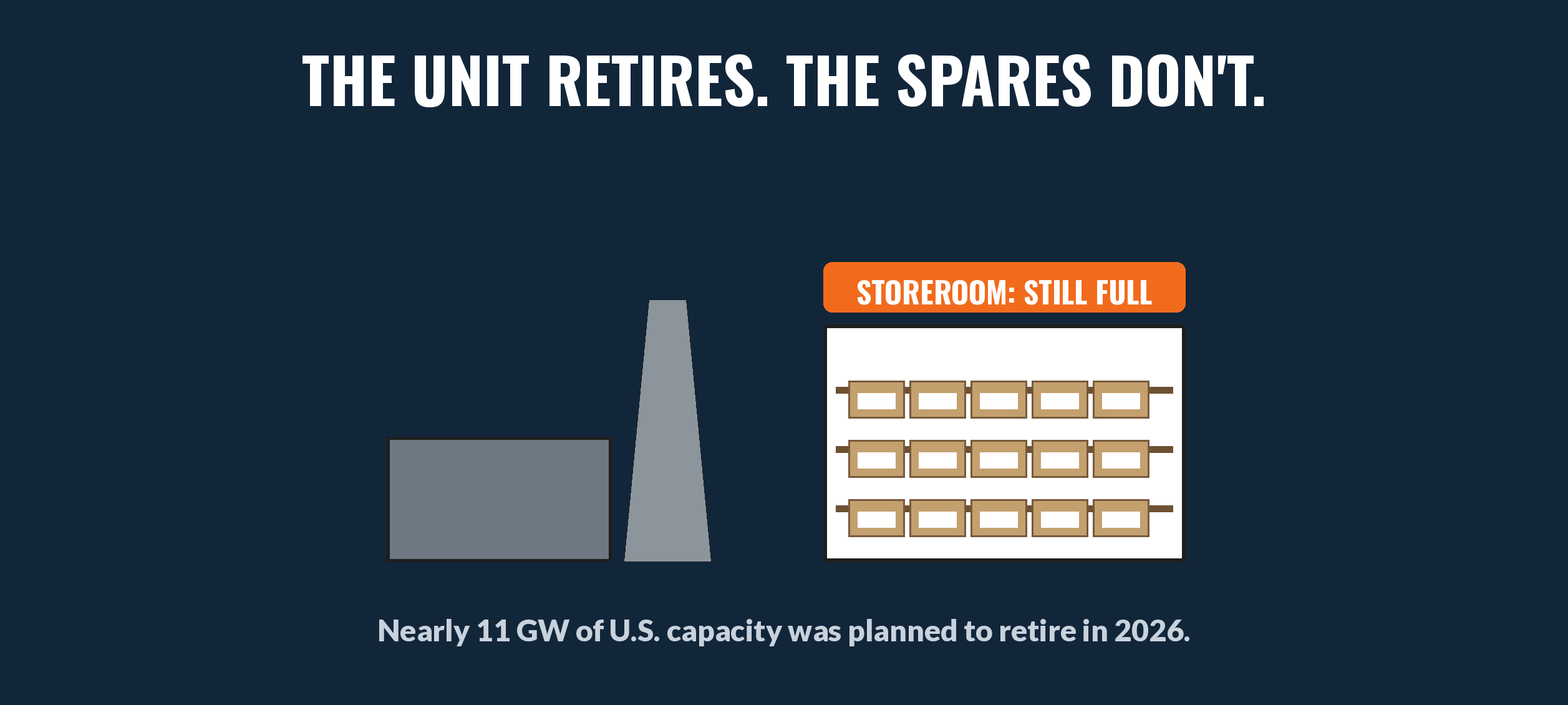
Our team can locate, cross-reference, and source all parts.
Our team can locate, cross-reference, and source all parts.