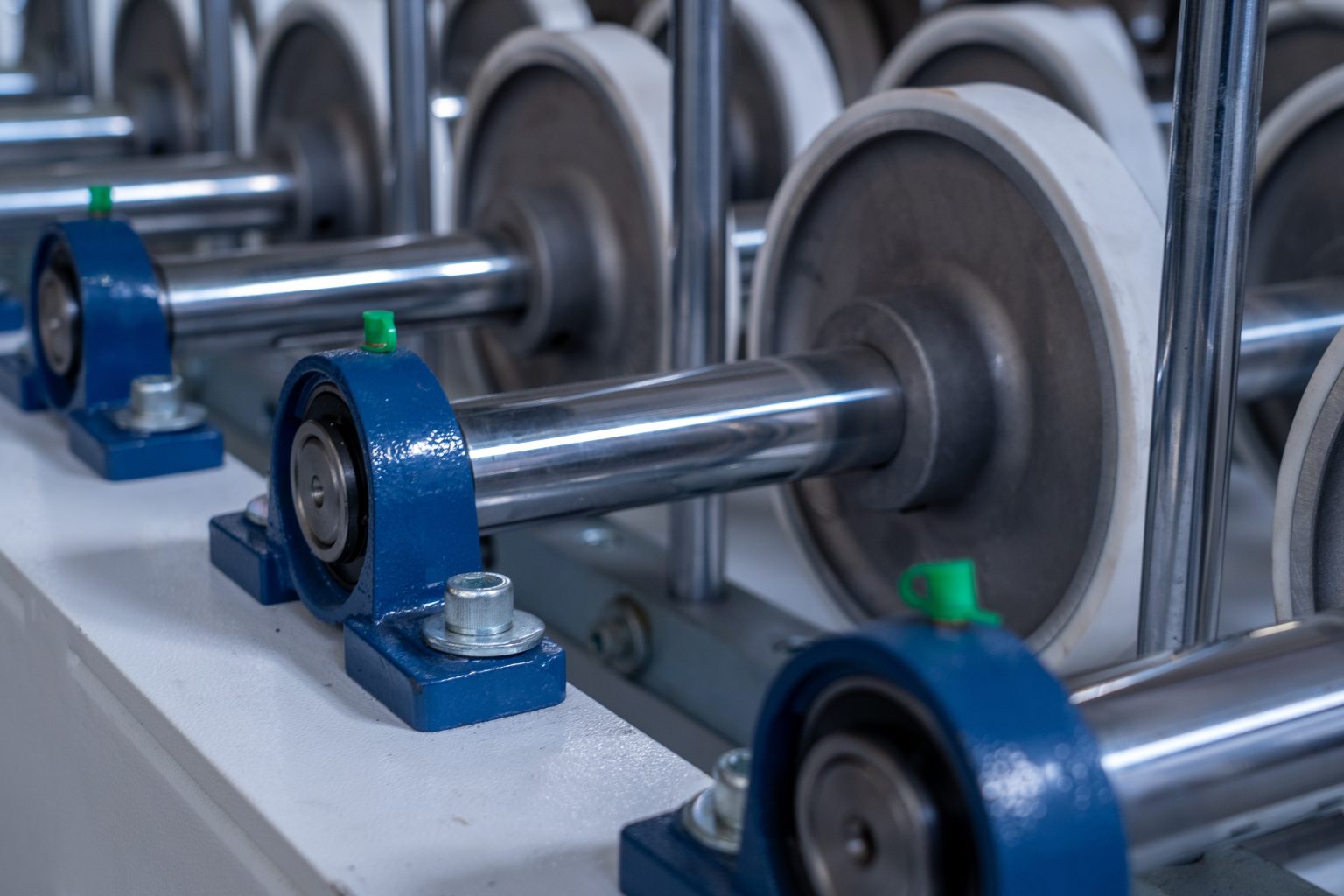
A pillow block bearing is a self-contained unit mounted in a housing that bolts directly to a surface. Installation involves securing the housing, inserting the shaft, and tightening the locking collar. This eliminates the need for custom housing fabrication or managing interference fits on-site.
This simplicity makes pillow block bearings one of the most common mounted bearing types in industrial equipment. They are widely used in conveyors, fans, pumps, agricultural machinery, and packaging lines where quick shaft support and repositioning are required.
This guide explains how pillow blocks function, reviews main bearing insert types and housing materials, and outlines key specification decisions to consider before ordering.
A pillow block (also called a plummer block or flange mount bearing unit in heavier-duty applications) is a pedestal-mounted bearing unit that supports a rotating shaft. The housing has a flat base with bolt holes, allowing it to be mounted to a flat surface. The bearing insert sits inside the housing and handles the actual load.
The term ‘pillow block’ typically refers to lighter-duty, one-piece cast iron or thermoplastic housings. ‘Plummer block’ usually refers to a heavier, two-piece housing for large shafts and high loads. The cap can be fully removed, allowing the shaft to be positioned without feeding it through from the end.
Most pillow block units use a spherical outer ring on the bearing insert, which allows the insert to self-align within the housing. That self-alignment compensates for minor shaft deflection or misalignment between mounting surfaces, which is why pillow blocks work in applications where perfect alignment is hard to guarantee.
The housing shape determines how the bearing mounts to the structure. Pillow blocks are mounted with the shaft parallel to the mounting surface, using a flat base. Flange bearings mount with the shaft perpendicular to the mounting surface; the housing features a face plate that bolts directly to a wall, plate, or frame.
The bearing insert in both types is often identical; only the housing geometry changes to suit installation requirements. Use a flange when mounting on the side of a frame with a perpendicular shaft. Use a pillow block when mounting on a base plate or floor with a parallel shaft.
The insert is the bearing that actually does the work inside the housing. The type you need depends on the load direction, speed, and the criticality of alignment.
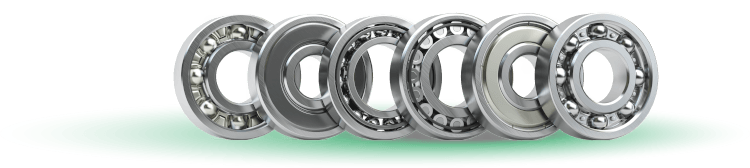
Ball bearing inserts are the most common insert type for pillow blocks. They handle both radial and moderate axial loads, run quietly, and work well at moderate to high speeds.
They’re the right choice for most general-purpose applications: fans, small conveyors, pumps, agricultural equipment, and light-to-medium industrial machinery.
Spherical roller inserts carry significantly higher radial loads than ball inserts of the same bore size. They’re also better at tolerating sustained misalignment and shock loading.
Use these when load is the primary design constraint: heavy conveyors, mining equipment, paper mills, and large agricultural drives. They’re available from SKF, Timken, NTN, and other major manufacturers in both metric and inch bore sizes.
Tapered roller inserts handle combined radial and axial loads well. They’re common in drive applications where helical gears or belt tension create both radial load and a consistent axial thrust component.
Tapered roller pillow blocks typically require more careful setup than ball insert units — preload must be set correctly during installation, or bearing life will be shortened.
| Housing Material | Best For | Watch Out For |
| Cast Iron | Standard industrial applications, most indoor environments | Susceptible to corrosion in wet or chemical environments |
| Stainless Steel | Food processing, washdown environments, marine | Higher cost; check bearing insert material too |
| Thermoplastic (Polymer) | Light loads, corrosive environments, weight-sensitive apps | Lower load and temperature limits than metal housings |
| Cast Steel / Ductile Iron | Heavy-duty plummer blocks, mining, steel mills | Heavy; typically requires a two-piece (cap) design |
For standard industrial applications at normal temperatures without chemical or moisture exposure, cast iron is the default and the most cost-effective choice. If the bearing is in a wash-down area, near food contact, or in a corrosive environment, stainless or thermoplastic is worth the premium.
The locking mechanism determines how the bearing insert grips the shaft. It affects how easy the unit is to install and remove, as well as whether it’s appropriate for axial positioning.
A set screw tightens directly against the shaft. It’s the simplest and least expensive option. The downside is that set screw units can slip under heavy axial loads or vibration, and repeated locking and unlocking can damage the shaft surface.
Good for: light duty, infrequent removal, applications without significant axial loading.
An eccentric collar wraps around the inner ring and tightens as it rotates against the shaft. It distributes clamping force more evenly than a set screw and is less likely to damage the shaft. Some heavy-duty applications require a locking collar on both sides of the shaft.
Good for: moderate loads, applications where the shaft may need to be removed and reinstalled periodically.
An adapter sleeve is a tapered intermediate piece that drives the bearing inner ring tightly onto the shaft when the locknut is tightened. It provides the most secure axial positioning and is the right choice for heavy-duty applications and large-bore sizes.
Common on plummer block units with spherical roller inserts for large, high-load shafts.
Before ordering, you need to know six things:
If you have the part number from the bearing that’s being replaced, that’s the fastest path. Central Surplus can help you identify your part and cross-reference between manufacturers, so if the original brand isn’t in stock, we can identify a compatible replacement from another manufacturer.
| Central Surplus Pillow Block Inventory We stock pillow block bearings from SKF, Timken, Dodge, Fafnir, and other leading manufacturers in both inch and metric bore sizes. Same-day shipping available on most standard sizes. Contact us with your part number or shaft diameter, along with application details. |
Central Surplus stocks a wide selection of pillow block bearings from SKF, Timken, Dodge, and more. Search by part number, bore size, or brand. If you need help with cross-referencing or can’t find a specific unit, contact our team, and we’ll source it.
Our team can locate, cross-reference, and source all parts.
Our team can locate, cross-reference, and source all parts.