
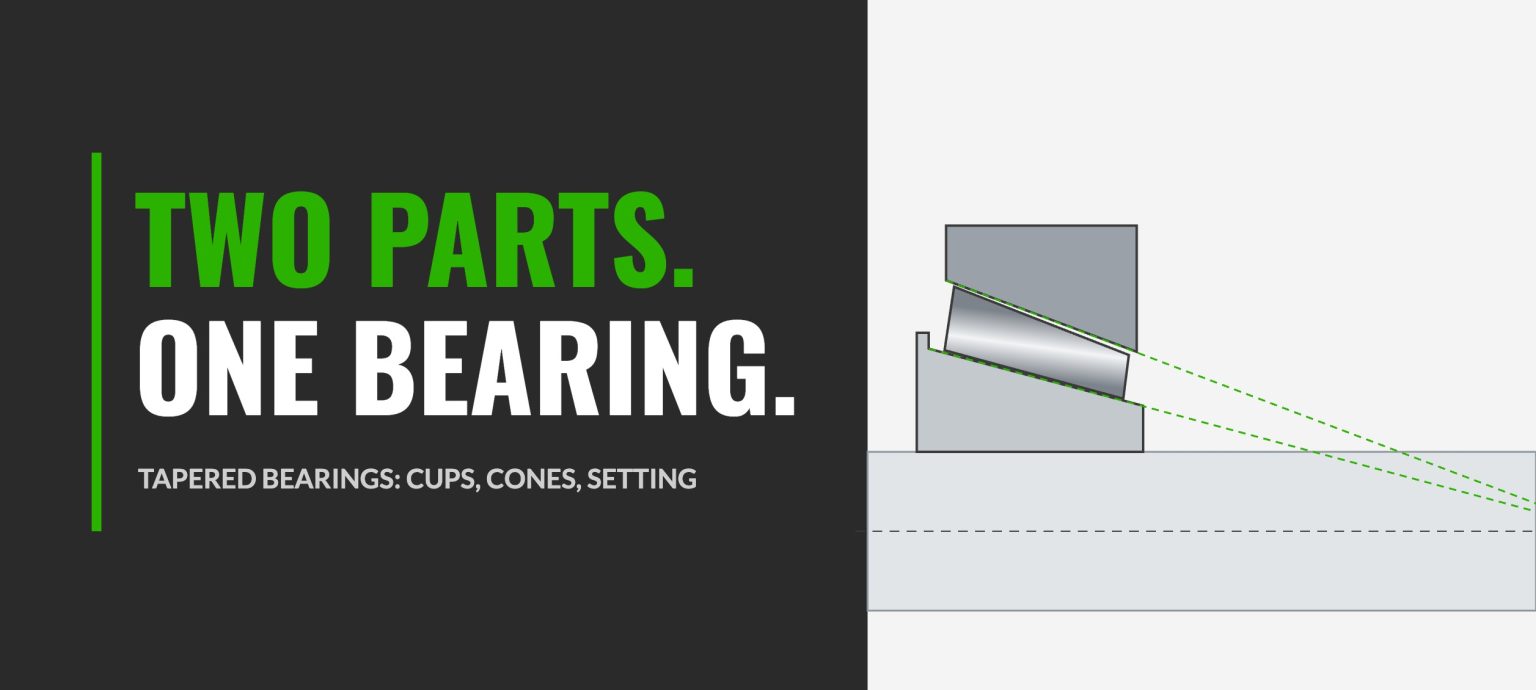
A wagon wheel going straight puts load straight down. Turn the corner and the load pushes sideways too, and 19th-century bearings couldn’t take it. Henry Timken, a St. Louis carriage maker, fixed that by tilting the rollers. His tapered roller bearing patents came through in 1898 (National Inventors Hall of Fame), and the design still carries most of the world’s wheel hubs, gearbox shafts and pinions.
They take combined load, radial and thrust at the same time, because the cup, cone and rollers all point at a common apex on the shaft axis. They’re also the bearing you buy in two pieces and set by hand. Get the pairing and the setting right and they last. Get either wrong and they cook.
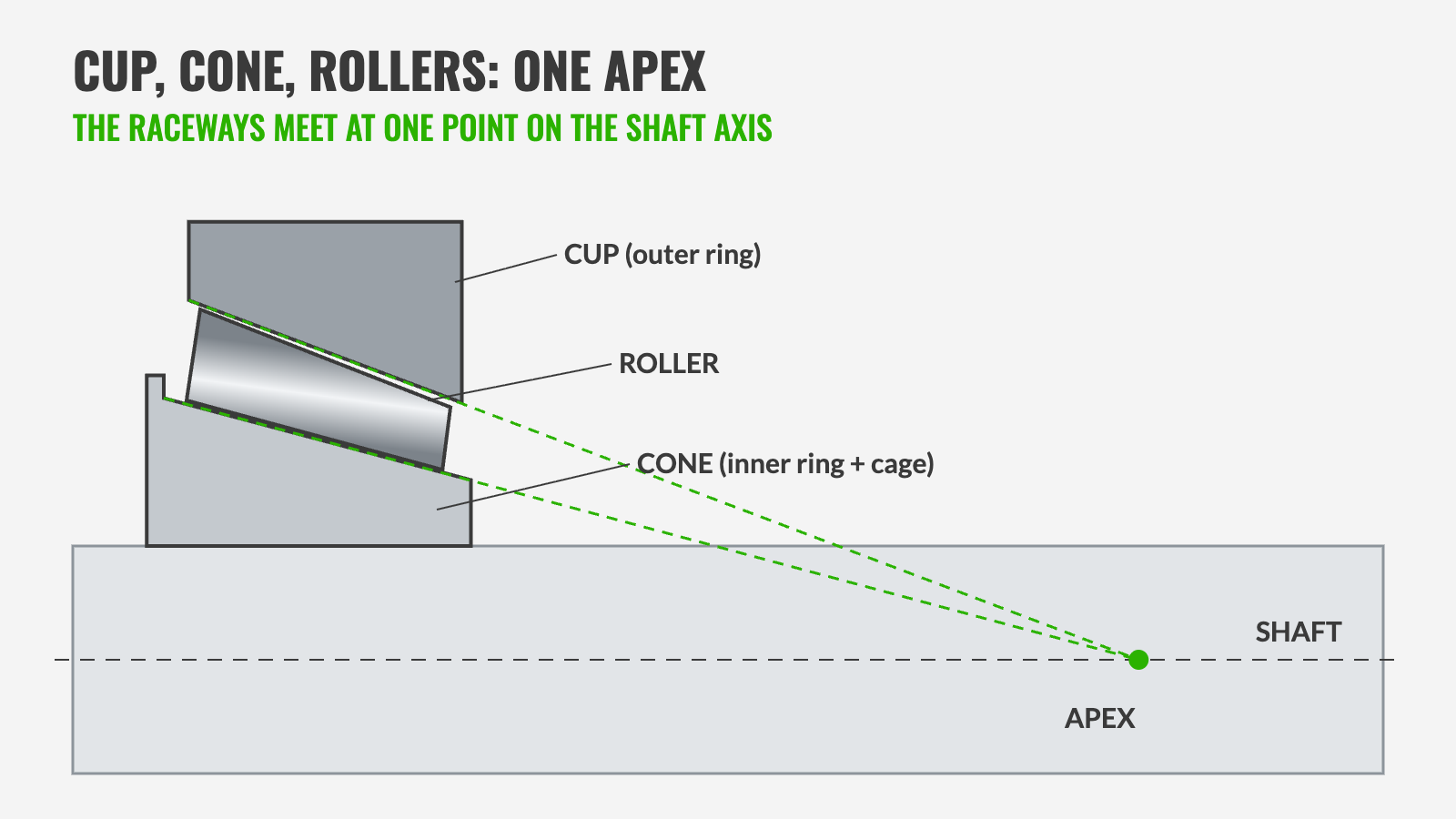
A tapered roller bearing comes apart. The cone is the inner ring with the rollers and cage attached. The cup is the separate outer ring. On inch bearings each carries its own number: an LM11949 cone runs in an LM11910 cup. Some brands sell the matched pair under a set number. Timken’s SET numbers are the best known. Metric tapered bearings follow ISO 355 and are usually sold as one assembly, such as a 30205 or 32210.
That split is where most ordering mistakes happen. Order the cone number and get a cone with no cup. Order a set and get both. Read the number off each piece before you order. If one is unreadable, the other usually tells you the pair.
Thrust in one direction only? See our guide to thrust bearings. Need tolerance for misalignment instead? A spherical roller bearing is the better fit.
Anywhere a shaft carries weight and gets pushed along its axis at the same time:
The common thread is combined load at moderate speed. For very high speeds with light loads, angular contact ball bearings usually run cooler. For heavy load with shaft deflection, a spherical roller bearing is more forgiving. Tapered bearings sit in the middle and do it at a good price.
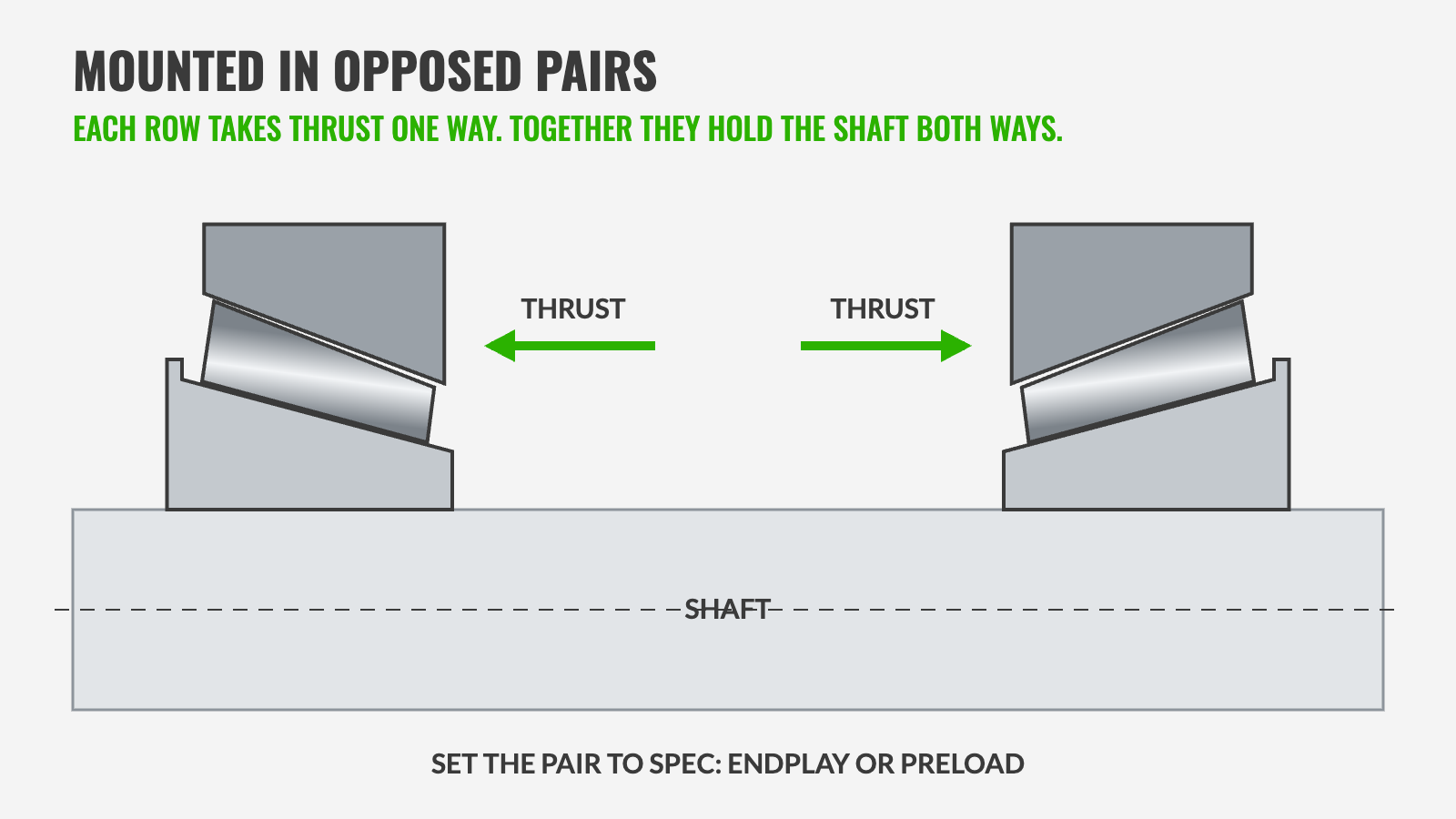
A pair of tapered bearings has to be adjusted on the shaft, and that setting decides their life more than almost anything else.
Too loose and the rollers skid, hammer and wear the races. Too tight and the bearing runs hot and fails fast. Follow the equipment manual’s spec. Never guess it, and never just torque the nut and walk away.
Inch tapered bearing numbers from Timken, Koyo, NTN, SKF and Bower largely interchange, because the industry adopted the ABMA part-numbering system for inch tapers, so an LM11949 is an LM11949 across brands. Older or proprietary numbers are trickier. Measure the cone bore, the cup OD, and the widths of each. Our bearing cross-reference covers the common ones. For the rest, send us both numbers or the dimensions and we’ll match them.
The cone is the inner ring with rollers and cage. The cup is the outer ring. On inch tapered bearings they’re sold and numbered separately.
Yes, in one direction per row. That’s why they’re mounted in opposed pairs.
Not if the cup has run. Replace them as a pair.
In the ABMA inch system, the prefix describes the bearing’s series and duty. LM is a light-medium series.
Central Surplus stocks tapered roller cups, cones and sets across the major brands, ships same day on orders placed before 6:00 p.m. Eastern, and typically prices below the big distributors. Send both numbers, a set number or the dimensions, or a whole list for one quote.
Need a bearing? Make it easy. Shop Bearings


Our team can locate, cross-reference, and source all parts.
Our team can locate, cross-reference, and source all parts.