




Motor Starters vs. Contactors vs. Overload Relays: What Each One Does and Why You Need All Three
When a motor stops running, the first instinct is to find the part that looks

Availability:
1 in stock
Precision single-row deep groove ball bearing, 50 mm bore x 110 mm outside diameter x 27 mm wide, open on both sides, with a machined brass cage, ABEC 5 running accuracy and C2 internal clearance – deliberately tighter than standard. For machine tool spindles, grinding heads and high-speed shafts where runout and axial stiffness matter and the ring-to-ring temperature difference is small.
List Price
$64.18
1 in stock

1 in stock
On the Shelf & Ready to Ship
On all orders

No Risk, No Hassle
Also Available From:

| MFR / Brand | Fafnir |
|---|---|
| MPN | 6310C2FYP5 |
| Model | 6310 C2 FY P5 / 6310 M C2 P5 6310P5 |
| Bearing Type | Precision Ball Bearing, Open |
| ID | 50 mm |
| OD | 110 mm |
| Width | 27 mm |
| Material | Bearing Steel |
|---|---|
| Series | 6300 |
| Condition | New |
| Relubrication | Yes - open bearing, lubricated by the host machine's oil, oil-mist or grease system |
| Preload | None - single deep groove ball bearing with no pairing or preload code. C2 is a tighter clearance class, not a preload specification. |
| Base Number | 6310 |
| Common Misspellings | 6310C2FY P5; 6310 C2FYP5; 63l0; 6310 c2 fyp5; 6310-CZ-FY-P5; 6310 F4 P5; 6310 C2 EY P5; 6310 ABEC-5; koyo 63l0c2fyp5; koya 6310; 6310 fy-p5 |
| Bore Shaft Size | 50 mm |
| Mpn Variants | 6310 C2 FY P5; 6310C2FYP5; 6310 C2FY P5; 6310C2 FYP5; 6310-C2-FY-P5; 6310 FY P5; 6310 C2 P5; 6310-P5; 6310 P5; 6310P5; 6310 C2; 6310C2; 6310 C2 MB P5; 6310 MB P5; 6310 M C2 P5; 6310 (ISO base number) |
| Manufacturer Status | Legacy / new old stock. Koyo bearing production now sits under JTEKT; current-production equivalents appear under the JTEKT Koyo brand. |
| Compatible With Replaces | Fits any seat machined for a 50 x 110 x 27 mm ISO 15 single-row deep groove ball bearing. A specification-equivalent replacement must have ALL THREE of P5 / ABEC 5 tolerance class, C2 internal clearance and a machined brass cage - a commodity 6310 fits the seats but does not replace the specification, and substituting CN or C3 clearance into a C2 application (or the reverse) is a genuine failure risk. Suitable for machine tool spindle and grinding head rebuilds originally specified with a C2 P5 brass-caged 6310. |
| Arrangement Configuration | Single bearing, radial mounting. NOT a matched or universally ground pair - only one piece exists. |
| Precision Class | ABEC 5 (P5). Koyo scale: no code = ABEC 1, P6 = ABEC 3, P5 = ABEC 5, P4 = ABEC 7. |
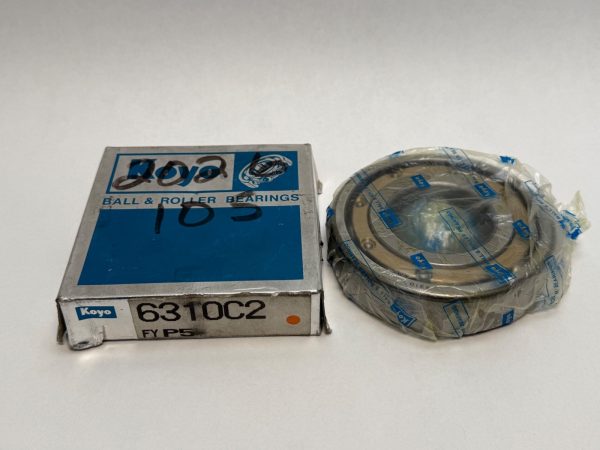
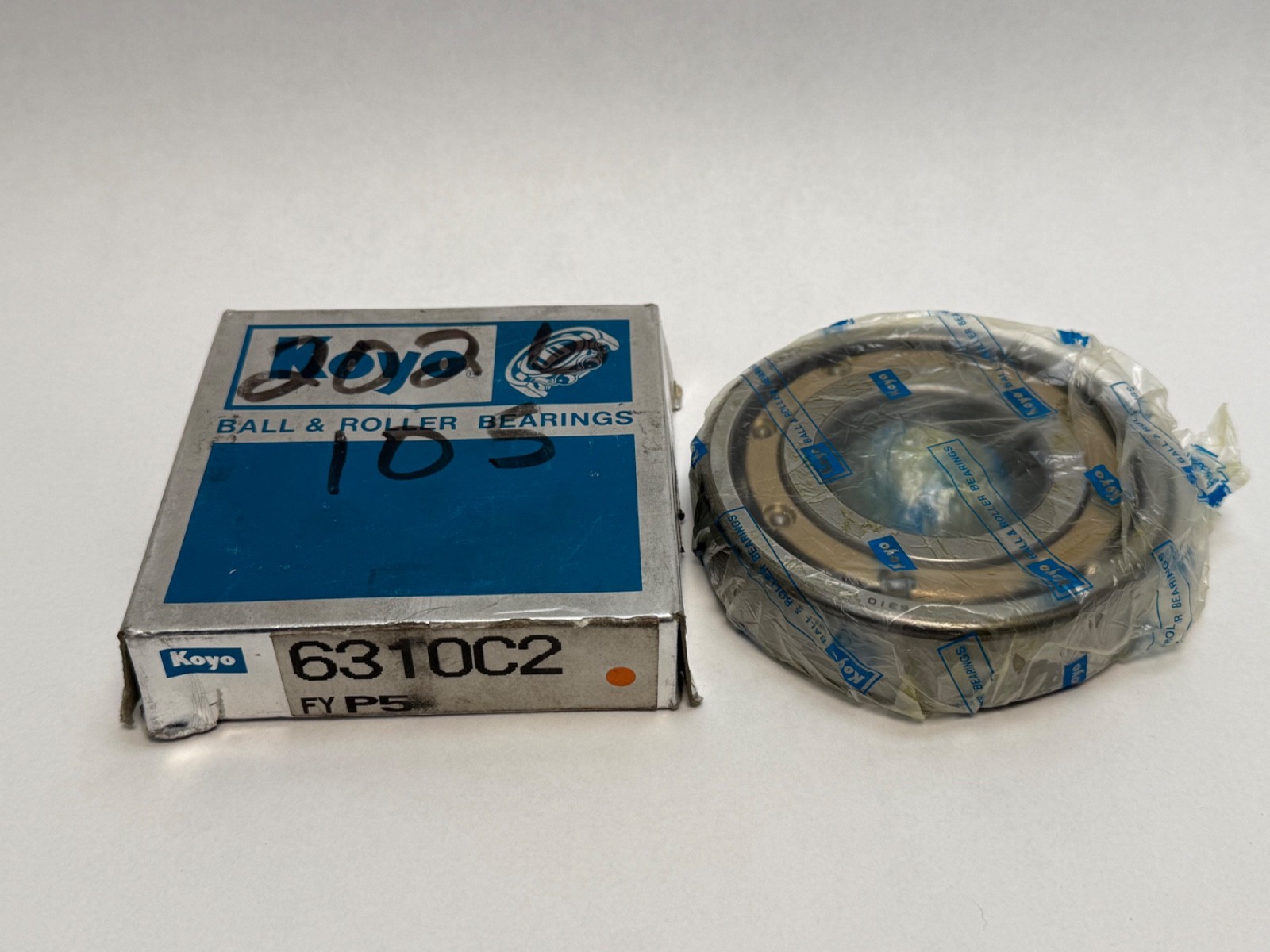
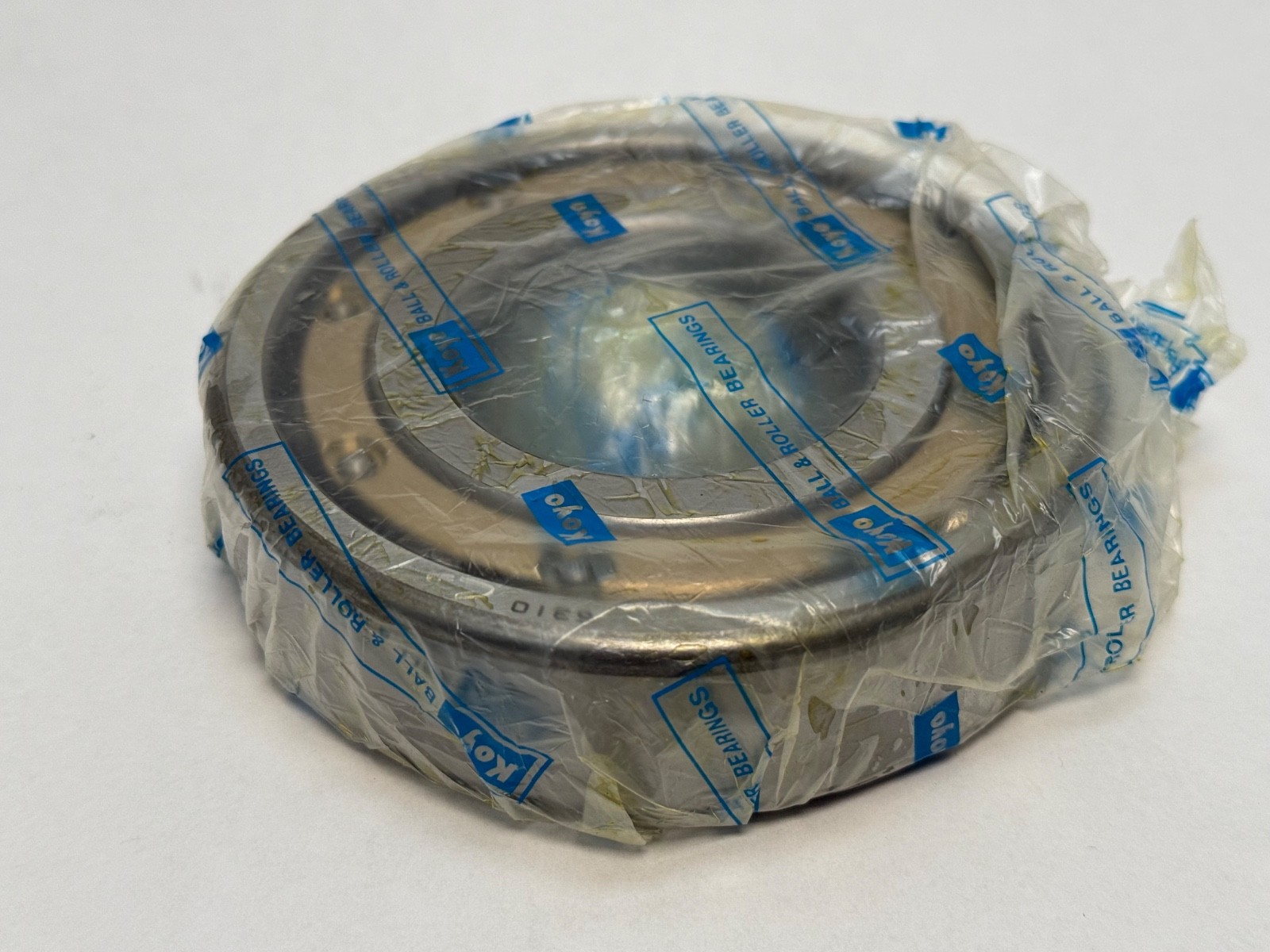
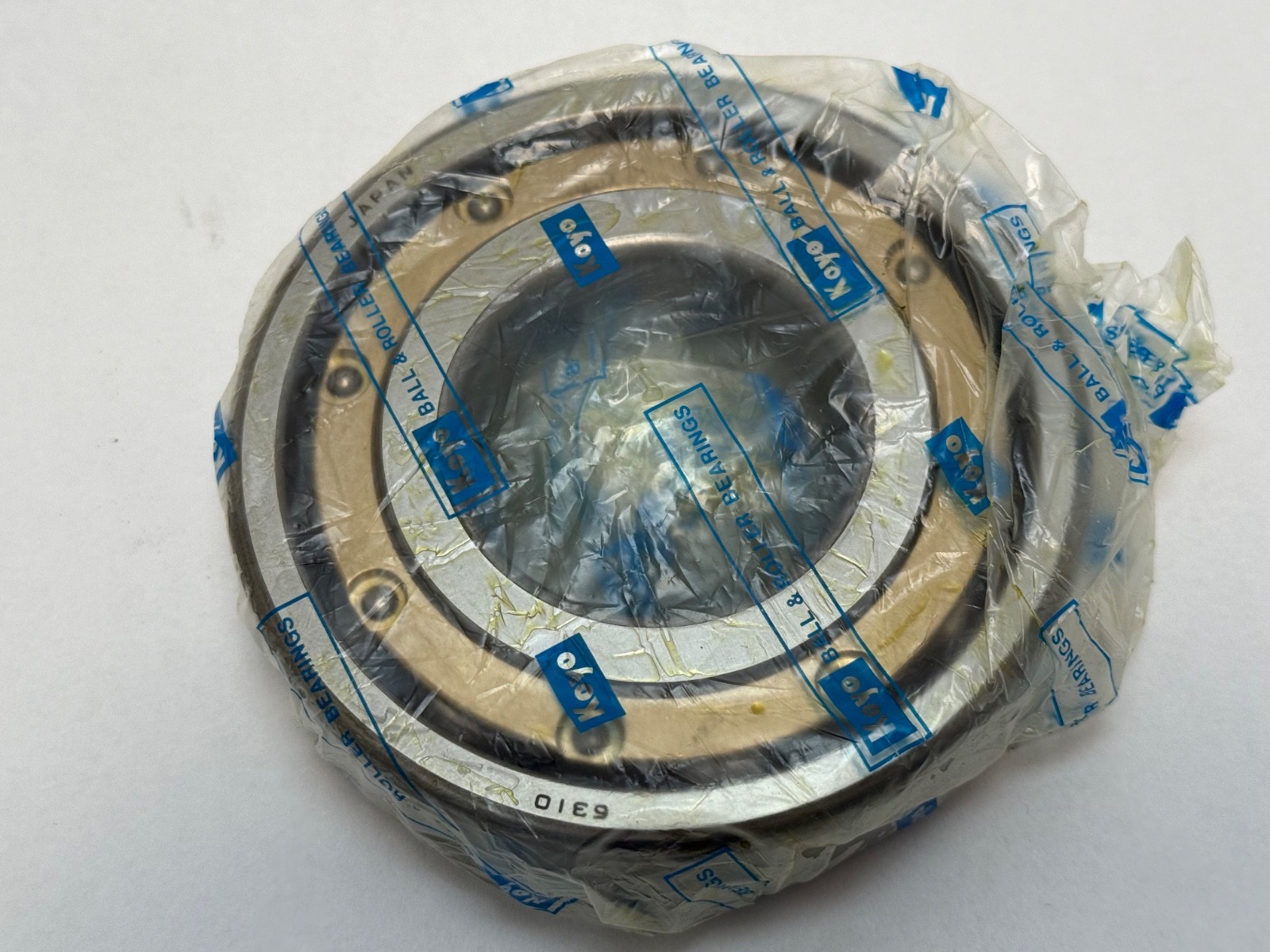
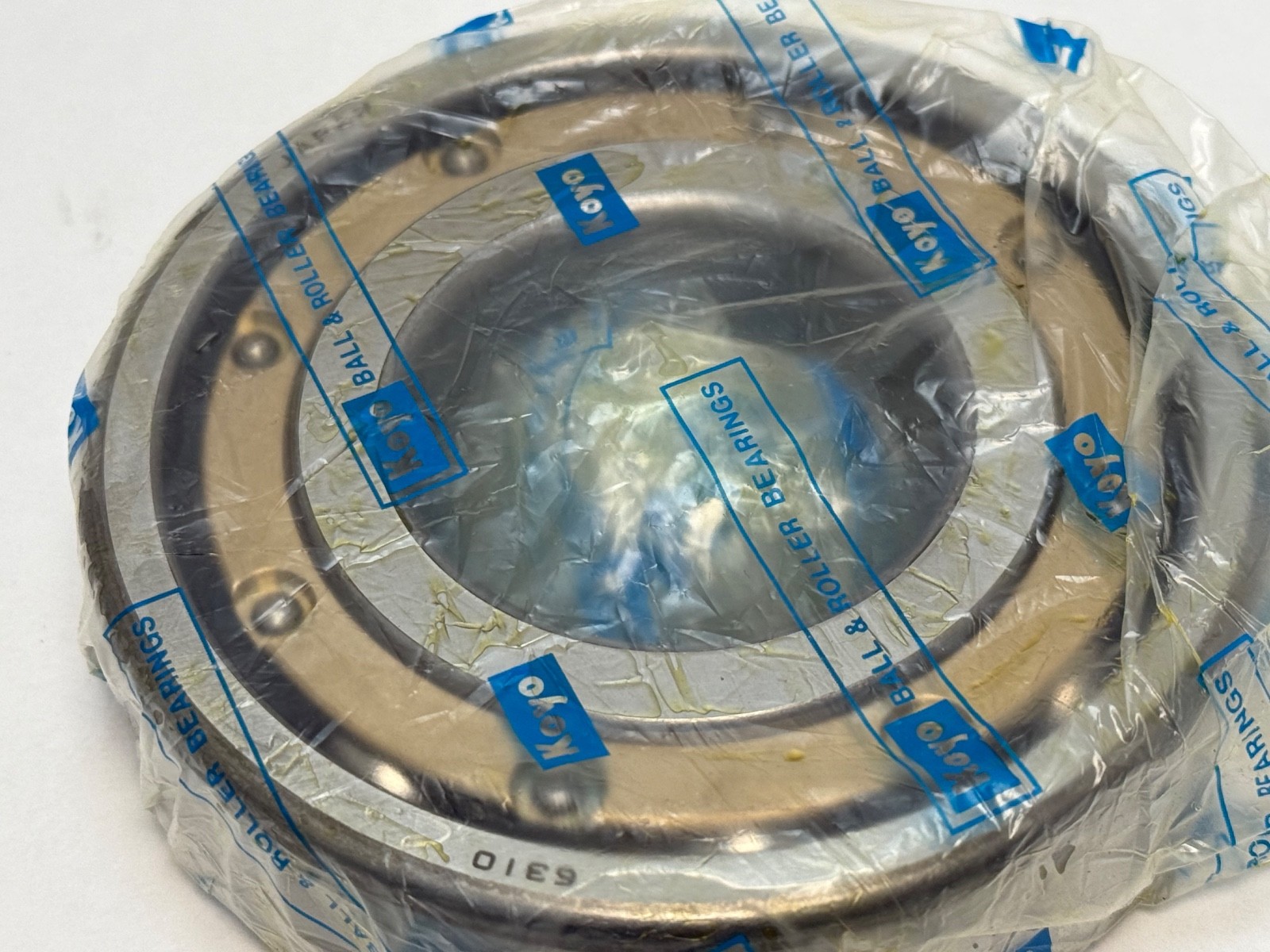
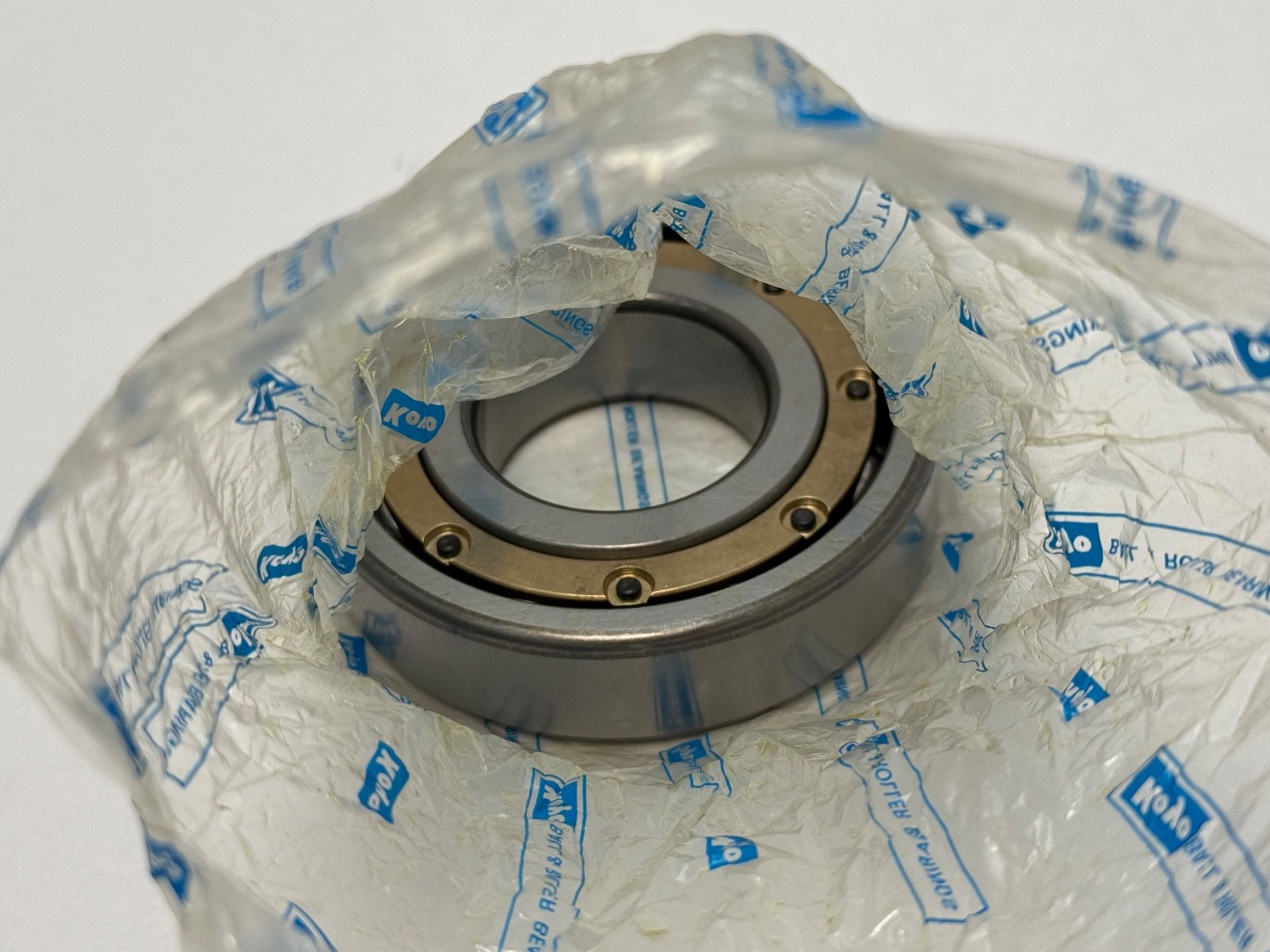
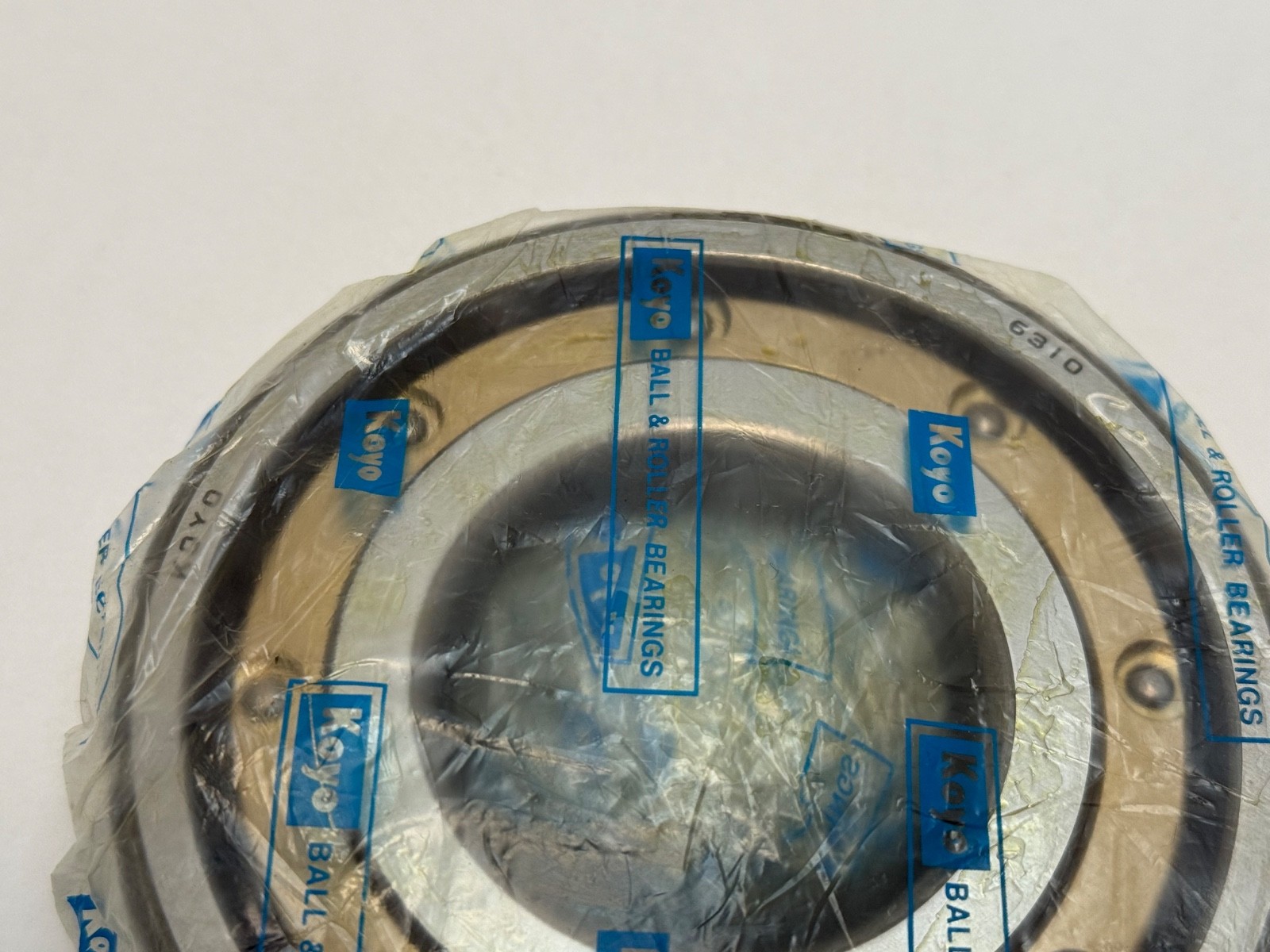
| Additional Attributes | Carton: Koyo blue/silver box, "Koyo BALL & ROLLER BEARINGS", box-end label printed 6310C2 with FY P5 beneath; legacy warehouse marker pen on the box face. Outer ring marked 6310. Bearing in original Koyo-printed VCI wrap, unopened. Suffix order per Koyo's own worked example (series, bore, closure, clearance, retainer, tolerance, grease) matches 6310 C2 FY P5 exactly. Country of origin NOT asserted - Japan is likely for Koyo but no country line is visible on the carton in the photographs, and the old record's Japan claim was entangled with a false FAFNIR brand attribution. No date code visible. No UPC. LEFT BLANK, NOT PUBLISHED: limiting and reference speed for this cage/clearance/class combination; C2 clearance micron range at 50 mm bore (Koyo publishes the class, not the range); cage guiding land (FY does not specify it); ball count; ball diameter; bearing mass; abutment dimensions; fatigue load limit. Load ratings C 77.5 kN and C0 38.3 kN are DISTRIBUTOR-tier and provisional, not Koyo-published. |
| Min Temp | -30°C |
| Cage Type | Stamped |
| Dynamic Load Rating | 61.8 kN |
| Static Load Rating | 38 kN |
| Precision Rating | ABEC 5 / P5 |
| Rolling Elements | Ball |
| Max Temp | 120°C |
| Item Weight | 2.20 lbs |
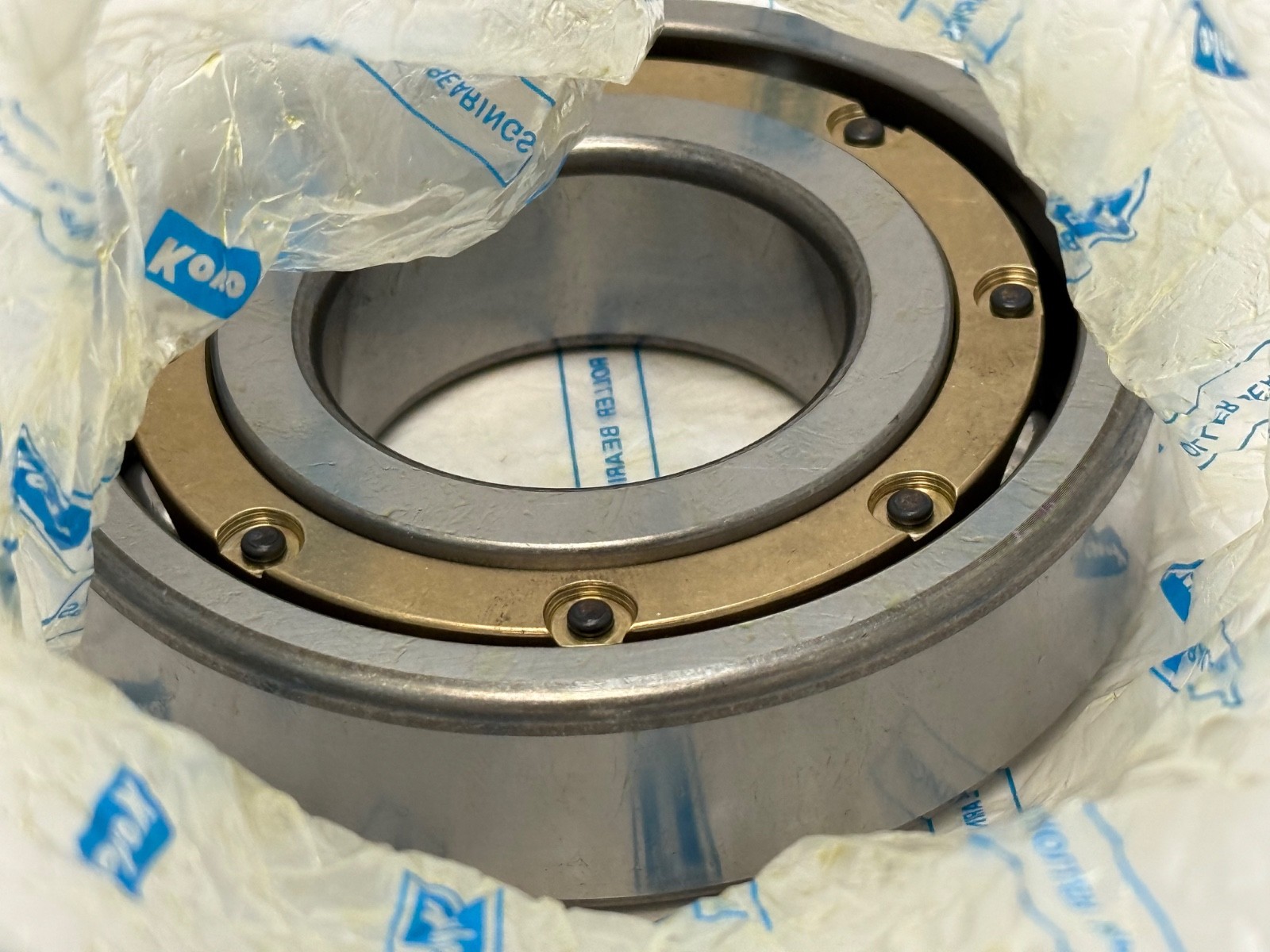
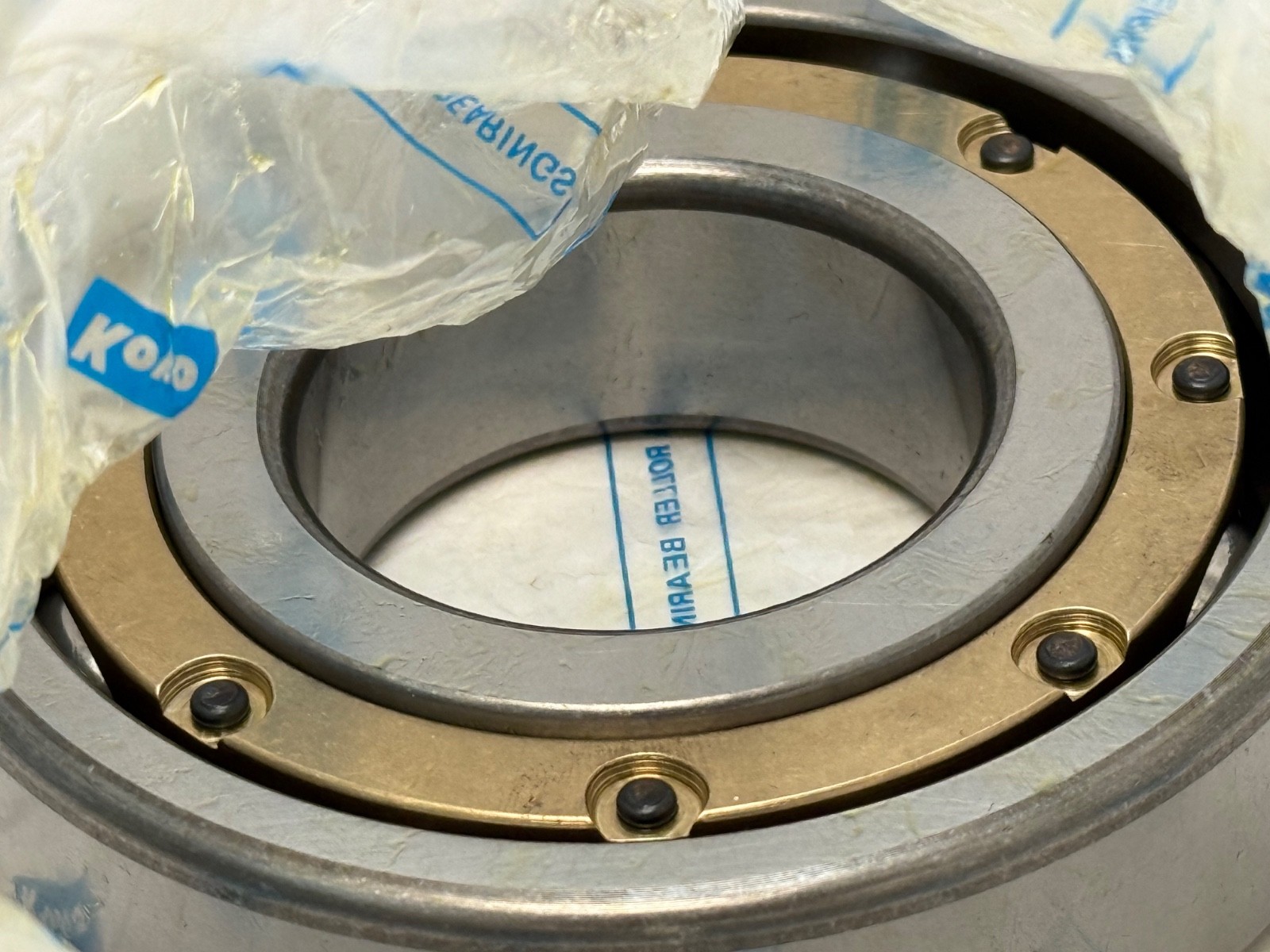
| Cage Material | Machined brass (copper alloy). Decoded from Koyo's own nomenclature guide (FY = machined brass retainer) AND photo-confirmed from the yellow-gold riveted cage visible through the original wrap. |
| Limiting Speed | Not published for this combination of machined brass cage, C2 clearance and P5 class, and deliberately left unstated. The figure for a commodity open 6310 would be misleading, because C2 clearance reduces thermal headroom and lowers the practical speed ceiling. |
| Number Of Rows | 1 |
| Bore Type | Straight |
| Snap Ring Included | No - no NR code, plain outer ring with no snap ring groove |
| Harmonization Code | 8482.10.5008 (ball bearings, other, over 30 mm outside diameter - verify against current HTSUS before export filing) |
| Design Units | Metric |
| Bearing Material | Through-hardened bearing steel rings and balls; machined brass cage |
| Internal Clearance | C2 |
| Part Number | 6310 C2 FY P5 |
| Cross Reference 1 | Koyo 6310 C2 FY P5 - open, machined brass cage, C2 clearance, ABEC 5 (this part, per the carton) |
|---|---|
| Cross Reference 2 | Koyo / JTEKT 6310 - ISO base number, same 50x110x27 mm envelope |
| Cross Reference 3 | SKF 6310 M/C2 P5 - open 6310, machined brass cage (M), C2 clearance, P5 class. Closest full-specification equivalent. |
| Cross Reference 4 | SKF 6310 MB/C2 P5 - as above with MB denoting an inner-ring-guided brass cage. Searchable equivalent; note Koyo's FY does not specify the guiding land, so this is a close cousin rather than a certified identical part. |
| Cross Reference 6 | NSK 6310 M C2 P5 - open 6310, machined brass cage, C2 clearance, P5 class |
| Cross Reference 7 | NTN / NACHI 6310 M C2 P5 - open 6310, machined brass cage, C2 clearance, P5 class |
| Cross Reference 8 | Fafnir (now Timken) 6310 - same 50x110x27 mm envelope. DIMENSIONAL reference only, and noted here because this record previously carried FAFNIR as the brand in error; a commodity Fafnir 6310 is NOT a specification equivalent of a C2 FY P5 precision bearing. |
| Cross Reference 9 | Central Surplus SKU B-AH6B2#OXHSM7 - SKF 6214 TC/C78, open ABEC 5 precision deep groove ball bearing, 70x125x24 mm, machined phenolic cage. Different size, same precision-spindle buyer. |
A precision single-row deep groove ball bearing in the metric 6300 medium series, 50 mm bore × 110 mm outside diameter × 27 mm width. Open on both sides, fitted with a machined brass cage, held to ABEC 5 running accuracy, and supplied with C2 radial internal clearance — which is tighter than standard, not looser. Every one of those three suffixes costs money to specify, so this bearing was ordered for a job where accuracy and stiffness mattered: a spindle, a grinding head, or a high-speed shaft carrying a precision tool or rotor.
Koyo publishes its own nomenclature guide, and it decodes this part number completely and unambiguously. The suffix order in Koyo’s own worked example is series, bore, closure, clearance, retainer, tolerance, grease — which is exactly the order 6310 C2 FY P5 follows.
6300 series — metric, single row, medium series. The heavier of the common cross-sections, which is why a 50 mm bore gets a 110 mm outside diameter here rather than the 90 mm of a 6210.
10 — bore code. For codes 04 and above, bore = code × 5, so 10 × 5 = 50 mm.
No closure code — open. Koyo would print Z or ZZ for shields, RS or 2RS for contact seals, RU or 2RU for non-contact seals.
C2 — radial internal clearance smaller than standard. In Koyo’s scheme C1 is smaller still, no code is standard, and C3 and C4 are progressively larger.
FY — machined brass retainer. We have confirmed this physically: the photographs show the yellow-gold machined cage with visible rivets through the wrap.
P5 — ABEC 5 precision. Koyo’s scale is no code = ABEC 1, P6 = ABEC 3, P5 = ABEC 5, P4 = ABEC 7.
No grease code — consistent with an open bearing, which is shipped dry apart from its preservative. Koyo prints XM, SR, A2 or P2 when a grease is charged.
This record previously listed the brand as FAFNIR. That is wrong, and demonstrably so. Fafnir was an American bearing brand, now part of Timken, and it never used Koyo’s suffix system. FY is a Koyo retainer code, P5 is Koyo’s tolerance code, and the bearing arrived in a Koyo carton with its box end printed 6310C2 / FY P5, wrapped in Koyo-branded paper. The brand has been corrected to Koyo (now part of JTEKT). We have also removed the claim that the bearing was “manufactured by FAFNIR in Japan”, which combined two mutually exclusive facts in one sentence.
Why C2 clearance is the spec that decides whether this bearing works:
C2 is the specification most likely to be misread on this listing, because people see a C-number and assume loose. It is the opposite: C2 is tighter than the standard CN class. Tighter mounted clearance means the balls sit more firmly against both raceways, more balls share the load at any instant, and the bearing is stiffer both radially and axially with less runout and less noise. That is exactly what a precision spindle wants, and it is why C2 and P5 are specified together here.
The catch is that clearance is consumed, not fixed. An interference fit on the shaft expands the inner ring; a tight housing fit compresses the outer ring; and in service the inner ring almost always runs hotter than the outer, so it grows more. All three effects eat into the clearance you started with. Begin with C2 and you have less to give away, so a mismatch bites quickly, and it bites in both directions:
Too tight — the residual clearance goes to zero and the bearing runs preloaded. Friction rises, the bearing heats, the inner ring grows further, the clearance closes further, and friction rises again. That loop is self-reinforcing and it destroys bearings in hours, not years. This is the failure mode a C2 bearing is genuinely exposed to, and it is why C2 belongs in an application with a modest ring-to-ring temperature difference and properly specified fits — not in a hot pump end or a motor with a heavy interference fit and a big thermal gradient.
Too loose — the load is carried by too few balls, contact stress climbs, and the balls can skid rather than roll, which scuffs the raceways and shows up as noise and vibration. Precision goes out of the window and fatigue life falls.
The practical rule: do not substitute a C2 bearing into a CN or C3 application, and do not substitute CN or C3 into a machine designed around C2. Check what the original spindle drawing calls for. If it calls for C3, this is not your bearing, however attractive the P5 rating looks.
A machined brass cage is the traditional heavy-duty, high-speed precision choice. It is dimensionally stable, tolerant of temperatures that would soften a polymer cage and embarrass a phenolic one, resistant to most lubricants including aggressive synthetics, and stiff enough to resist the centrifugal ballooning that limits pressed steel cages at speed. It runs quietly and it survives handling. The costs are mass — a brass cage is heavier than steel or polymer, so it contributes more to imbalance and to cage-pocket friction at very high speed — and price. On a 50 mm bore precision bearing intended for a spindle, brass is the sensible answer, and it is a meaningfully better cage than the pressed steel in a commodity 6310.
ABEC 5 (P5) tightens the tolerances on bore, outside diameter and width, and above all on the radial and axial runout of the assembled bearing, compared with the ABEC 1 / Normal class. It does not raise load capacity. What it buys is positional accuracy and quiet, repeatable running: a surface finish you can hold on a machine tool, less chatter in a grinding head, less bearing-induced imbalance in a high-speed rotor. It only pays off if the shaft and housing deserve it. Mount a P5 bearing in a worn housing bore and you have simply bought an expensive commodity bearing. Precision bearings magnify the quality of the seats they sit in, in both directions.
Bore d — 50 mm; outside diameter D — 110 mm; width B — 27 mm
Bearing type — single row deep groove ball bearing, open, 6300 medium series
Internal clearance — C2, smaller than standard
Precision class — ABEC 5 / P5
Cage — machined brass, riveted
Basic dynamic load rating C — 77.5 kN (distributor-published figure, see note)
Basic static load rating C₀ — 38.3 kN (distributor-published figure, see note)
An honest note on those two load ratings: the dimensions, series, clearance class, cage type and precision class above are all decoded from Koyo’s own published nomenclature guide and confirmed against the carton and the bearing. The two load ratings are not from a Koyo document — they are the figures a trusted bearing distributor publishes for the Koyo 6310 family, and Koyo’s own catalogue page for this bearing is not accessible to us. Treat them as provisional. They are useful for sizing sanity checks and they will be close, but if your rating-life calculation is tight, get the figure from Koyo or your Koyo distributor before you commit. We would rather label a number as second-hand than pass it off as the manufacturer’s.
Limiting and reference speeds are deliberately left blank. Speed capability on this bearing depends on the combination of the brass cage, the C2 clearance and the P5 class, and no published figure exists for that specific combination. Quoting the number for a commodity open 6310 would be misleading, because C2 clearance in particular lowers the practical speed ceiling by reducing the thermal headroom.
One bearing, in its original Koyo carton, and it is the only one we have. This is a single bearing, not a matched or preloaded pair: the designation carries no pairing or preload code, and deep groove ball bearings are not universally ground for pairing the way angular contact bearings are. If your spindle takes two, this listing supplies one of them, and we cannot supply the second.
Work clean and work carefully, because a P5 C2 bearing punishes sloppy assembly more than a commodity bearing does. Press only on the ring you are mounting — inner ring onto the shaft, outer ring into the housing — and never through the balls. Measure the shaft and housing seats before you start and check them against the fits your spindle drawing specifies rather than against a generic table; with C2 clearance, an interference fit that is 20 microns too tight can take the mounted clearance to zero on its own. Heat mounting is fine with a brass cage, which is the most tolerant of the common cage materials. The bearing ships dry apart from its preservative, so degrease it and then lubricate with the oil, oil-mist or grease your spindle calls for — and remember that a tight-clearance bearing generates more heat, so do not over-grease it.
Separate the two questions of fit and specification. Dimensionally, 50 × 110 × 27 mm is the ISO 15 standard 6310 envelope, so any 6310 from any manufacturer drops into the same seats — SKF, FAG, NSK, NTN, NACHI, Timken and Fafnir all make one. By specification, almost none of them replace this bearing. You need all three of a P5 / ABEC 5 tolerance class, C2 internal clearance and a machined brass cage. In SKF and FAG notation that combination reads roughly 6310 M/C2 P5, where M denotes the machined brass cage; NSK and NTN would express it as 6310 M C2 P5. The cage guidance detail is worth a word of caution: SKF’s related codes distinguish MA (outer-ring guided) from MB (inner-ring guided), whereas Koyo’s FY specifies the brass machined retainer without stating which land guides it. So a Koyo FY and an SKF MB are close cousins rather than certified identical twins, and this listing also carries the 6310 C2 MB P5 designation for exactly that reason — as a searchable equivalent, not a claim of identity.
Obsolescence trail worth knowing: Koyo bearing production now sits under JTEKT, so current-production equivalents appear under the JTEKT Koyo brand. If you are rebuilding a precision spindle, we also stock an SKF 6214 TC/C78 — an open ABEC 5 precision deep groove ball bearing, 70 × 125 × 24 mm, with a machined phenolic cage — under SKU B-AH6B2#OXHSM7.
$95.00
148 in stock
$60.69
8 in stock

$51.59
2 in stock

A shipping cutoff banner measures a vendor’s dock. It tells
Nine bearing and power transmission manufacturers raised list prices this
When a motor stops running, the first instinct is to find the part that looks
From Caligula’s luxury fleet to modern factories, this is the story of how a single
When sourcing a replacement bearing, you will often find both Timken and SKF options for
Our team can locate, cross-reference, and source all parts.
Our team can locate, cross-reference, and source all parts.
Sort
Brand
Price
MPN
Categories