
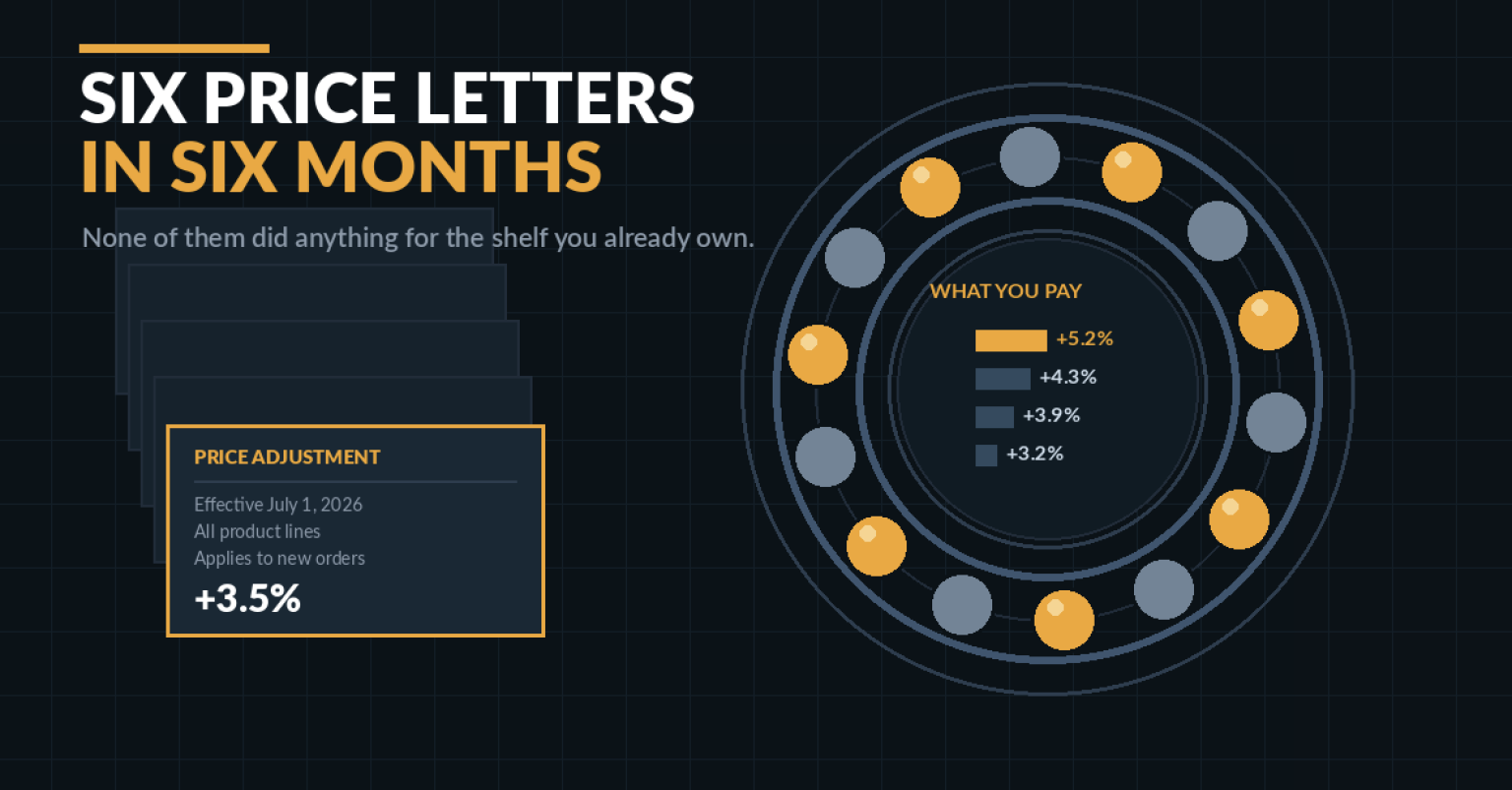
Nine bearing and power transmission manufacturers raised list prices this year, several of them twice — and the material already sitting on your shelf did not come up with them.
Bearing price increases reset what every future part costs you, while the dead stock in your crib gets harder to move every quarter it sits.
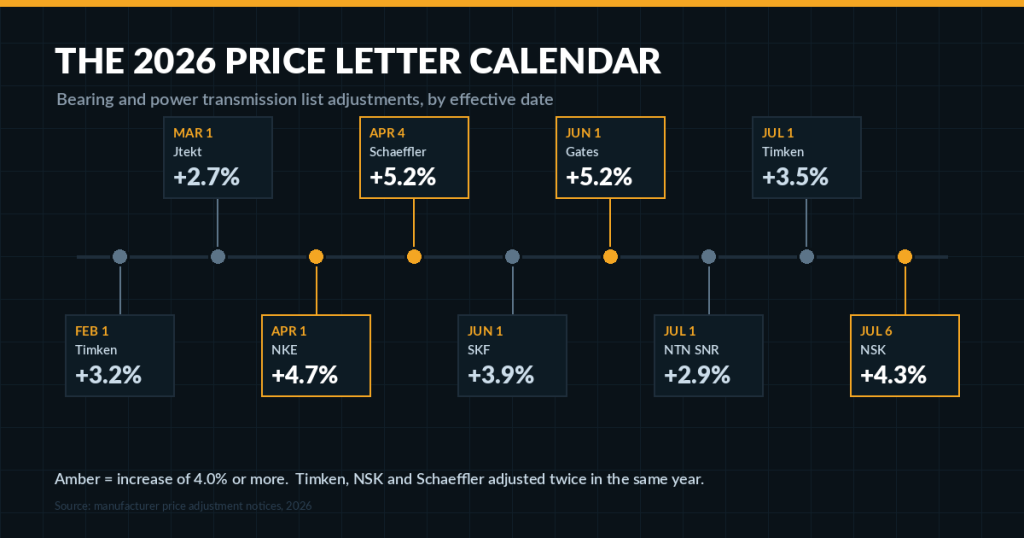
Six Bearing Price Increases Landed Before The Fourth Of July
Run the 2026 manufacturer price adjustment list and the pattern is hard to miss.
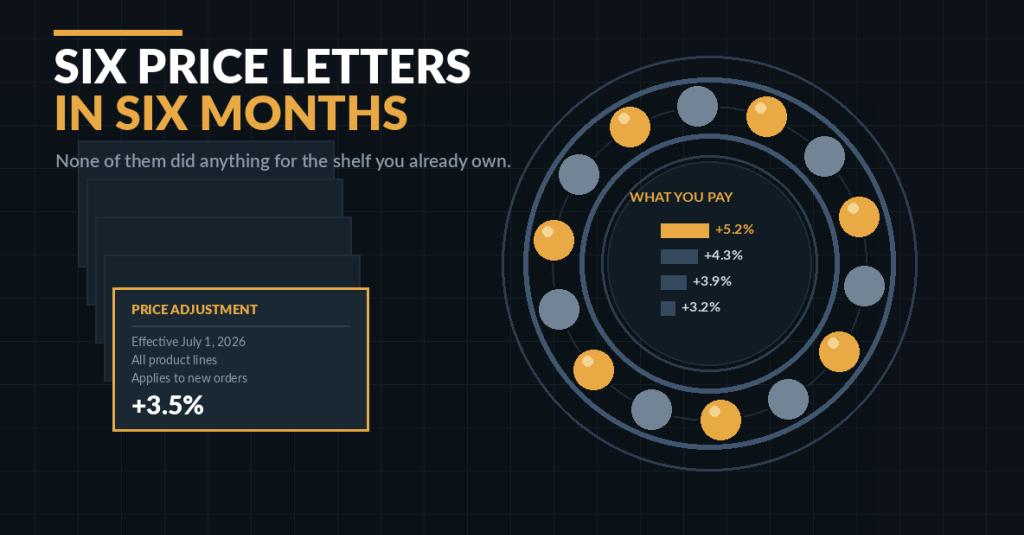
Timken, NSK and Schaeffler all went twice. Six bearing price increases in six months, from six different letterheads. Take that as a run rate.
And it’s working. Timken’s Q1 2026 sales rose 8%, driven primarily by higher pricing.
Every one of those letters cites the same three inputs, and two of them are real.
So the next part you buy costs more. Fine. Everybody’s in that boat.
But actually run the math.
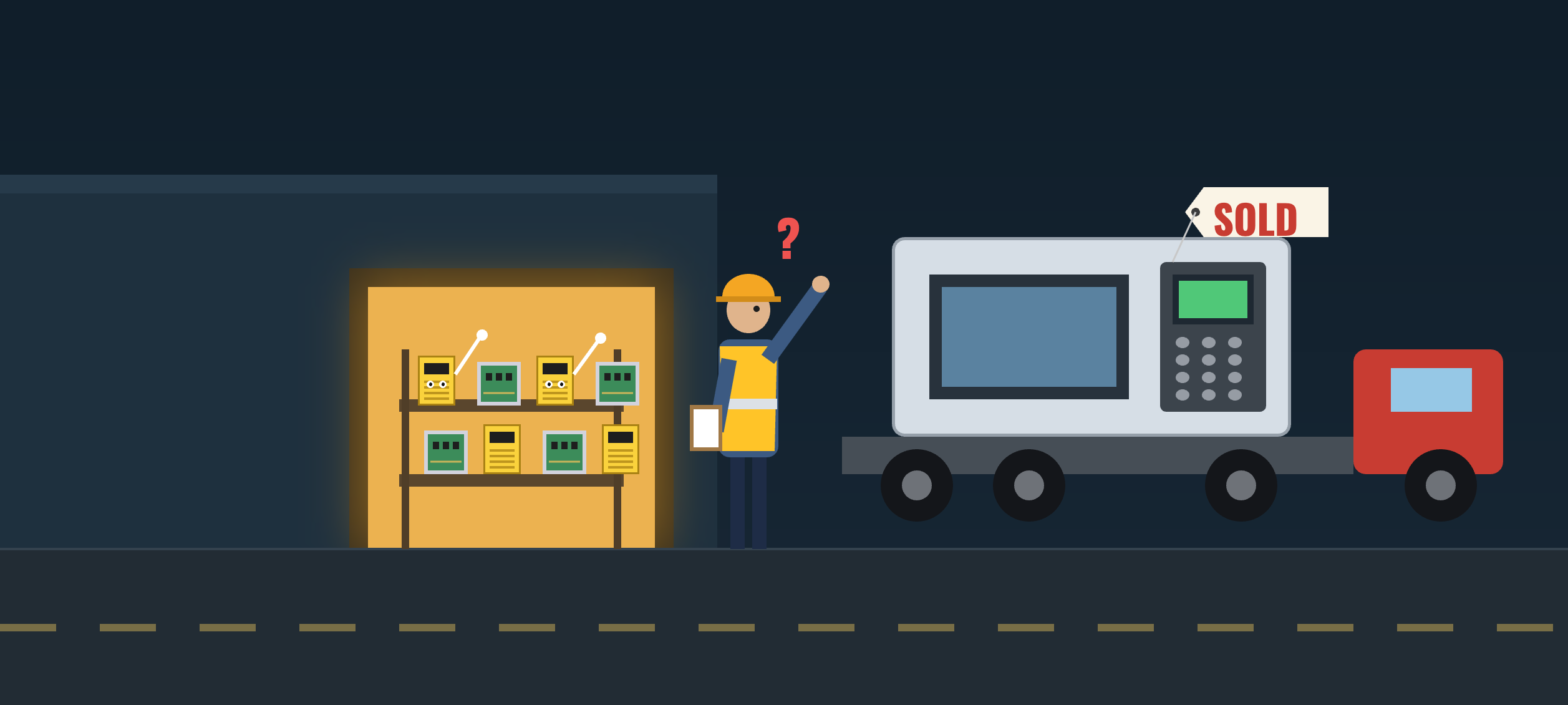
None of that helps the crib. The letters move forward, not backward. They reprice what the manufacturer will sell you next quarter — they don’t do anything for a shelf full of automation parts you bought for a line that isn’t there anymore.
That material is going the other direction. Every year it sits, the installed base that could use it shrinks. Platforms get superseded, spec changes, the equipment it was bought for gets scrapped somewhere else too.
Industrial parts product obsolescence should be a main reason why you call a surplus buyer.
The pool of buyers who can still use your part number is smaller this August than it was last August. It will be smaller again next year.
We see this on almost every plant walk — the deepest shelves are the ones tied to equipment that left the building, was recently repaired or simply doesn’t need the spares. They thought it would be useful at some point too.
That’s not an asset appreciating, its a closing window.
1. Sort the crib by consequence, not by turns.
2. Move the new-in-box material while there’s still a buyer for it.
3. Stop buying the gap off the new list.
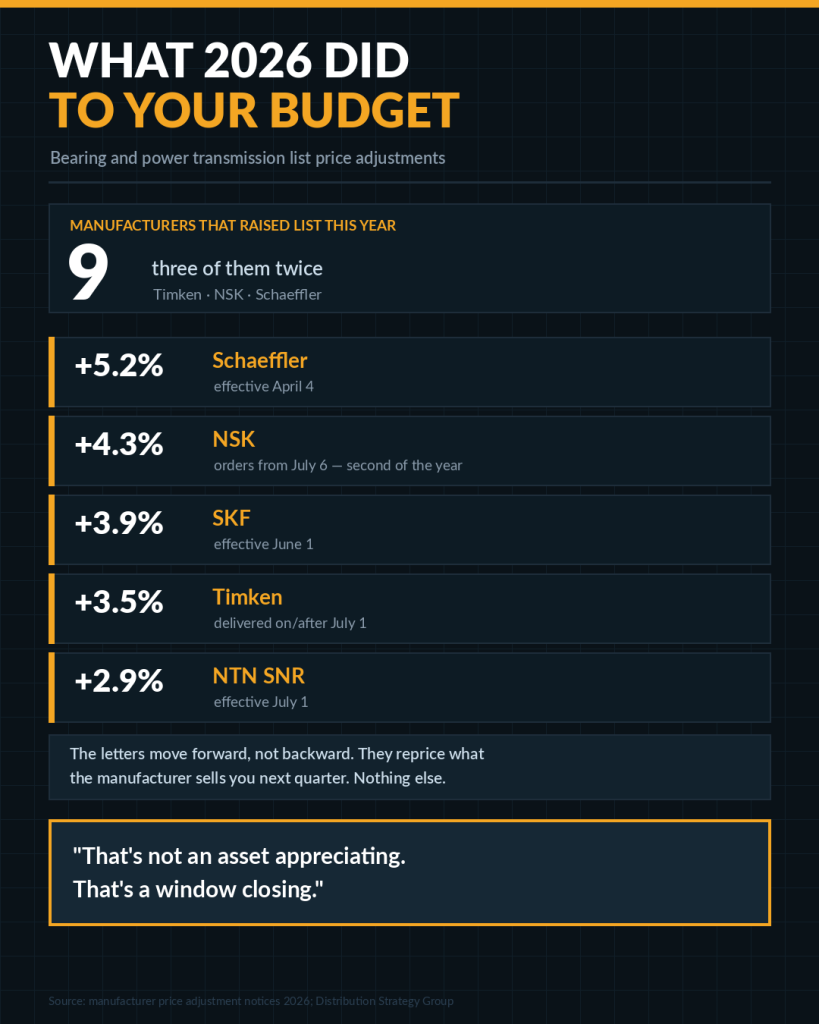
Nine manufacturers raising prices in one year isn’t a shock event. It’s a permanent step change in what industrial maintenance costs to run.
Two camps form from here.
The first absorbs every increase off the current list, keeps the crib exactly as it is, and watches the storeroom budget climb every February and every July. Forever.
The second clears the shelf while the material still has a buyer, and starts sourcing the parts it actually needs from a channel that isn’t indexed to a letterhead.
There is your opening.
Bearing price increases are the loudest version of this, but the same thing is running through linear motion, belts, chain and every copper-bearing or power transmission category on the shelf. And beyond mechanical, the same gap is opening on drives and control hardware as legacy platforms go end-of-life.
Don’t sleep on this. The Q4 letters are already drafted.
What to watch: the next round of manufacturer price adjustments landing for January 1 effective dates, copper’s move into deficit, and whether tariff pass-through gets folded permanently into list rather than sitting as a surcharge.
Either way, next year’s parts cost more and this year’s dead stock is worth less. Only one of those is still yours to decide.


Our team can locate, cross-reference, and source all parts.
Our team can locate, cross-reference, and source all parts.