
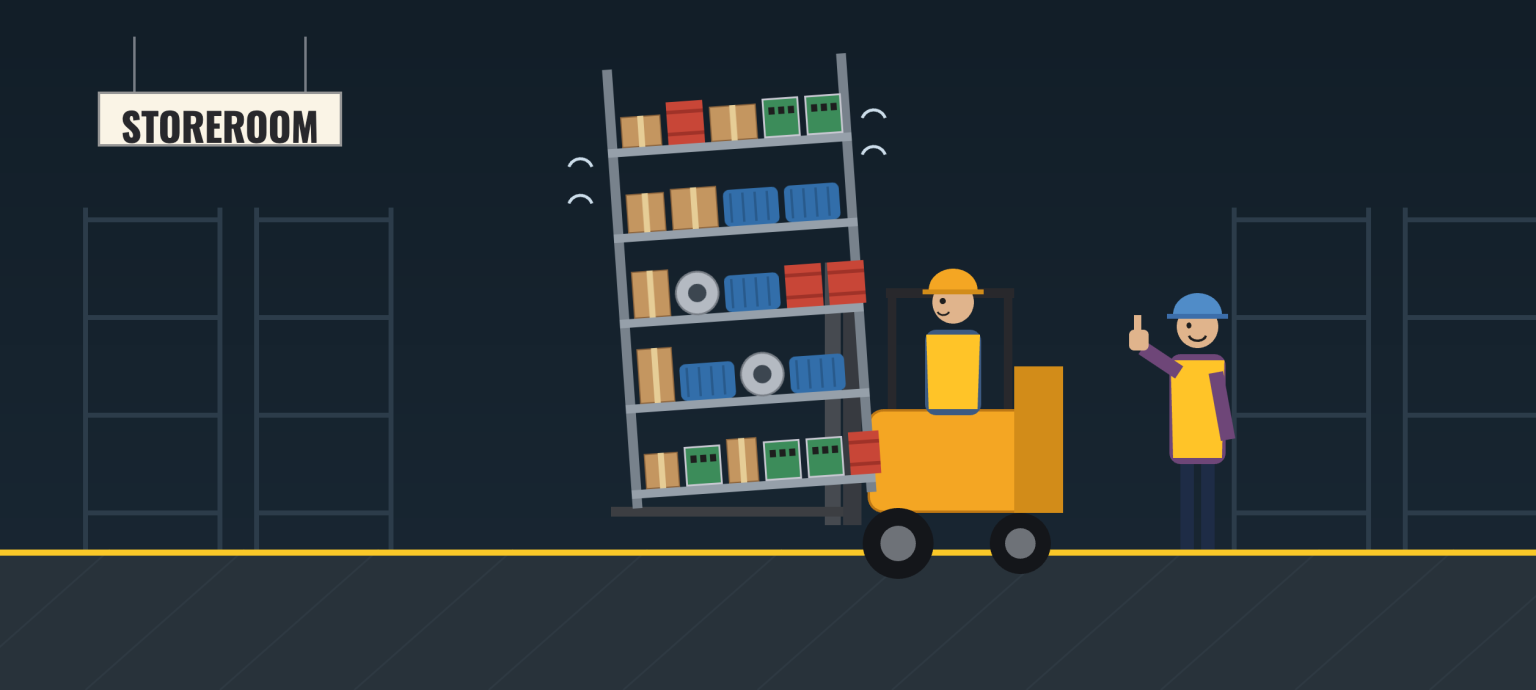
Most plants clear a storeroom one part number at a time, which is why most storerooms never get cleared. The buyers who take the whole room at once know something the spreadsheet doesn’t.
Selling an MRO storeroom in one lot means one list, one offer, one truck, and an empty aisle by the end of the month. 1 everything. 0 headache.
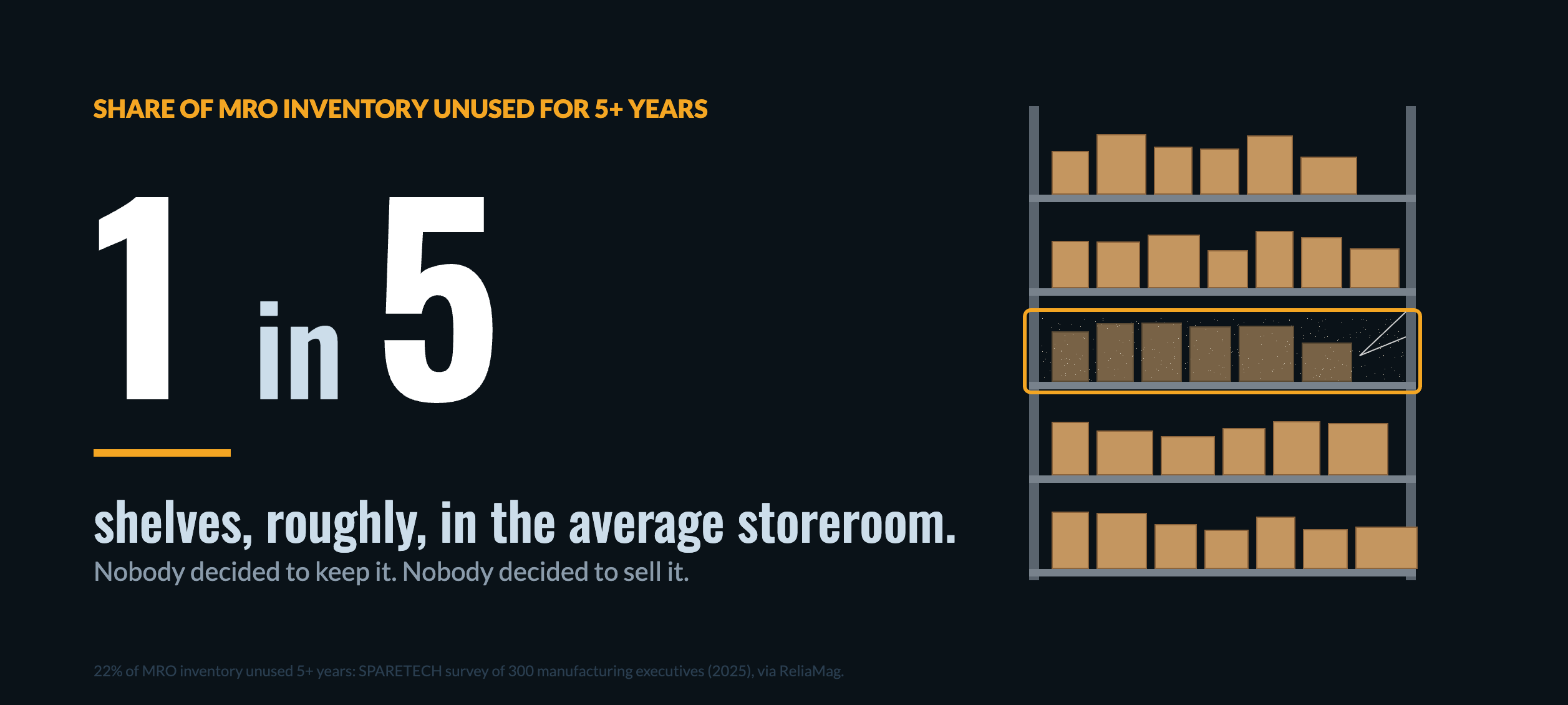
A 2025 survey of 300 manufacturing executives found that 22 percent of MRO inventory has gone unused for more than five years.
That’s roughly one shelf in five.
Nobody decided to keep it. Nobody decided to sell it, either. It just stayed, the way a treadmill stays in a spare bedroom.
And somewhere on those shelves are bearings, gear reducers, contactors, PLC cards, PCBs and drives for machines that left years ago.
The usual plan is to pick through it. Pull the good stuff, list it, maybe sell a few pieces a month.
You know, one person is assigned to sell those… but that is not their job, or what they are good at.
That plan has been “in progress” at most plants since the last reorg.
Here’s the alternative. A storeroom sold in pieces takes years. A storeroom sold whole takes one list and one truck.
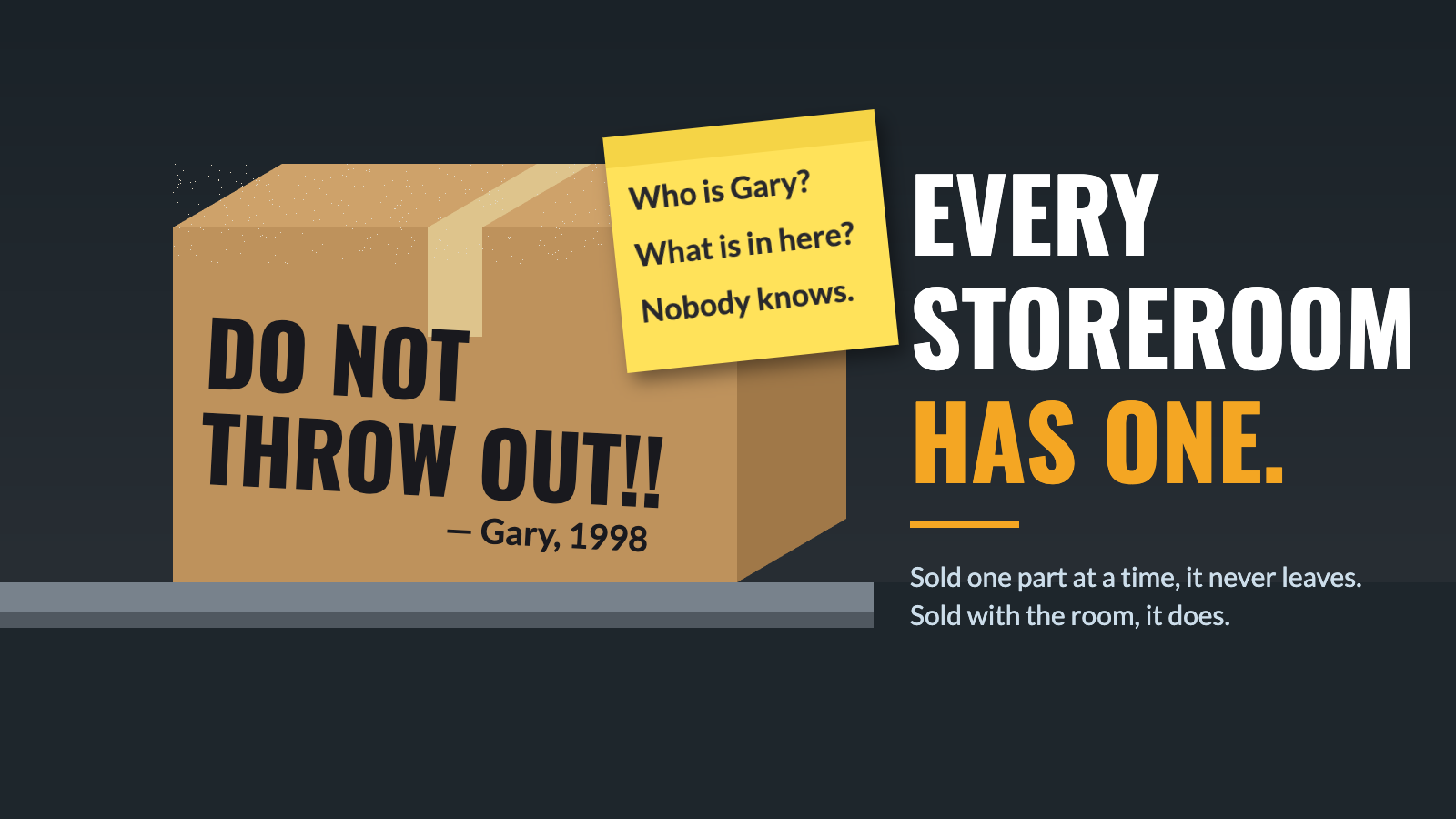
Fair question. Half of what’s back there, nobody can even name.
A lot buyer isn’t buying your top ten part numbers. He’s buying a catalog.
A storeroom that took a plant thirty years to fill holds thousands of line items across bearings, power transmission, electrical controls, PLCs and circuit boards and motors and drives. Somewhere, every one of those parts is the thing another plant is waiting on.
Most lot buyers are resellers and distributors who source for other plants. For them, a full MRO storeroom in one lot is inventory they couldn’t buy from any OEM at any price.
Then they sell those parts back to plants one at a time, which is exactly the part of the job you never wanted.
That’s the trade. You get the aisle back in one move. Her customers get parts that aren’t on anybody’s shelf anymore, shipped the same week instead of quoted at twelve.
Cherry-picking breaks that. Pull the forty recognizable items and sell them first, and what’s left is the hard-to-move remainder. Nobody bids on that, so it sits another five years.
The one-lot deal works because the buyer takes the easy parts and the orphans in the same truck. He’ll sort it on his dock. You don’t have to sort it on yours.
(We’ve walked plenty of storerooms where the “keep” pile and the “sell” pile were the same pile. It’s fine. Ship both.)
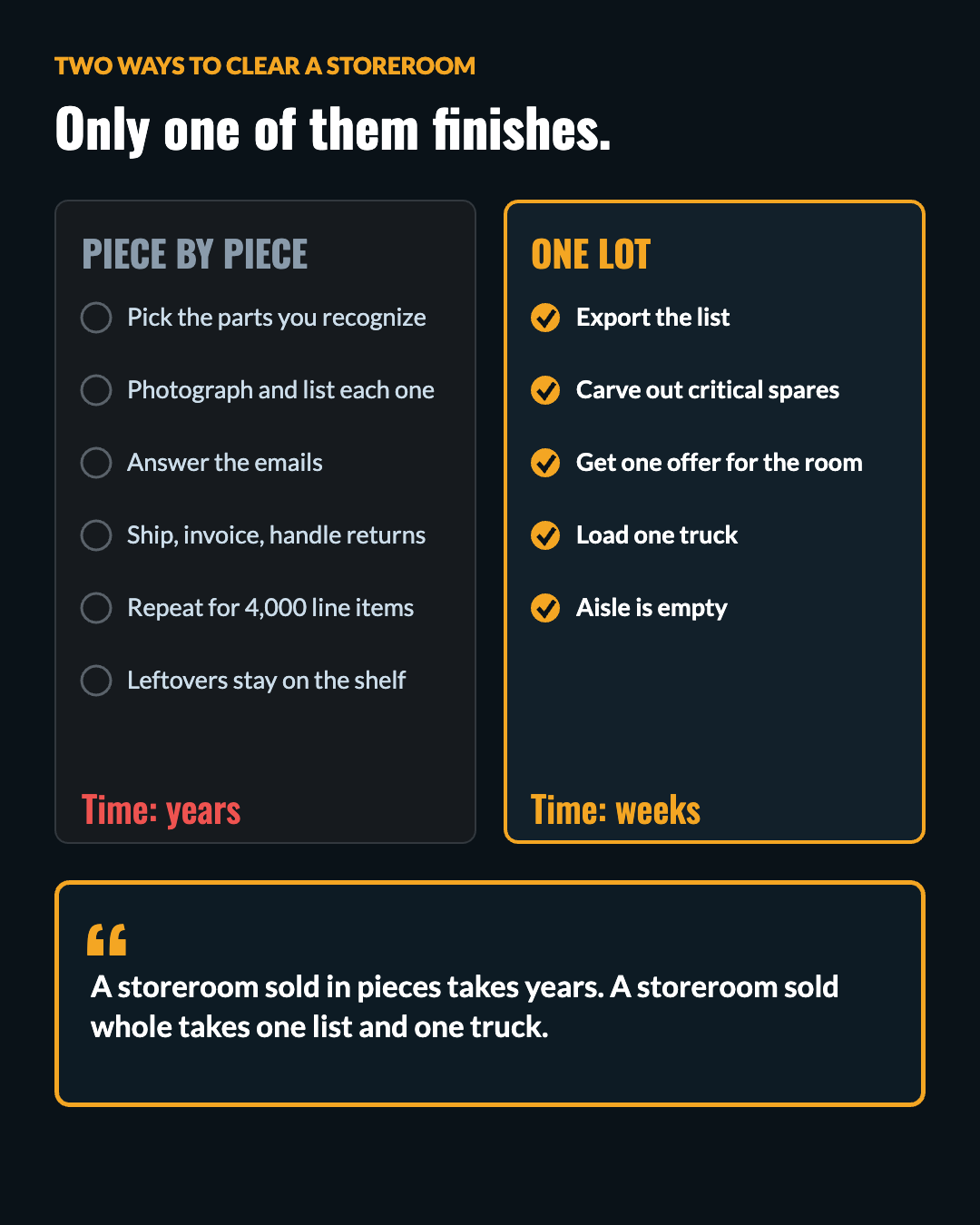
Less paperwork than you’d think. Here’s how it usually runs:
That’s it. No listings, no returns, no emails about whether a coupling still has its keyway.
Oh, and the finance team praises you up and down, you might even get a commission.
They go with the lot. That’s the point.
When you sell an MRO storeroom in one lot, the junk comes along for the ride.
Every storeroom has a back corner of things nobody can identify: a crate of seals with no labels, a motor with the nameplate painted over, a box marked “SAVE” in handwriting from 1998.
Sold one at a time, that corner never leaves, and you end up spending cash on trying to move them, with your time. Sold as part of the room, it’s the buyer’s corner now.
That’s also why lot pricing works at all. The buyer weighs the parts he can resell against the ones he can’t and prices the room, not the SKU.
Some of it will be resold. Some of it will be scrapped. Either way, it isn’t yours to count at year-end anymore.
The finance team cheers on.
Nobody invoices you for a full storeroom. (unless you keep it) That’s why it’s easy to ignore.
But the room still has costs. The square footage you’re heating. The annual count somebody has to walk. The insurance on the building it sits in. The tax line on inventory that hasn’t earned a dime since the equipment it fit was hauled away.
Keep the room another year and you’ll pay all of it again, for parts that lost another year of buyers in the meantime.
Sell an MRO storeroom in one lot and every one of those lines goes to zero on the same day. The aisle becomes floor space. The count gets shorter. The team rejoices.
For the plant, it’s cash and floor space. It’s up to the buyer to figure out how to move the slow stock.
Whether you’re closing a building, consolidating plants or just tired of walking past the same pallets, the math only gets worse the longer the room stays full.
Clearing specific platforms first? Start with PLCs and drives, then send the rest of the room.
Ready to sell industrial MRO parts? Make it easy. → Sell Your Parts



Our team can locate, cross-reference, and source all parts.
Our team can locate, cross-reference, and source all parts.