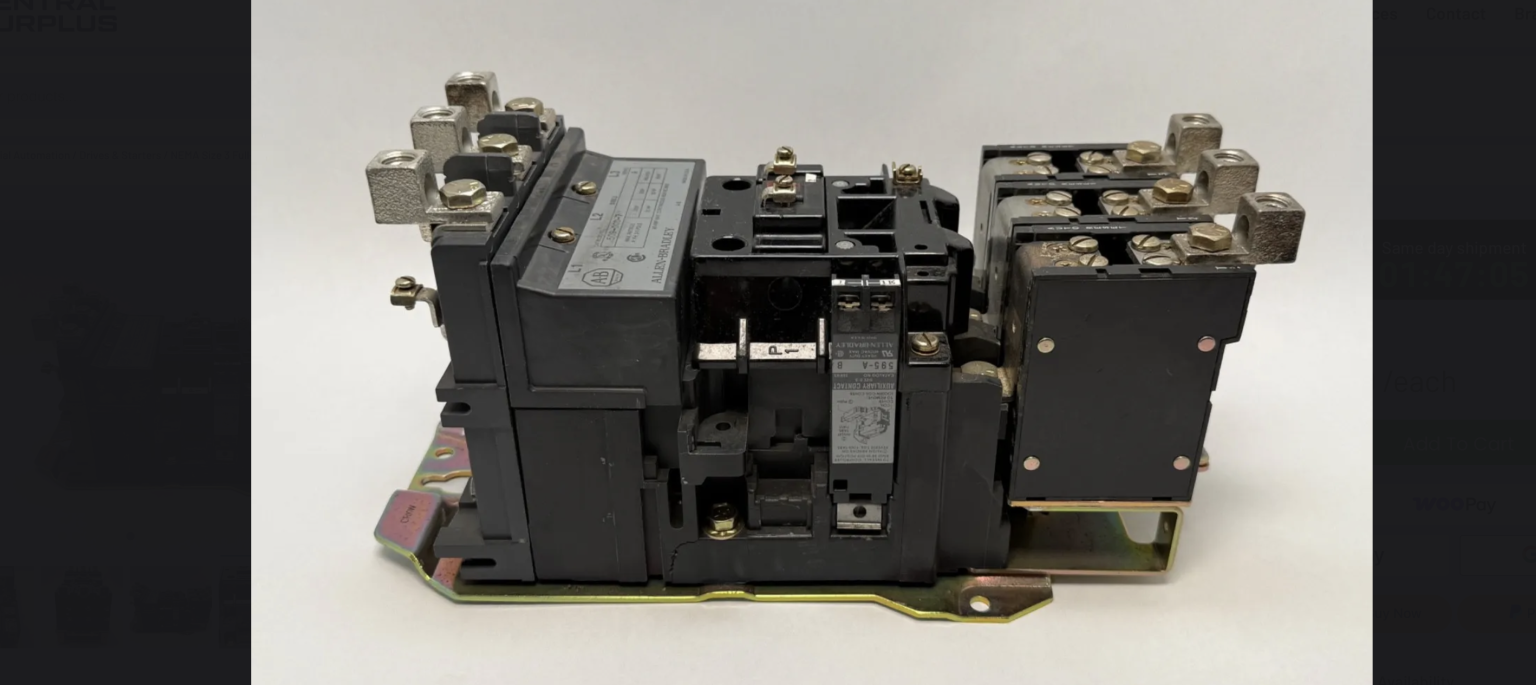
When a motor stops running, the first instinct is to find the part that looks burnt or broken and order a replacement. That’s usually the right move. The problem is when you replace the wrong part.
At Central Surplus, one of the more common sourcing calls we get goes something like this: a motor won’t start, someone pulls the starter panel, sees a burned contactor, orders a new contactor, and then the new contactor burns up too. The overload relay tripped repeatedly, and nobody knew it because they didn’t know it existed as a separate component. This post is for anyone who has ever been in that situation or wants to avoid it.
A motor starter is not a single part. It’s a combination of two components: a contactor and an overload relay. Understanding what each does and why they work together is the foundation for correctly diagnosing and replacing motor control components.
A contactor is an electrically operated switch. When the control circuit sends a voltage signal to the contactor coil, the coil generates a magnetic field that pulls a set of contacts closed, completing the power circuit to the motor. When the control signal drops, the contacts open and the motor stops.
That’s it. A contactor does not protect the motor from overload. It does not limit the starting current. It repeatedly switches power on and off on command from the control circuit.
Contactors are sized by their current rating (in amps) and their coil voltage. A 24V DC control circuit uses a 24V coil. A 120V AC circuit uses a 120V coil. Getting the coil voltage wrong means the contactor either won’t pull in or will be driven by too much voltage, both of which cause premature failure. While some modern contactors feature wide-range electronic coils that accept multiple voltages, standard legacy contactors require an exact match.
An overload relay monitors motor current and opens the control circuit if the current exceeds a set threshold for a sufficient duration. It’s the component that protects the motor from damage caused by sustained overload conditions: a jammed conveyor, a pump cavitating, a drive running at the edge of its capacity for hours.
The keyword here is sustained. An overload relay is designed to tolerate short-duration overcurrent, like motor inrush current during starting, without tripping. It’s calibrated to the motor’s full-load amperage (FLA) rating. If the motor draws significantly more than its FLA for more than a few seconds, the relay trips, opening the control circuit and dropping out the contactor.
When someone replaces a contactor without checking the overload relay, and the motor keeps failing to run, or the new contactor burns up, the overload relay is almost always the place to look. Either it’s still tripped (and needs to be reset), or it was set incorrectly for the motor’s FLA rating, or there’s an actual overload condition in the driven equipment that caused everything to fail in the first place.
A motor starter is a contactor and an overload relay assembled as a unit. The contactor handles switching. The overload relay handles protection. Together, they form the standard motor control assembly used in industrial panels, machine tools, conveyor systems, and pump controls worldwide.
Some starters are sold as combined units. Others are assembled from separately purchased contactors and relay blocks. Either way, the function is the same: controlled starting and running of an AC motor with thermal overload protection.
| Component | What It Does and What It Doesn’t |
| Contactor | Switches motor power on and off. Does NOT protect the motor from overload. |
| Overload Relay | Monitors current and trips if sustained overload is detected. Does NOT switch motor power directly. |
| Motor Starter | Contactor + overload relay as a unit. Handles both switching and protection. |
The contactor coil sits in the control circuit, not the power circuit. The control circuit typically runs at a lower voltage (24V DC, 120V AC, or 240V AC, depending on the panel design) and carries very little current. The power circuit carries the full motor current.
The overload relay’s contacts are also in the control circuit. When the relay trips, it opens a contact in series with the contactor coil. With the coil de-energized, the main contacts open, and the motor stops.
This is why replacing only the contactor sometimes doesn’t solve the problem. If the overload relay’s control-circuit contact is open because the relay tripped, the contactor coil never sees the control voltage, and the motor never starts, regardless of whether the contactor itself is good.
| Diagnostic sequence when a motor won’t start 1. Check for control voltage at the contactor coil terminals. If no voltage, the control circuit is open. 2. Check the overload relay: is it tripped? Most thermal overload relays have a visible indicator and a manual reset button. 3. If the relay is tripped, identify why before resetting it. Check the motor’s actual running current against the FLA on the nameplate. 4. If the relay resets and the motor runs but trips again, look at the driven equipment for an overload condition, not the electrical components. |
Contactors are rated by continuous current capacity and the type of load they’re designed to switch. The most common rating system for AC motor applications is the IEC utilization categories:
| IEC Category | Application |
| AC-1 | Non-inductive loads. Resistive heating, incandescent lighting. |
| AC-2 | Slip-ring motors. Starting and switching while running. |
| AC-3 | Squirrel-cage motors. Starting and switching off while running. Most common industrial motor application. |
| AC-4 | Squirrel-cage motors. Plugging, inching, jogging. Higher switching duty than AC-3. |
For standard AC induction motors starting across the line, AC-3 is the correct rating. A contactor rated AC-3 at a given current has been tested for the repeated starting duty imposed by motor loads. An AC-1 contactor of the same current rating is not rated for the inrush conditions of motor starting and will fail prematurely.
When replacing a contactor, match the current rating, coil voltage, and utilization category. If the original part number is available, contact Central Surplus for exact replacement or cross-reference sourcing.
Overload relays are set to match the motor’s full-load amperage, as listed on the motor nameplate. Most thermal overload relays have an adjustment dial that lets you set the trip current within a range, for example, 4 to 6 amps or 9 to 13 amps.
The relay must be set to the motor’s FLA, not the circuit breaker or fuse rating. The circuit breaker protects the wiring. The overload relay protects the motor. They’re calibrated for different purposes.
Electronic overload relays, which are increasingly common in newer panels, allow more precise trip settings and sometimes include phase loss detection, current display, and remote reset capability. The selection principle is the same: match the current range to the motor’s FLA.
| Symptom | Likely Cause | What to Check |
| Contactor chatters or hums | Low control voltage or worn contacts | Measure the control voltage at the coil. Inspect contact surfaces. |
| Contactor pulls in, but motor won’t run | Open the overload relay contact | Check if the overload relay is tripped. Reset and investigate the cause. |
| Overload relay trips repeatedly | The motor is actually overloaded, or the relay is set too low | Check motor running current vs. FLA. Verify relay setting. |
| Contactor contacts weld closed | Excessive inrush current or wrong AC rating | Check utilization category. Look for starting conditions that exceed the contractor rating. |
| Motor runs but trips after warm-up | The thermal relay heats as the motor load increases | Measure current at full operating temperature. Check load on driven equipment. |
No. A contactor alone has no overload protection. Running a motor on a contactor without an overload relay is code-noncompliant in most jurisdictions and will eventually damage the motor.
Not necessarily. If one component fails and the other tests well, you can replace only the failed component. The exception is when the failure event was severe enough (a fault current, for example) that both components may have suffered internal damage even if one appears intact. When in doubt, replace both.
A thermal overload relay uses a bimetal strip that bends as it heats from passing current, eventually tripping a contact when the trip threshold is reached. It’s simple, proven, and immune to electrical noise. An electronic overload relay uses current transformers and a microprocessor to directly monitor current. It’s more precise, offers adjustable trip class, and often adds diagnostic features. Both protect the motor. Electronic relays are easier to set precisely and more flexible.
The trip class defines how long the relay waits before tripping under overload conditions. Class 10 trips in 10 seconds or less at 600% of the set current. Class 20 trips in 20 seconds or less. Motors with high-inertia loads that take longer to accelerate require a higher trip class to avoid nuisance tripping during startup.
Central Surplus stocks contactors, overload relays, and motor starters from Allen-Bradley, Siemens, Schneider, Eaton & ABB, and other major manufacturers. Search our drives and starters inventory or contact our team with your part number or application details for sourcing support.

Our team can locate, cross-reference, and source all parts.
Our team can locate, cross-reference, and source all parts.