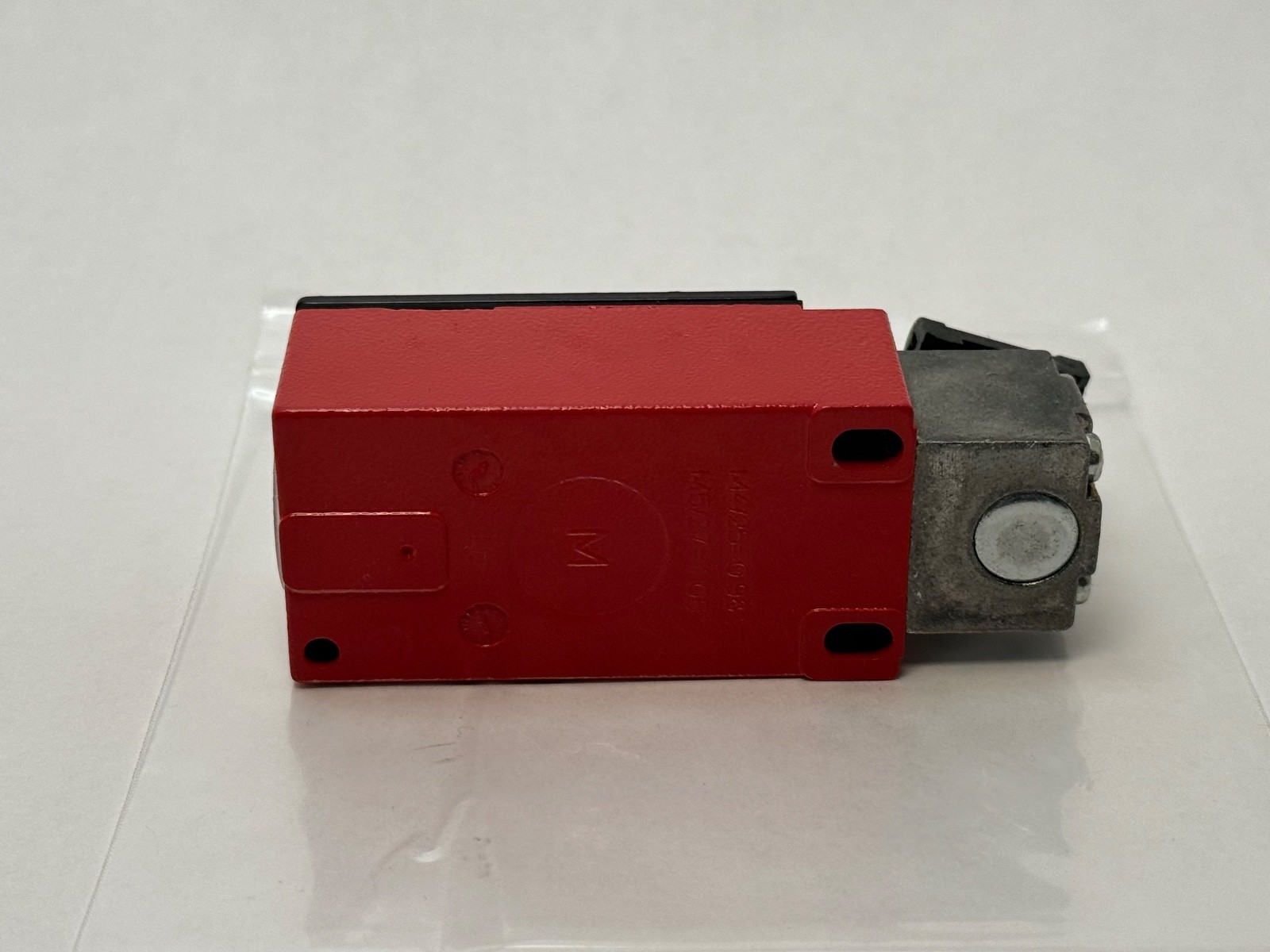
Product Description
What this part is
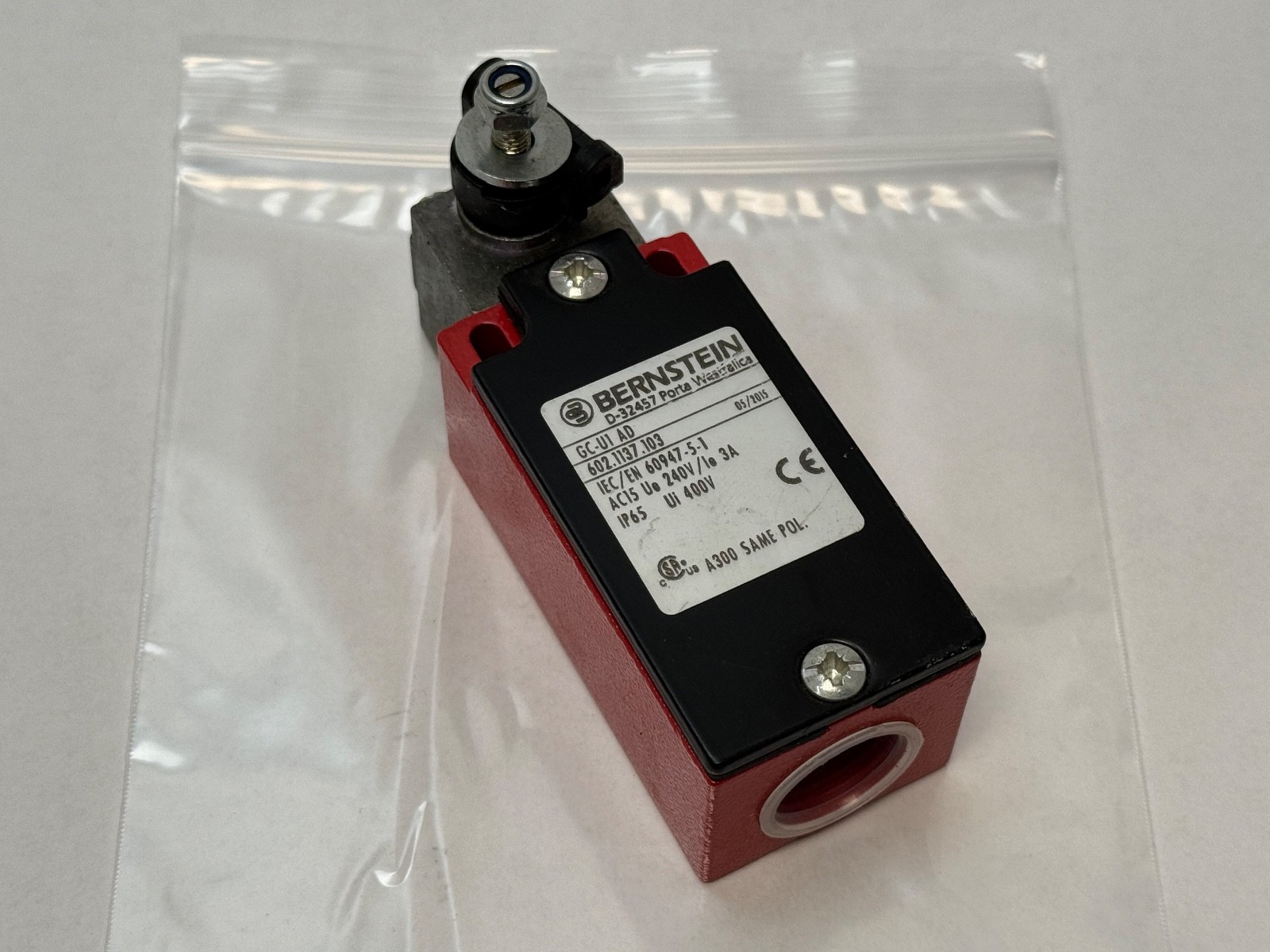
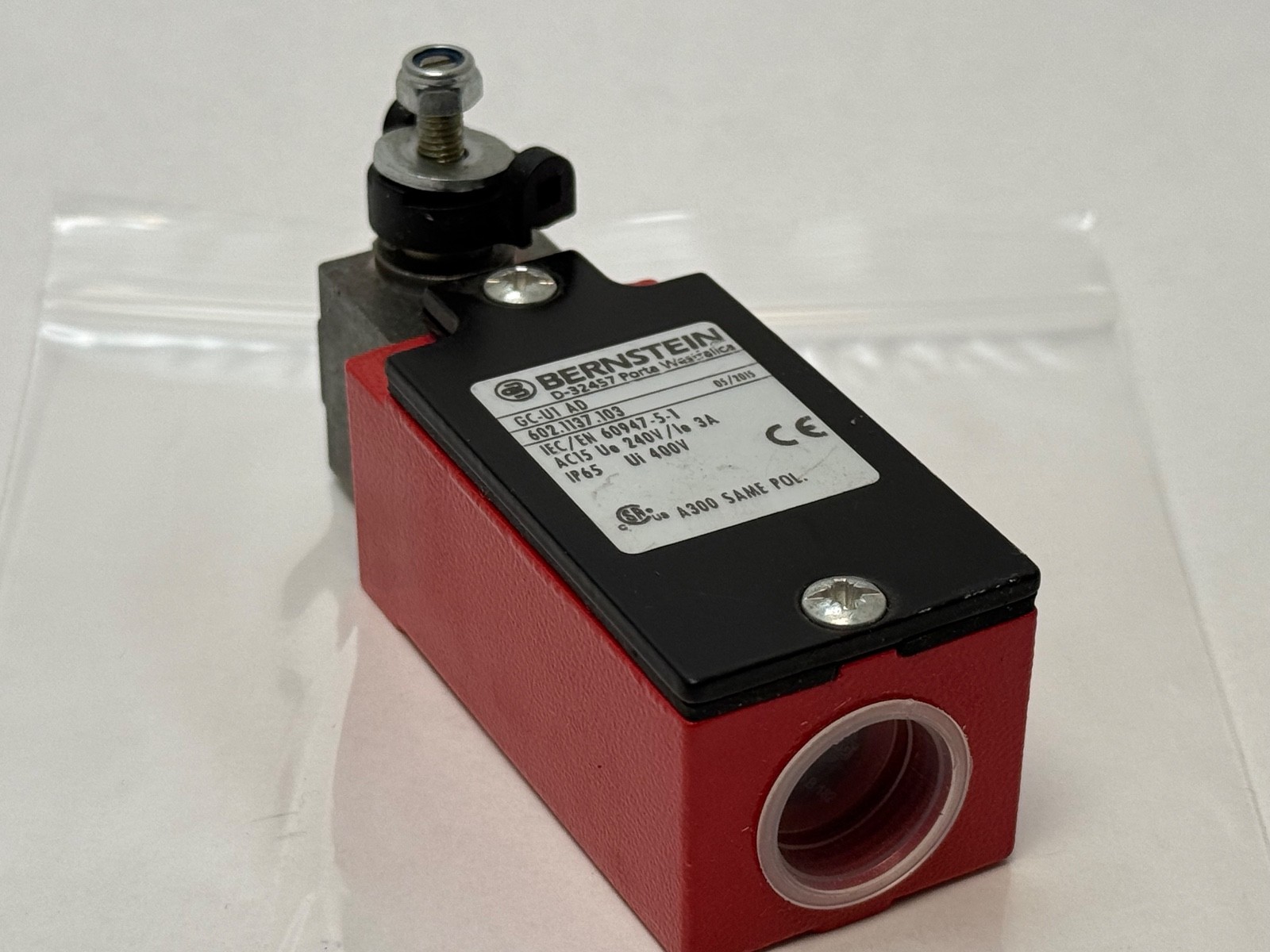
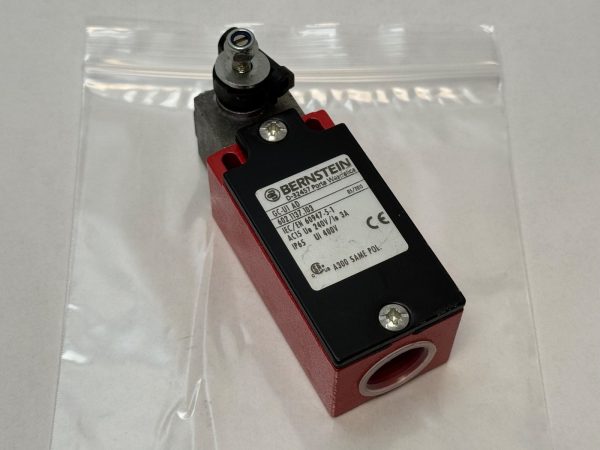
This is a Bernstein GC series metal-bodied limit switch with a rod actuator — a robust mechanical position switch for machine guarding, end-of-travel limits and position monitoring. The switch body is die-cast aluminium with a sheet aluminium cover, the turret head carries a steel rod that is deflected by the moving machine element, and inside are one normally closed and one normally open contact.
Decoding the type designation
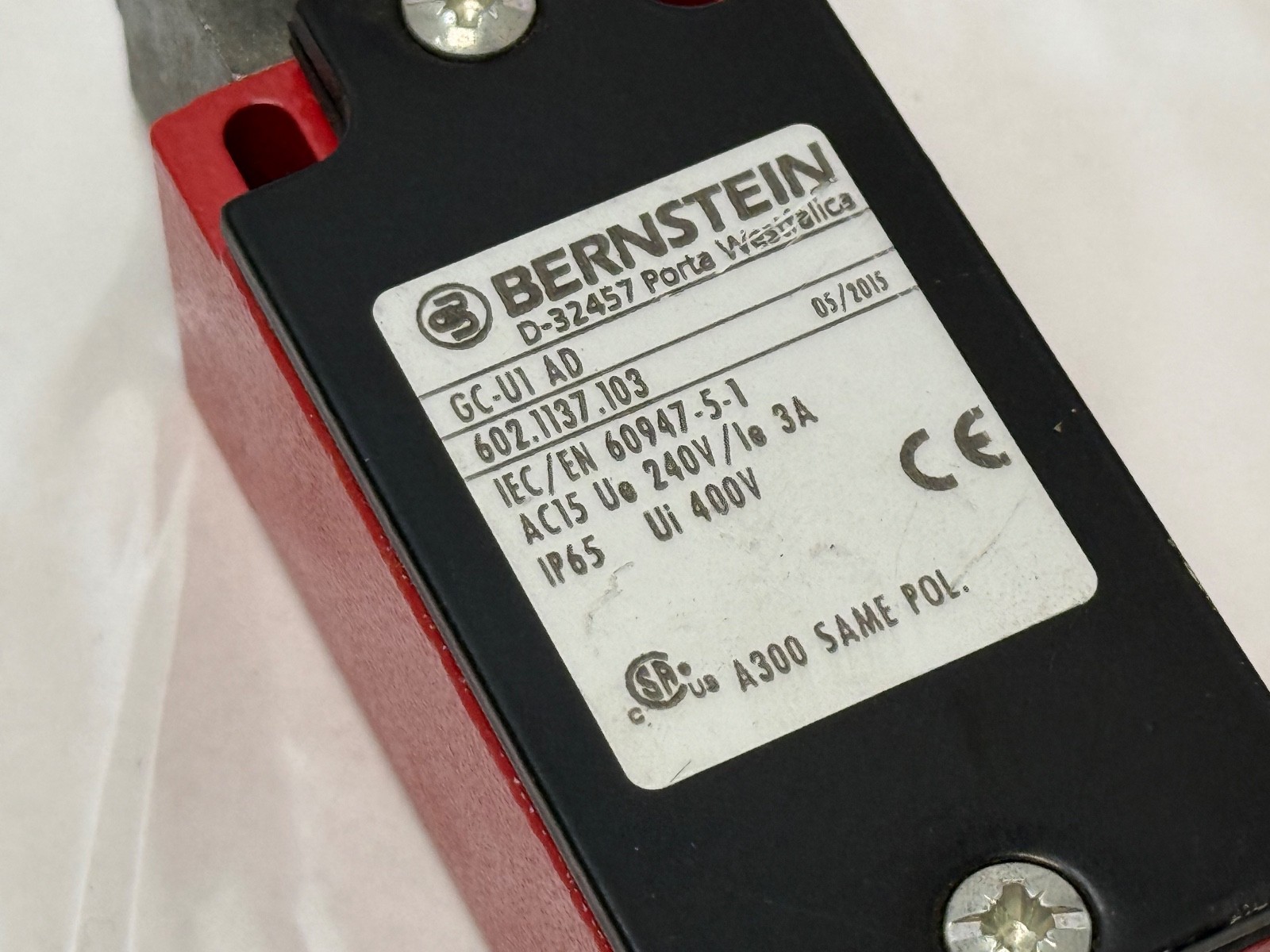
GC: Bernstein’s metal-enclosed limit switch series, die-cast aluminium body.
U1: slow-action contact block with one NC and one NO contact. This is the letter to watch. The parallel SU1 designation (GC-SU1 AD, article 6021187125) is the snap-action version. Same body, same actuator, different switching behaviour.
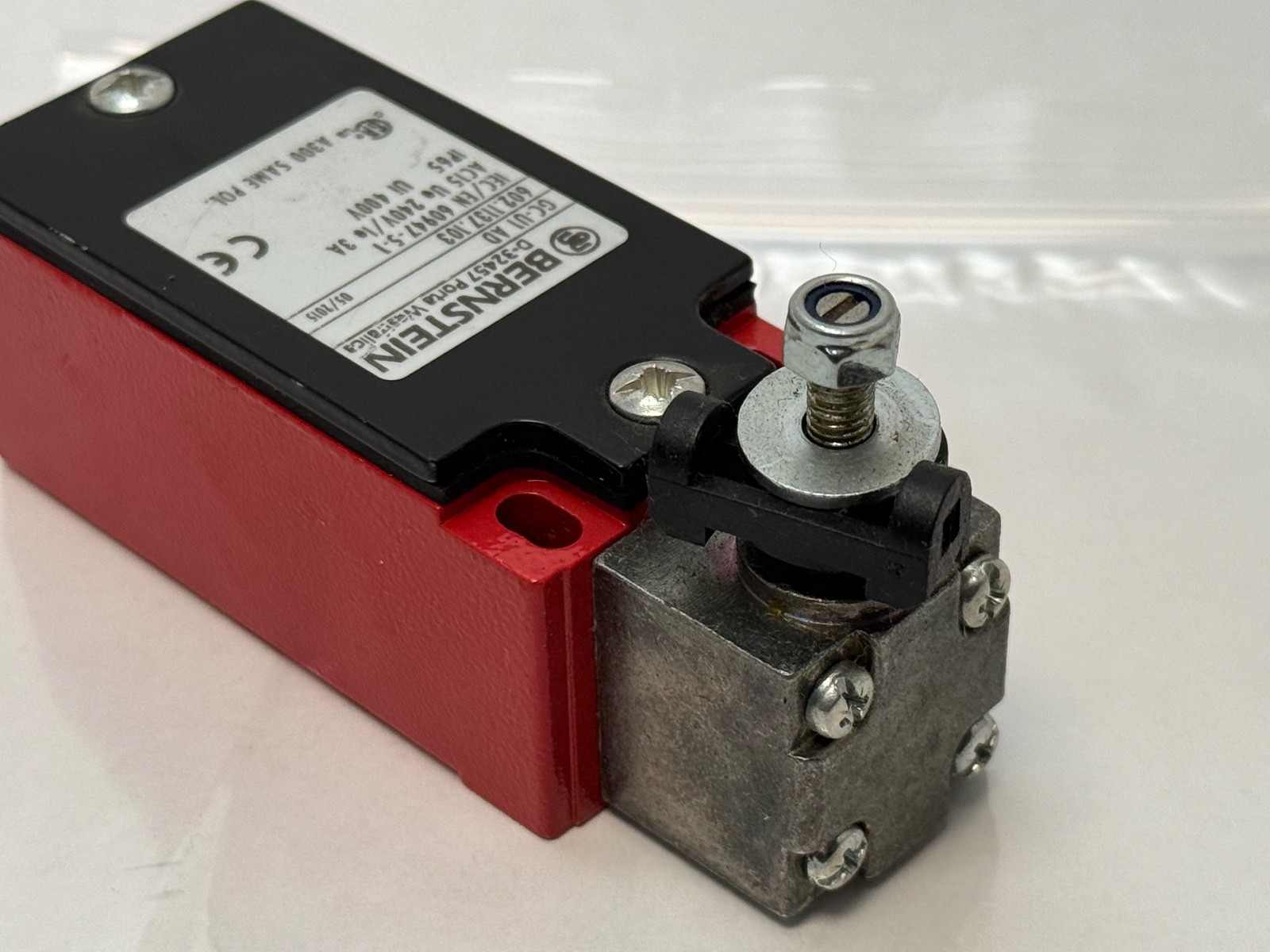
AD: rod actuator on a turret head, Zn die-cast head with a steel rod. The neighbouring actuator codes on the same body are AV, AH (adjustable lever), AF, FF, IW, RIW, HIW, KU and W, all separate article numbers.
Article number: written both as 602.1137.103 and 6021137103. Bernstein uses the dotted form in catalogues and the undotted form in its own PIM system, and both are worth searching.
Slow-action versus snap-action
This unit is the slow-action variant, and it is a deliberate engineering choice rather than a lesser option.
In a slow-action switch the contacts move at a speed proportional to the actuator movement. The changeover point is highly repeatable and directly related to actuator position, which is what you want when the switch is defining a precise mechanical position. Slow-action is also the conventional choice where the NC contact must be forced open by direct mechanical action, since there is no spring-over mechanism between the actuator and the contact bridge to interpose a failure mode.
In a snap-action switch (the GC-SU1 AD) an over-centre spring flips the contacts quickly regardless of how slowly the actuator moves. That gives cleaner make-and-break on higher currents and less contact bounce at very low actuation speeds, at the cost of a less position-exact switching point and some differential travel.
The rule of thumb: if the switch is defining a position, slow-action; if it is switching a meaningful load and the actuator may creep, snap-action. They share the same body and actuator and are separate parts.
Positively opening NC contact
The NC contact in this switch is a positively opening (direct opening action) contact, and in Bernstein’s circuit diagrams these carry the standard direct-opening symbol. That means the actuator forces the NC contact open through a rigid mechanical link, so the contact cannot remain welded shut while the actuator is depressed. It is the property that makes a mechanical position switch usable in a safety-related circuit, and it is the reason a switch like this is specified for guard monitoring rather than a plain microswitch.
The contact configuration is Bernstein type Zb: a galvanically isolated changeover contact. The two contacts are electrically separate from each other, so the NC and NO can sit in different circuits at different potentials, typically the NC in the safety chain and the NO signalling to the PLC.
Published specifications
Enclosure: die-cast aluminium.
Cover: sheet aluminium.
Actuator: turret head (Zn die-cast) with AD rod (steel).
Actuator head: repositionable by 4 x 90°.
Contact type: 1 NC, 1 NO, type Zb (galvanically isolated changeover), slow-action.
NC contact: positively opening.
Ambient air temperature: −30 °C to +80 °C.
Mechanical life: 10 x 10^6 operating cycles.
Switching frequency: up to 100 per minute.
Mounting: 2 x M4.
Connection: 4 screw terminals (M3.5).
Terminal designation: to DIN EN 50013.
Conductor cross-sections: solid 0.5 to 1.5 mm², or stranded with ferrules 0.5 to 1.5 mm².
Cable entry: 1 x M20 x 1.5.
Weight: approximately 0.22 kg.
Installation position: operator definable.
Protection: IP65 to IEC/EN 60529.
What these specs mean in practice
Ten million operating cycles at up to 100 per minute is a genuine industrial duty rating — run at one operation per second continuously, that is years of service. This is a switch for a production machine, not for occasional actuation.
The die-cast aluminium body and IP65 rating are why a GC is specified over a plastic-bodied switch: it survives being knocked, it tolerates coolant and washdown spray, and it will not crack if the machine element overtravels into it. The metal actuator suits high mechanical loads.
The turret head repositioning by four 90° steps is a practical installation feature. The switch body can be mounted where the bracket allows and the head then rotated so the rod faces the moving element, instead of fabricating an adaptor plate. The chosen orientation determines the direction of actuation.
−30 °C to +80 °C covers unheated buildings, cold stores and hot areas near ovens or drives.
M20 x 1.5 is the single cable entry, and the terminals accept 0.5 to 1.5 mm² — adequate for control wiring, not for power. Terminal designations follow DIN EN 50013, so the numbering matches a standard European wiring diagram.
Quantity and configuration
Switch only, as pictured, sold individually. The M20 x 1.5 cable gland, cable, M4 mounting screws, brackets or mounting plates, ferrules, and any actuating cam, ramp or striker on the machine side are each separate items. This is the standard non-latching build; Bernstein offers a latching function on this series on request as a separately ordered variant.
Interchange guidance
Search forms include GC-U1 AD, GCU1AD, 602.1137.103, 6021137103 and 602-1137-103. Within the GC series treat these as related models, not equivalents. GC-SU1 AD (6021187125) is the snap-action version of this exact switch. GC-U1 AV (6021136104), GC-U1 AH (602.1135.102), GC-U1 AF (602.1139.106) and GC-U1 FF (602.1140.476) are the same slow-action body with different actuators. GC-U1Z and GC-A2Z / GC-E2 variants have different contact arrangements including 2 NC, 2 NO and overlapping contacts. All will bolt to the same 2 x M4 pattern and then behave differently, which is exactly the substitution to avoid. Bernstein is a German manufacturer and the GC series remains a current catalogue range with published datasheets, so a like-for-like new switch is available.




 store
store