
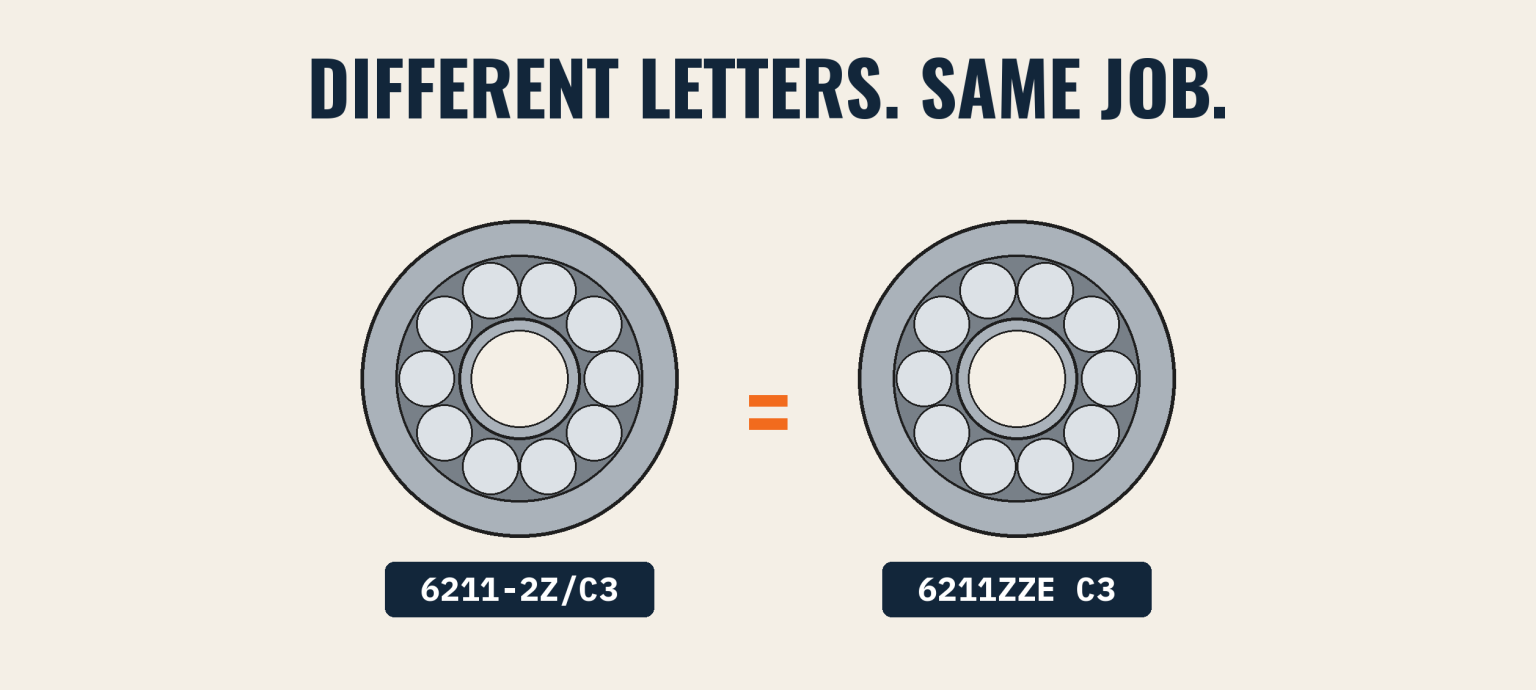
“Bearing cross reference” is one of the phrases people search most when a part number stops making sense. It’s also one of the most misunderstood. A bearing cross reference chart will happily tell you an SKF 6211 equals an NSK 6211. What it won’t tell you is whether the one you’re about to order has the same seals, the same clearance and the same cage as the one coming out of the machine.
Here’s how to read a cross reference properly, with real pairs from our own shelf. (If your number is gone altogether, start with how to replace a discontinued bearing.)
A cross reference chart matches the basic number: the series and bore code that define the outside envelope. For standard metric bearings, that envelope is the same no matter who made it. A 6211 deep groove ball bearing is 55 x 100 x 21 mm from every major brand.
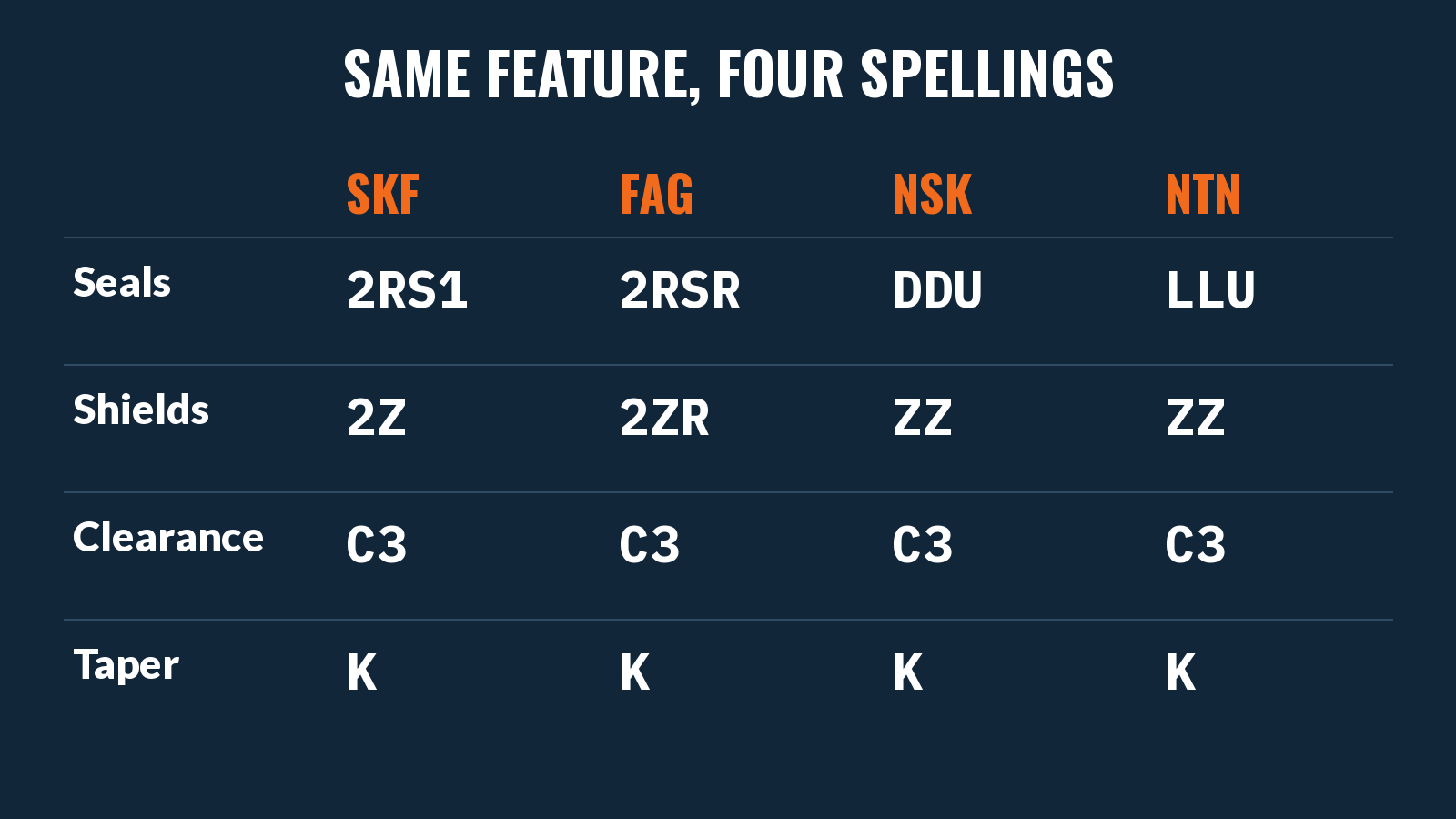
That’s the easy half. The hard half is everything after the basic number: the suffix. Each manufacturer writes the same features with different letters, and that’s where a bearing interchange goes right or wrong.
Common equivalents across four major brands. Always confirm against the manufacturer’s catalog for critical applications, because designs change and some features don’t map one-to-one.
| Feature | SKF | FAG / Schaeffler | NSK | NTN |
|---|---|---|---|---|
| Two contact seals | 2RS1 / 2RSH | 2RSR | DDU | LLU |
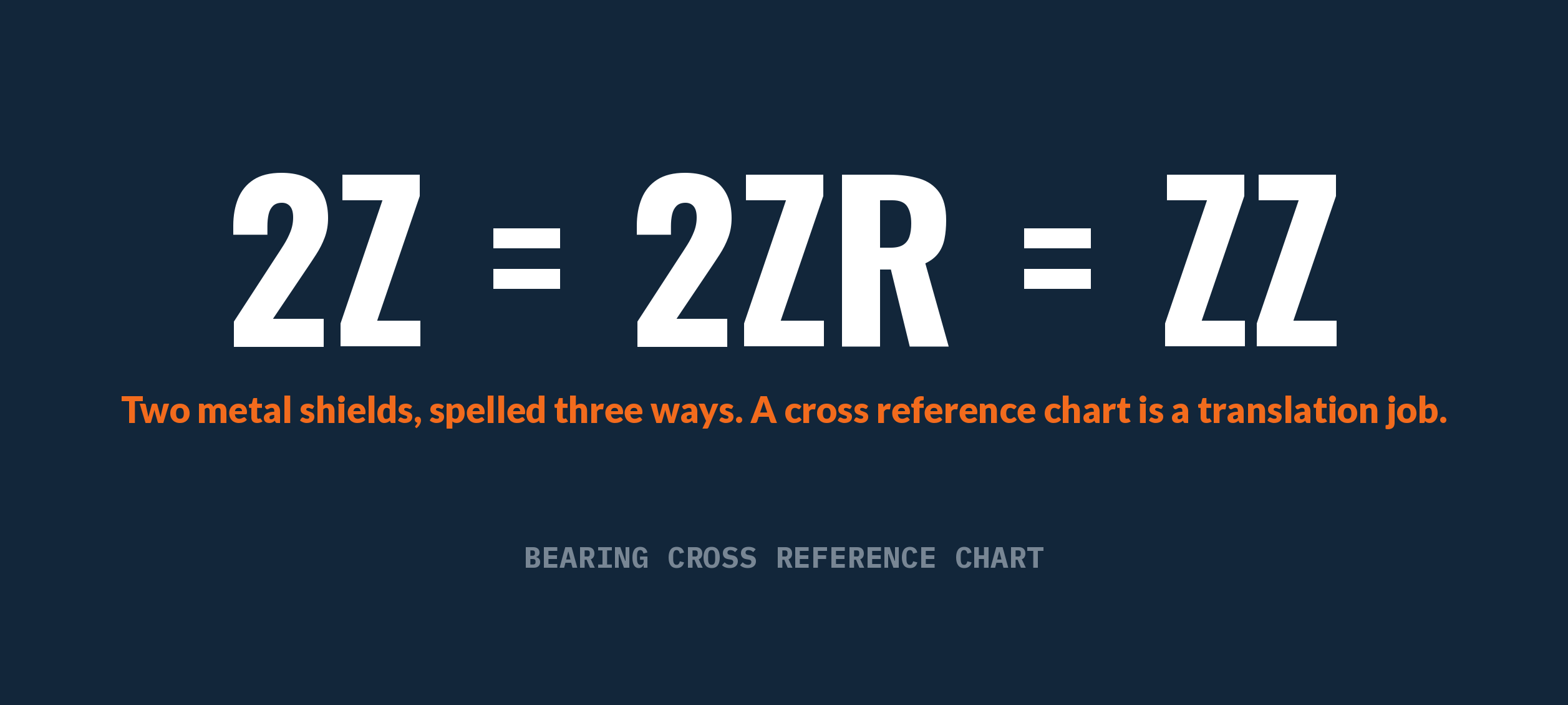
| Two metal shields | 2Z | 2ZR | ZZ | ZZ |
| Greater-than-normal clearance | C3 | C3 | C3 | C3 |
| Tapered bore (1:12) | K | K | K | K |
| Spherical roller lube groove and holes | W33 | standard on E1 designs | E4 | D1 |
Read a number with that table in mind and the code starts talking. SKF 6211-2Z/C3 and Nachi 6211ZZE C3 are both 55 mm bore deep groove ball bearings with two shields and C3 clearance. Different letters, same job. Both are on our shelf right now.
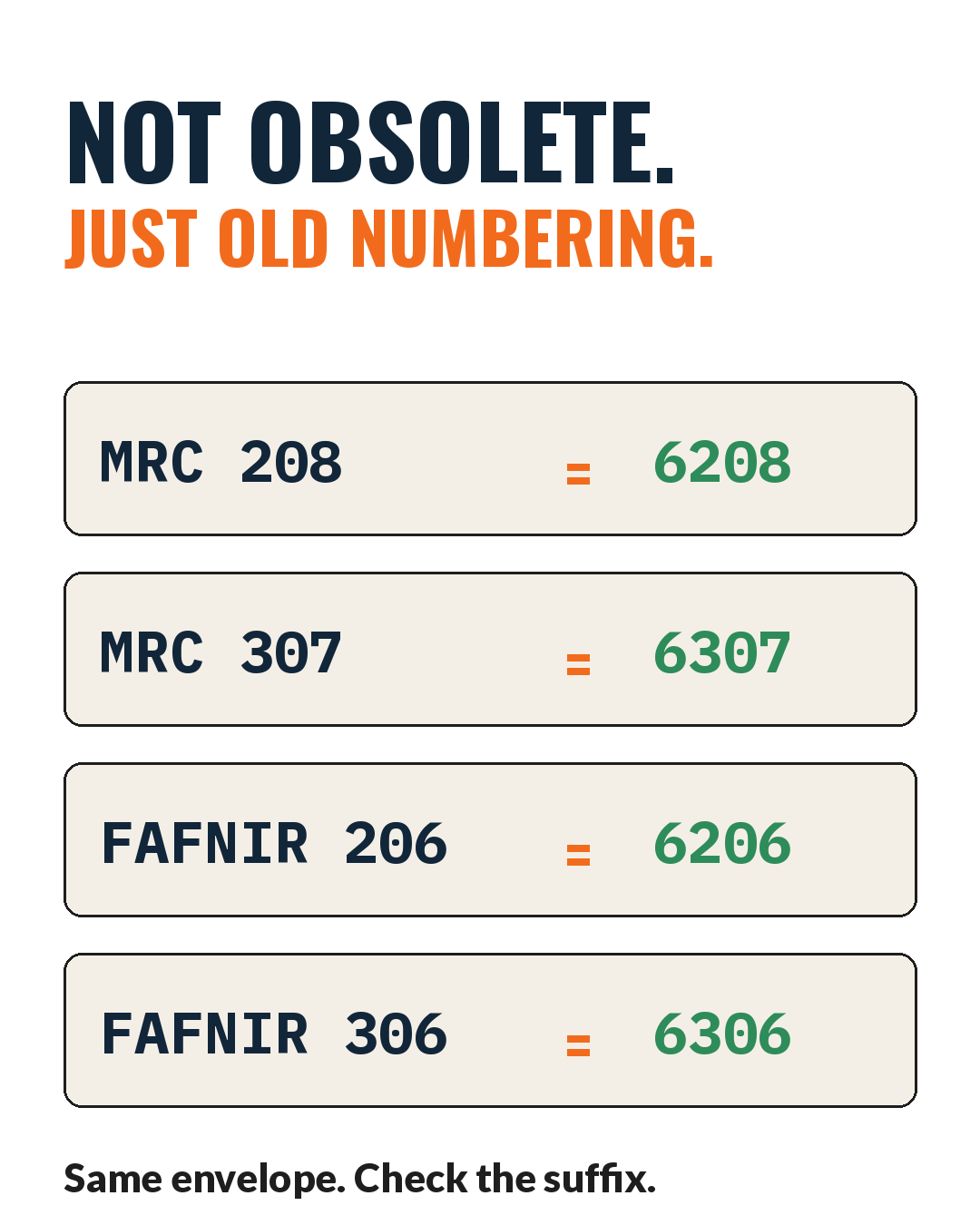
Older American brands didn’t always use the 6000-series system, and a basic bearing cross reference chart will often miss them:
If the number in your hand has three digits where you expected four, check the size before you assume it’s obsolete. Our bearing size chart lists the standard dimensions for the common series.
Tapered roller bearings deserve their own warning. Many are inch-dimensioned and sold as two parts: the cone (inner ring with rollers) and the cup (outer ring). The numbers are separate, like Timken 387/382B, where 387 is the cone and 382B is a flanged cup. A cross reference has to match both halves, and the cup’s flange or width can differ even when the cone is identical.
Metric tapered bearings, like a FAG 32222-A, follow ISO numbering and cross over cleanly between brands. Inch sets follow industry numbering that most major brands share, but always check the cup.
Search for a bearing interchange online and you’ll sometimes find two charts giving different answers. Usually it’s one of three things: one chart is matching only the basic number and ignoring the suffix; one is out of date after a brand changed its design code; or one is a distributor’s chart quietly steering you toward the brand it sells. When charts disagree, go back to the caliper and the manufacturer’s own catalog. The bearing in your hand is the only source that can’t be wrong about its own size.
Do those three and a bearing cross reference chart becomes a shopping list, not a guess.
We carry more than 50,000 bearings from SKF, FAG, NSK, NTN, Timken, MRC, Fafnir, Nachi, RHP and others, so the equivalent you need is often already here. One example: RHP 22309 EMW33 C3, a 45 mm bore spherical roller bearing with the lube groove and C3. Every listing shows the actual unit and its condition.
The size is the same. The seals, clearance, cage and precision depend on the suffix, so translate those before you swap.
SKF and the other makers publish designation guides in their catalogs. Use them to translate suffixes, and use a caliper to confirm the size.
2RS-style suffixes mean two rubber contact seals; ZZ-style suffixes mean two metal shields.
Know the size, need the part? Make it easy. → Shop Bearings


Our team can locate, cross-reference, and source all parts.
Our team can locate, cross-reference, and source all parts.