Product Description
What this part is
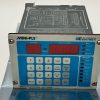
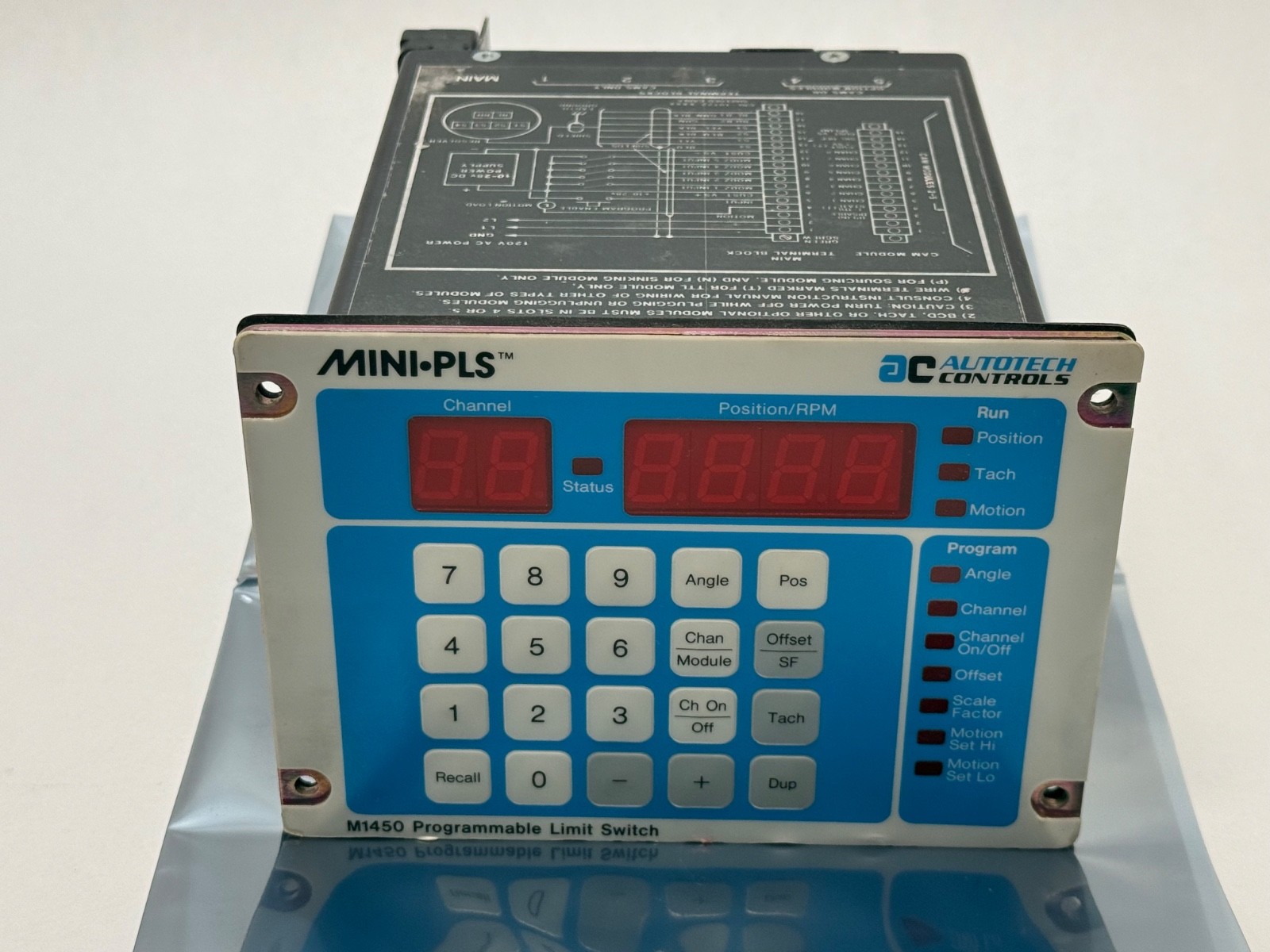
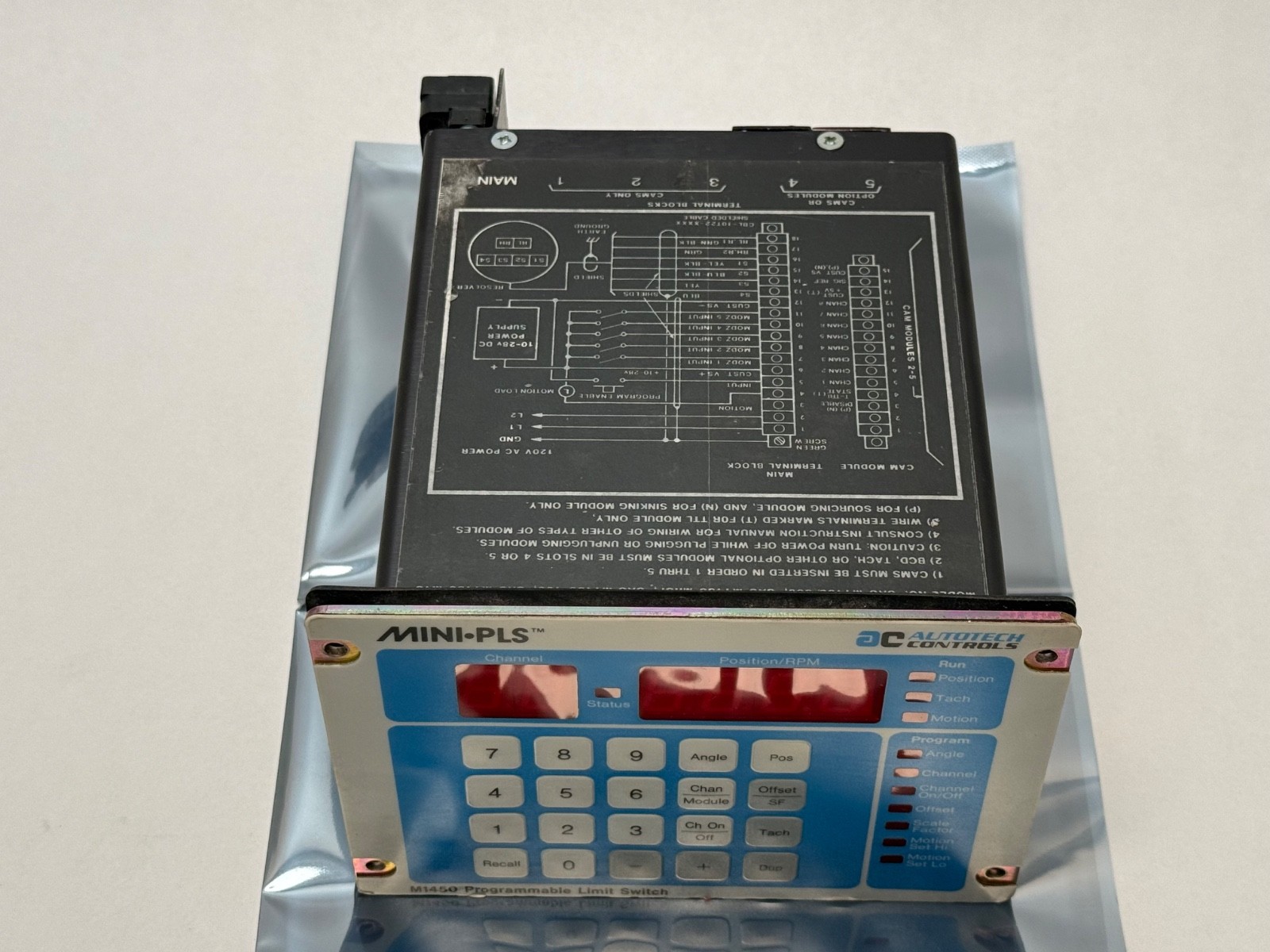
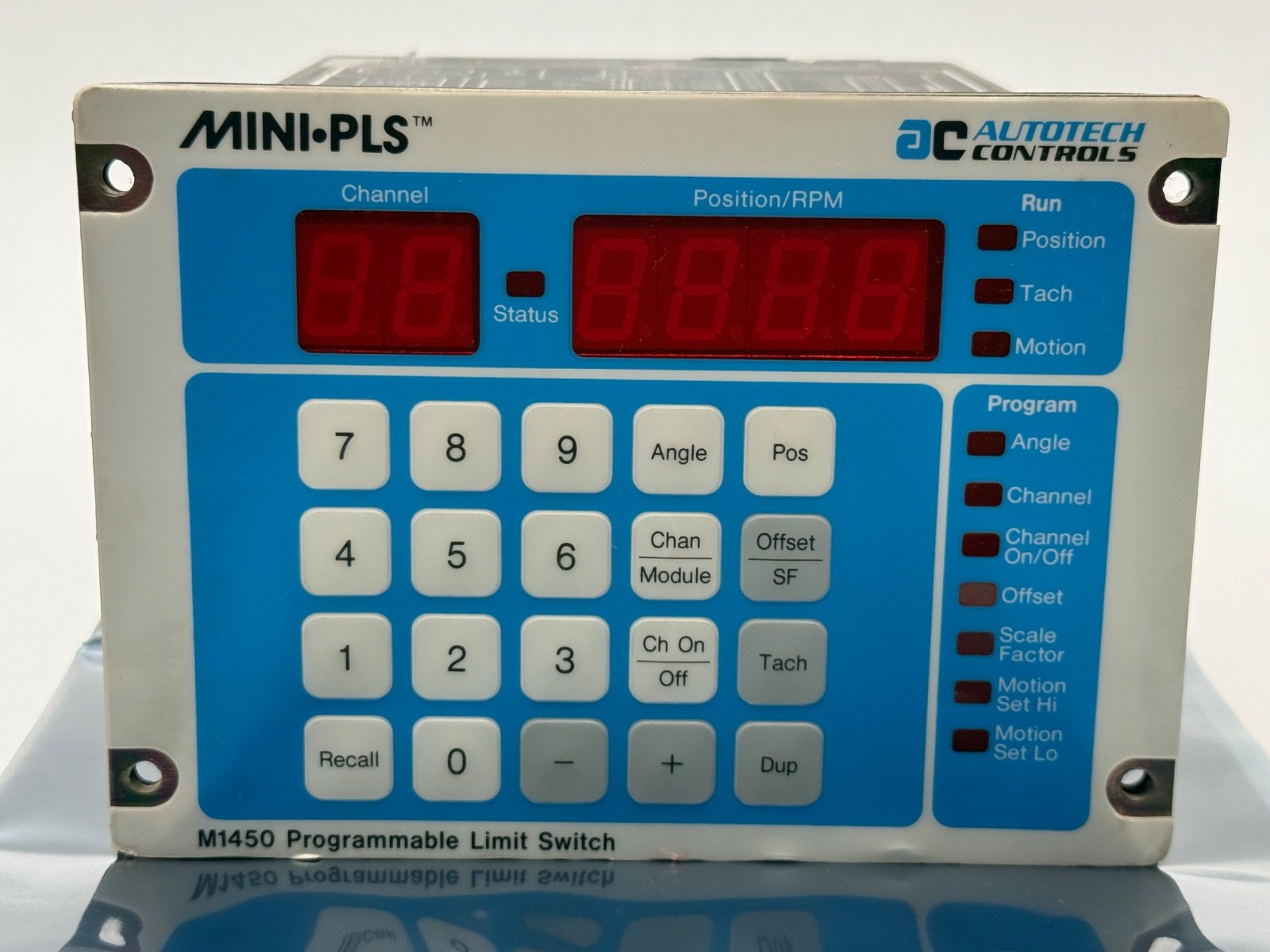
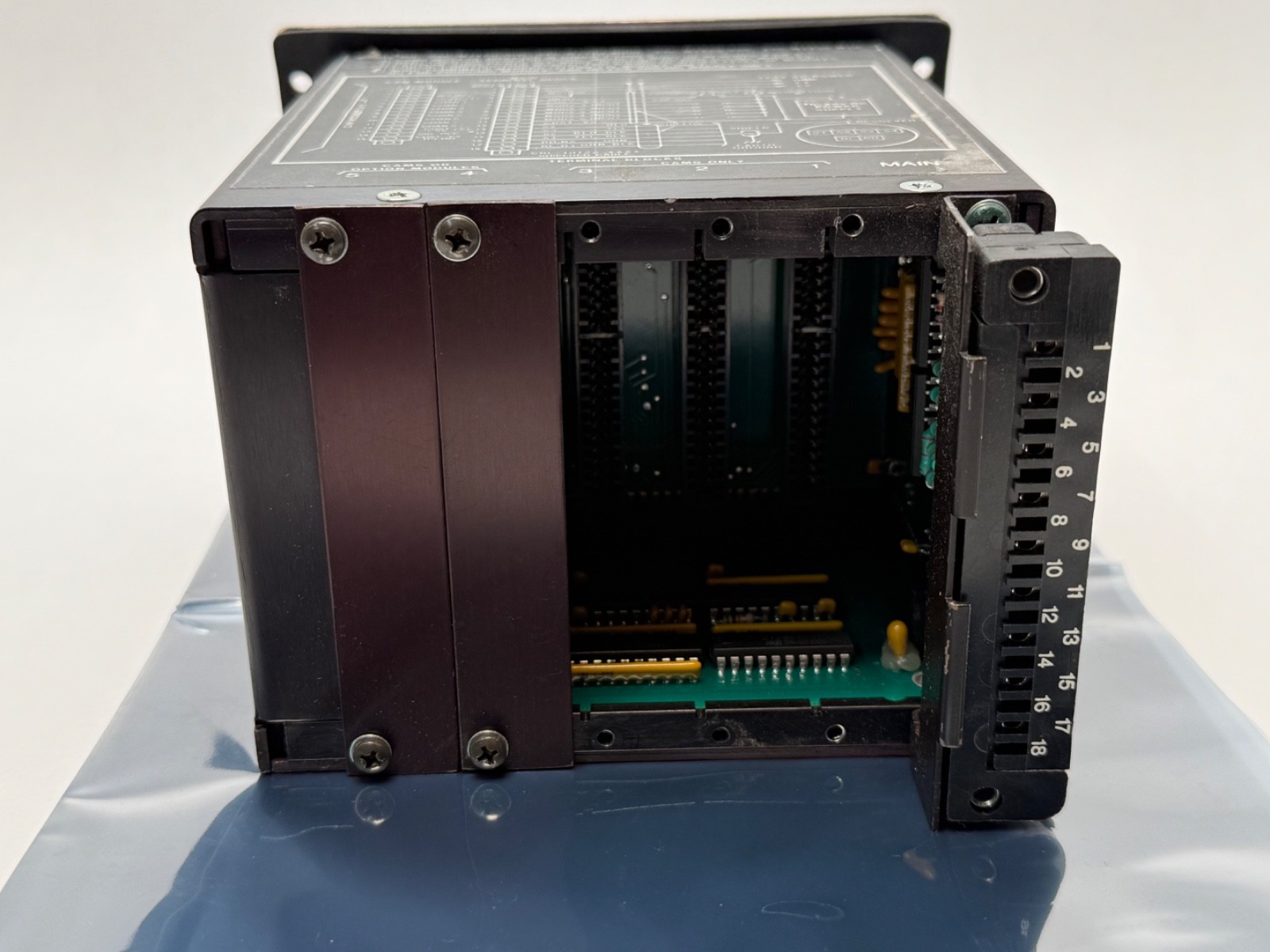
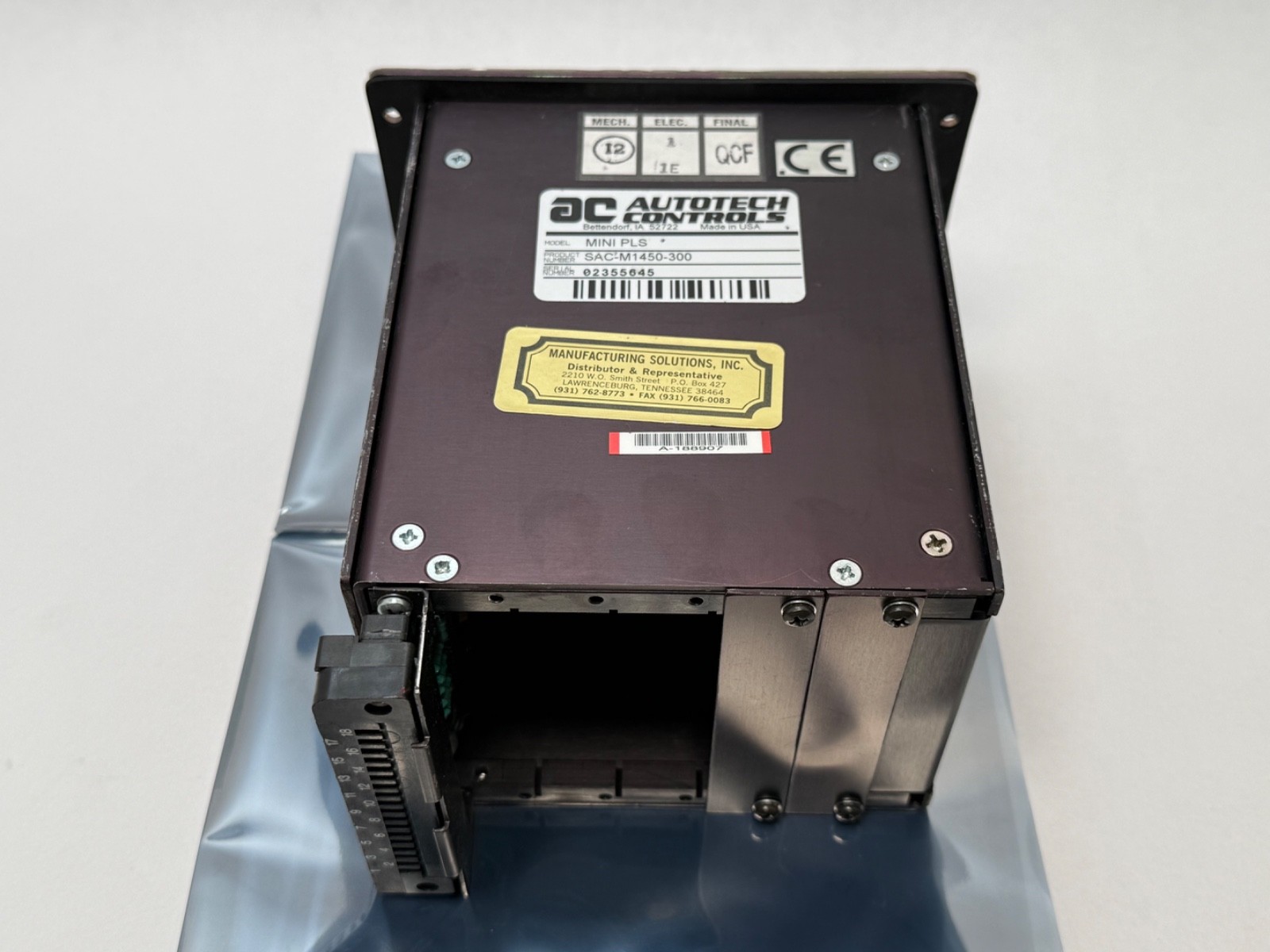
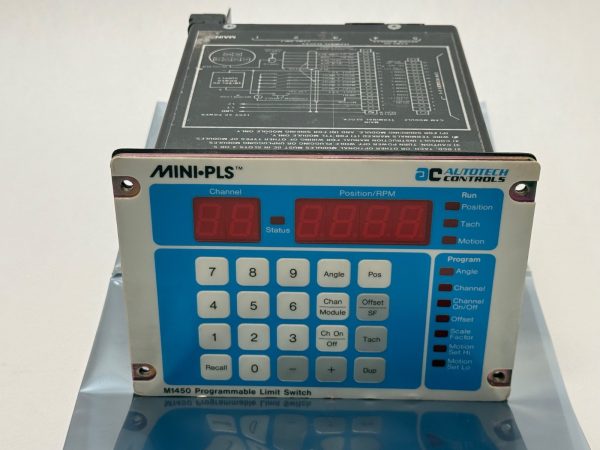
An Autotech Controls MINI·PLS front-panel programmable limit switch, catalogue number SAC-M1450-300. A PLS is the solid-state replacement for a mechanical cam-and-limit-switch drum: instead of cutting steel cams, you type setpoints. It is three instruments in one box — programmable limit switch, tachometer and motion detector.
The system is inherently two-part. A brushless resolver mounts on the machine and produces an absolute rotary position signal; this programmable unit mounts in the control panel, converts that signal to digital, displays it, and compares it against the dwell setpoints you have programmed. When the cycle crosses a setpoint the corresponding output turns on or off.
Part number decode: SAC-M1450-300:
SAC- — Autotech’s prefix for the front-panel-mounting programmable unit supplied on its own.M1450 — the MINI·PLS M1450 platform (successor generation to the M1250, sibling to the M1451).-300 — the specific model: 3-digit display, single-turn rotary, with ModZ dynamic zeroing and speed compensation (rate offset), and — uniquely within the M1450 family — optional serial communication.Autotech’s own selection table sets the -300 apart from its siblings, and the differences decide fit:
M1450-300 (this unit): 3-digit, 17–1000 counts per turn, scale factor 16–999, no decimal point, RS-232C or RS-422A serial communication available — on the -300 only.M1450-400: 4-digit, 10–4096 counts per turn, scale factor 9–4095, arbitrary decimal point placement, but slower scan (1300–2700 µs versus 160–301 µs).M1450-MROF: 3-digit with up to 19 individually programmable rate offsets instead of per-module offsets, and no ModZ.M1451-010: adds a brake monitor and broken-wire detector.
The resolution / scan-time trade-off, and why it matters
This is the decision that separates the -300 from the -400. The -300 tops out at 1000 counts per turn but scans in 160 µs with one cam module, rising to 301 µs with five. The -400 gives you four times the resolution but scans in 1300–2700 µs — roughly an order of magnitude slower. On a fast press or a high-speed packaging cam, scan time is your output repeatability: a slow scan at high RPM means the output fires several degrees late and the error grows with speed. Choose the -300 when timing repeatability on a quick machine matters more than fine angular readout; choose the -400 when you need sub-degree resolution on a slower axis. Do not treat them as interchangeable.
Scale factor is programmable and defined as desired counts per turn minus one — so for a readout in whole degrees you program 359.
ModZ and rate offset — the two features you are paying for:
Rate offset (ROF), or speed compensation, adds a positive number that varies linearly with RPM to the resolver position, advancing the setpoints as the machine speeds up. This is how you stop an air valve or glue gun firing late as the line accelerates — it compensates for fixed downstream actuation delay without reprogramming setpoints for every speed. Resolution is programmable in tenths of scale-factor units per ten RPM. Caution from the manual: too much rate offset can produce more than one revolution of offset at high speed.
ModZ (dynamic zeroing) resets the zero reference for a selected group of channels on an external trigger, independent of actual resolver position. Position then increments from that new zero as the shaft turns forward. This is the classic glue-application feature — a photo-eye detects an incoming product, ModZ zeroes, and the glue gun fires at a position relative to the product rather than to the machine. On the -300, ModZ covers slots 1–4, 32 channels in groups of eight, and the number of ModZ channels equals resolution ÷ 2.
Capacity and I/O
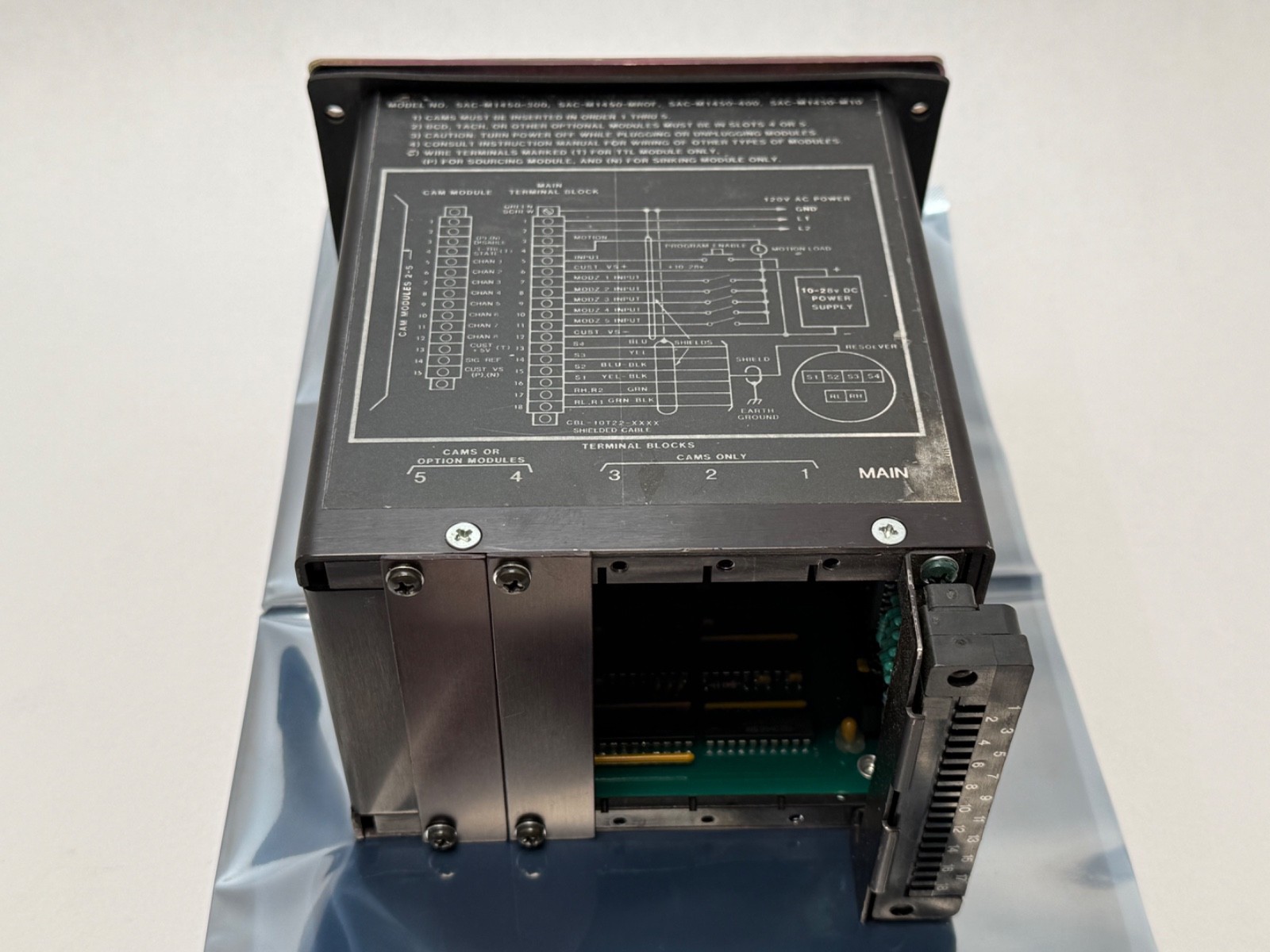
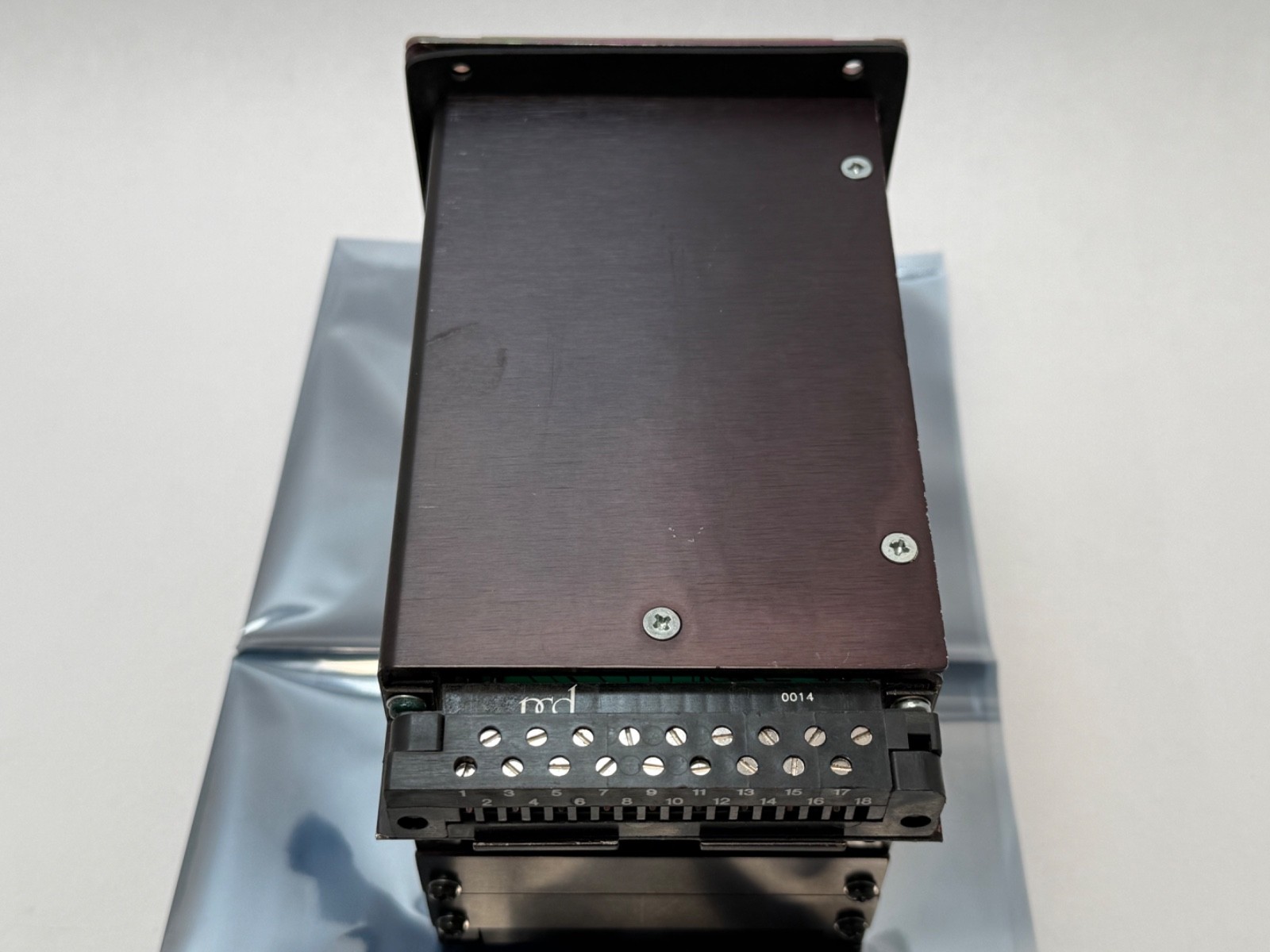
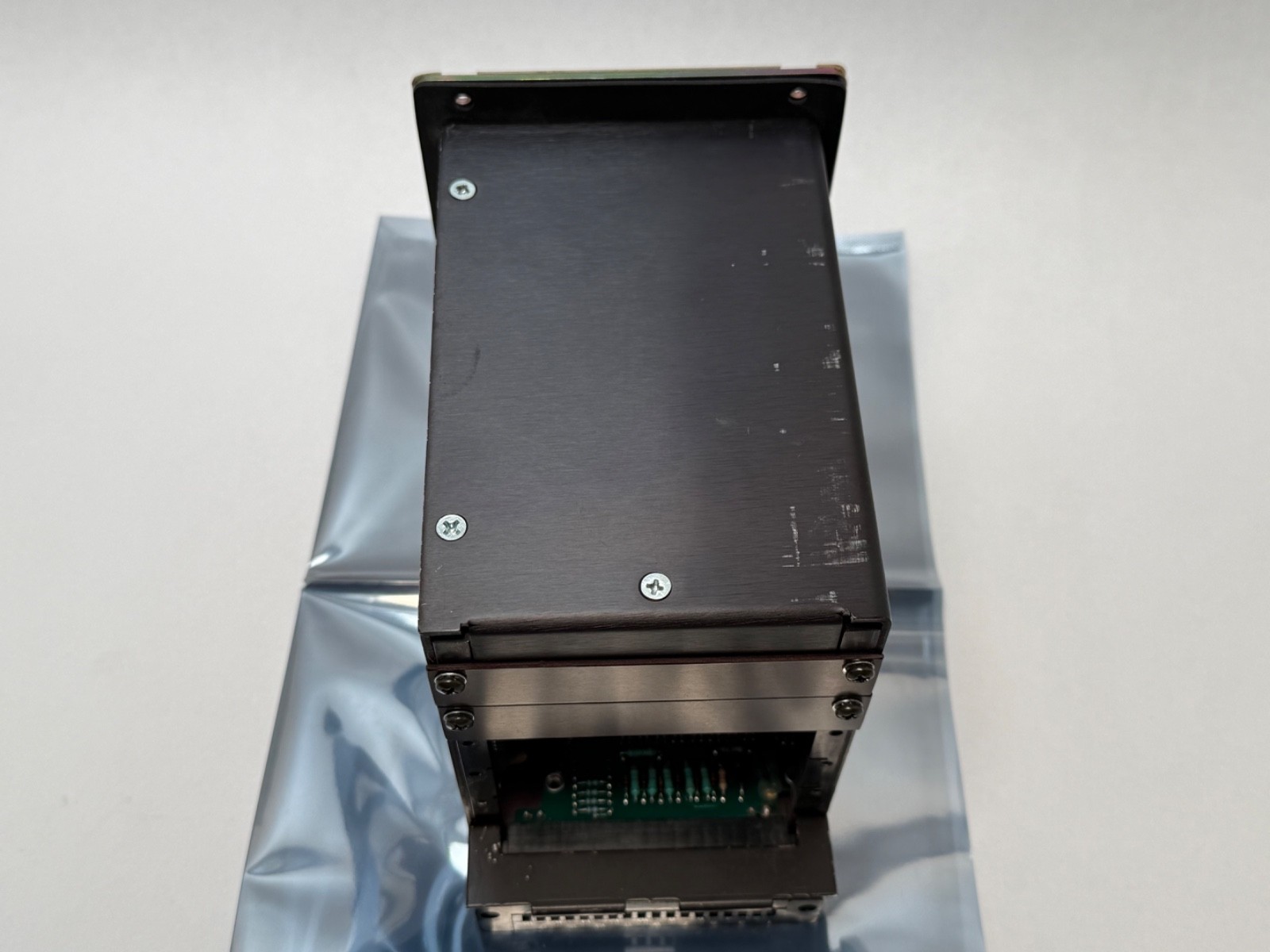
Up to 40 programmable channels, from five output modules of eight channels each; slots 1–4 (32 channels) support ModZ, and rate offset can affect slots 1–5 (40 channels) in groups of eight. Output modules are EEPROM-based transportable plug-ins, which is the maintenance argument for this platform — setpoints travel with the module, so a swap does not mean a reprogram. Outputs are optically isolated and available as either power or logic type. The motion detector output is NPN sinking, 30 Vdc maximum at 100 mA. Motion detector limits are programmable to 1899 RPM (low setpoint) and 1900 RPM (high setpoint). The ModZ input takes a contact closure to the customer’s +VS or a 10–28 V logic input (logic false 4 Vdc at 1 mA; logic true 10 Vdc at 10 mA to 28 Vdc at 30 mA). Patented + and − keys let you fine-tune setpoints while the machine is running, which is how these units get commissioned in practice. Auto-zero handles static zero offset. A broken-wire detector is an option on the platform.
Absolute position — the reason to use a resolver
The resolver gives genuinely absolute position: after a power outage, even if the machine has been moved by hand, the MINI·PLS shows true position on power-up. There is no homing cycle and no lost reference. The resolver itself is a rugged brushless NEMA 13 (IP54) single-turn unit suited to shock, vibration, humidity swings, oil mist, coolant and solvents, and the ratiometric converter gives a 1800 RPM maximum tracking speed with high noise immunity. The programmable unit can sit up to 2500 ft away from the resolver on overall foil-shielded cable (Autotech/AVG CBL-10T22-xxxx or equivalent). The resolver connection is short-circuit-proof. The front plate is splash-proof and oil-tight, so the panel unit can be mounted on the machine itself if the layout demands it.
What is and is not included
Read the catalogue wording carefully, because this is where surplus buyers get caught: the SAC- prefix denotes the front-panel programmable unit and, per Autotech’s own part-number table, cam modules and power outputs are not included. Nor is the resolver, the resolver cable, the relay/power-output chassis, or the optional serial communication module (which is a separately ordered ASY-part for the -300). Plan on sourcing cam/output modules, a compatible single-turn resolver (AVG/Autotech RL100, E7R, E8R, RL101 or equivalent) and the shielded transducer cable to make a working system. If you are replacing only the head unit on a machine that already has its modules and resolver, this is exactly the part you want.
Interchange, brand history and obsolescence
The M1450 family is a mature, long-obsolescent platform, and that is why the surplus market matters here: the whole point of buying an M1450-300 today is to keep an existing press or converting line running rather than re-engineering the cam timing into a PLC. Watch the brand trail when searching — Autotech Controls product lines have moved through AVG Automation (the transducers and cables are catalogued under AVG part numbers) and the Autotech name has since passed into the Avtron / Nidec group. You will find the same hardware listed as Autotech, Autotech Controls, AVG Automation and occasionally Nidec Avtron. Same MINI·PLS. Within the family, dimensional envelope is common: 40 channels in a 6.25 in x 4.5 in x 7.25 in enclosure. Documented as Made in USA and tested; seller refurbished.




 store
store