
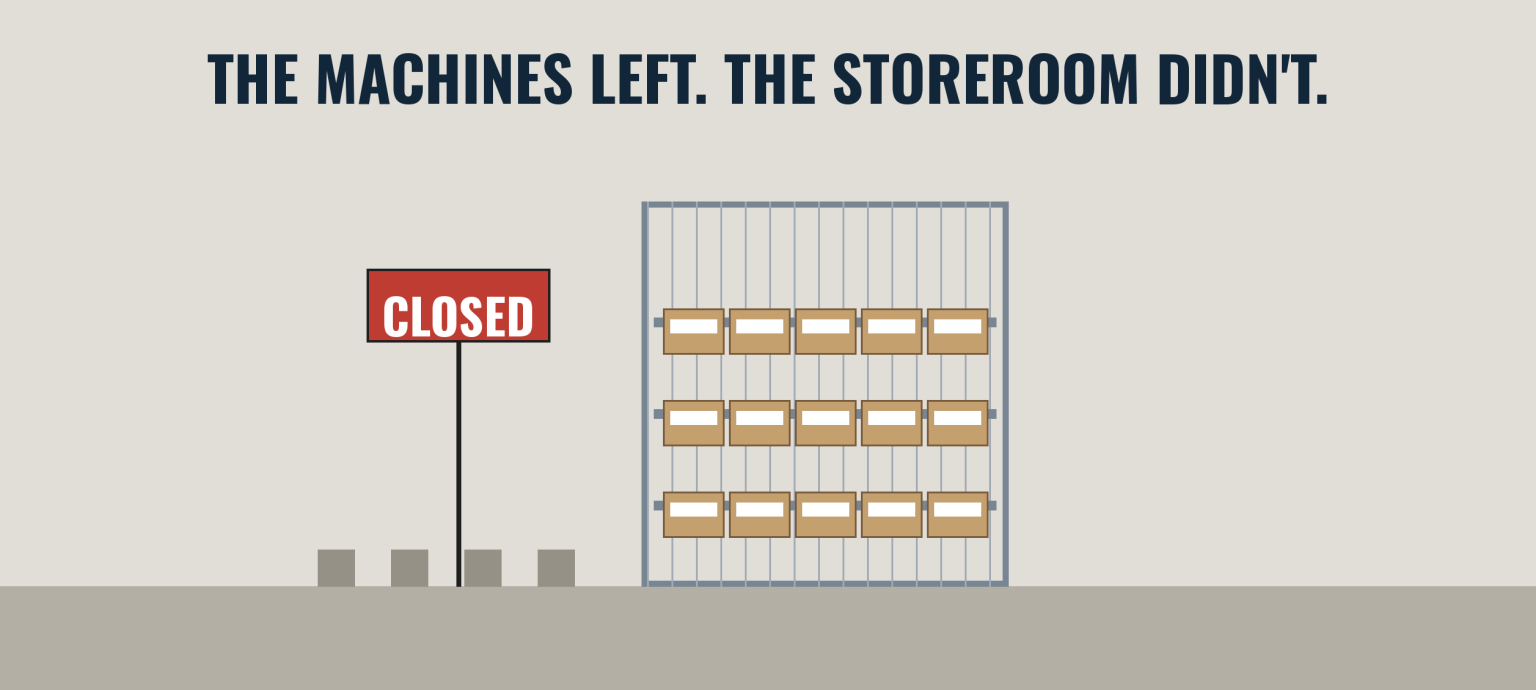
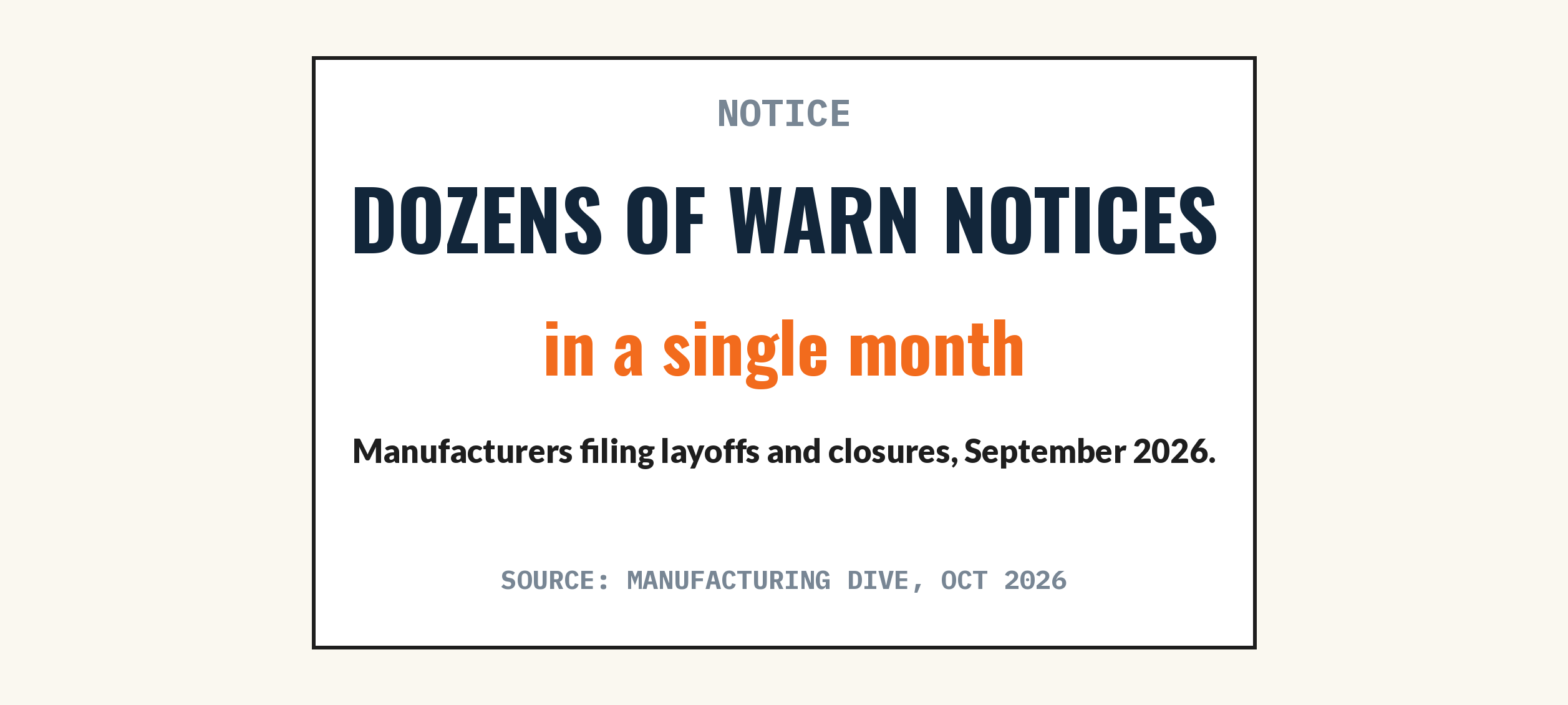
Every month, state labor departments get another stack of WARN notices. In September 2026 alone, Manufacturing Dive reported dozens of manufacturers filing notices for layoffs and closures. Over the summer, A.O. Smith filed to shut two central Ohio facilities, Groveport and Obetz, cutting about 92 jobs.
Behind every one of those notices is a building full of stuff. Here’s what really happens to it when a manufacturing plant closes, and the part almost every closure plan gets wrong.
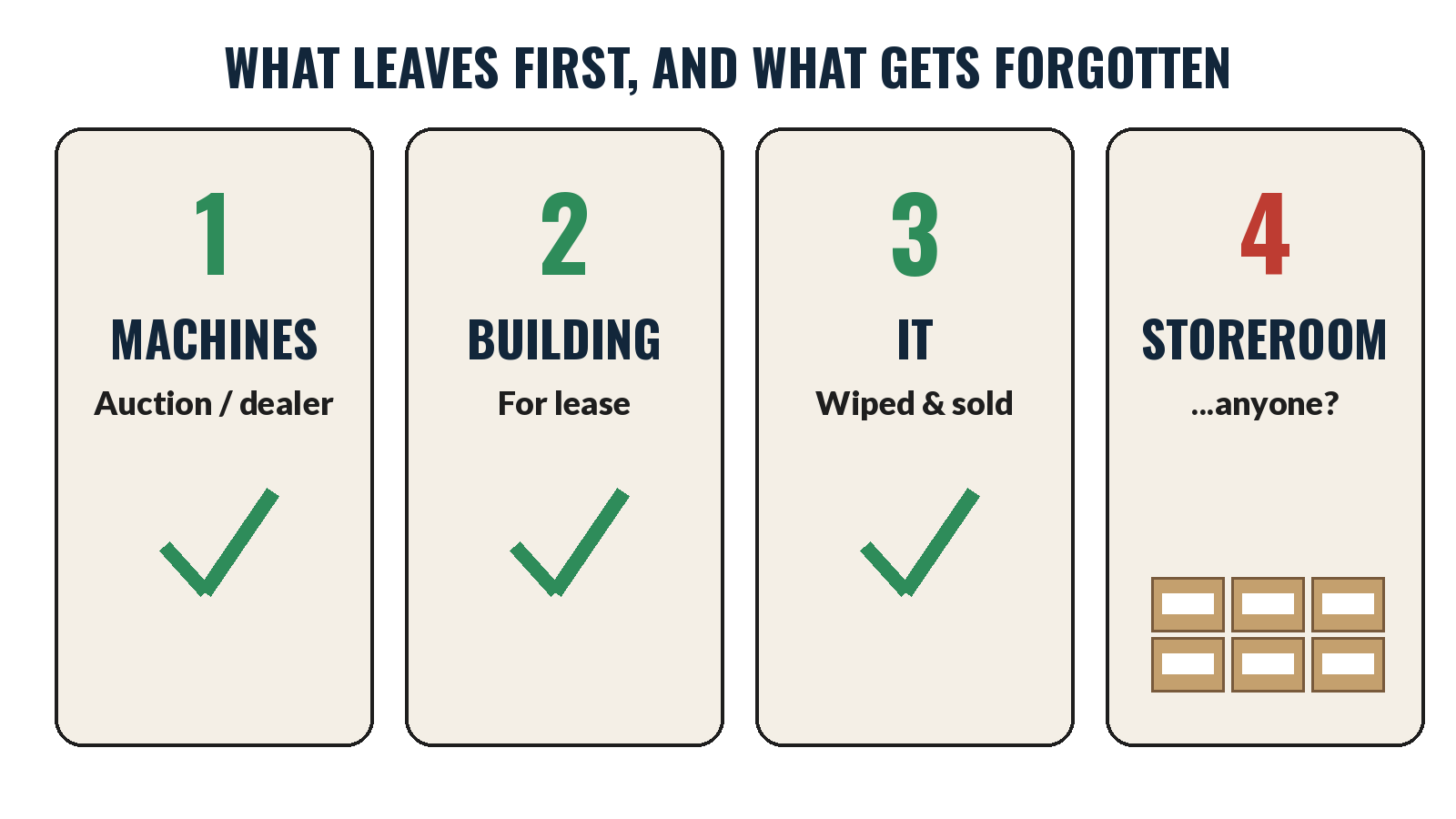
The big iron goes first, because it’s easy to see and easy to value. Presses, CNC machines, molding lines, robots and conveyors usually move to a sister plant, get sold to a machinery dealer, or go to an industrial auction. There’s a whole industry built around this, and it’s good at it.
Real estate gets listed or handed back to the landlord. Power, gas and water get scaled down to whatever keeps the sprinklers and security running.
Desks, computers, servers and phones get wiped, sold or recycled. Quick, mostly painless.
And then there’s the crib. Thousands of spare parts: bearings, motors, gearboxes, contactors, sensors, PLCs, drives, PCBs, power supplies, belts, seals. Every one of them bought to keep machines running that are now leaving on trucks. The controls cabinets alone can hold a small fortune in spares; if the plant went through a recent upgrade, some of those are PLC spares from the last migration that never got sold.
This is where closures stall.
When a manufacturing plant closes, the storeroom falls between every department’s job description. The auctioneer wants the machines, not ten thousand small boxes. Corporate wants the building empty by the lease date. The maintenance team that knew what the parts were is gone or leaving. So the crib sits, sometimes until the final walkthrough, when somebody calls a scrapper because the deadline is next week.
That’s the most expensive possible ending. Spare parts are often the most liquid assets in the building, light, standardized and in demand at every other plant still running. Selling them by the pound throws that away. Bearings are the clearest example: boxed, standardized and wanted everywhere, and still sitting on a clock. Here’s why it pays to sell surplus bearings sooner.
A closed plant doesn’t stop billing you. Rent or taxes, insurance, security, the skeleton utility load, and the people still on payroll to manage the wind-down. Every week the storeroom isn’t cleared is a week the building can’t be handed back. And the parts inside lose a little more value each month as the machines that use them get retired everywhere else.
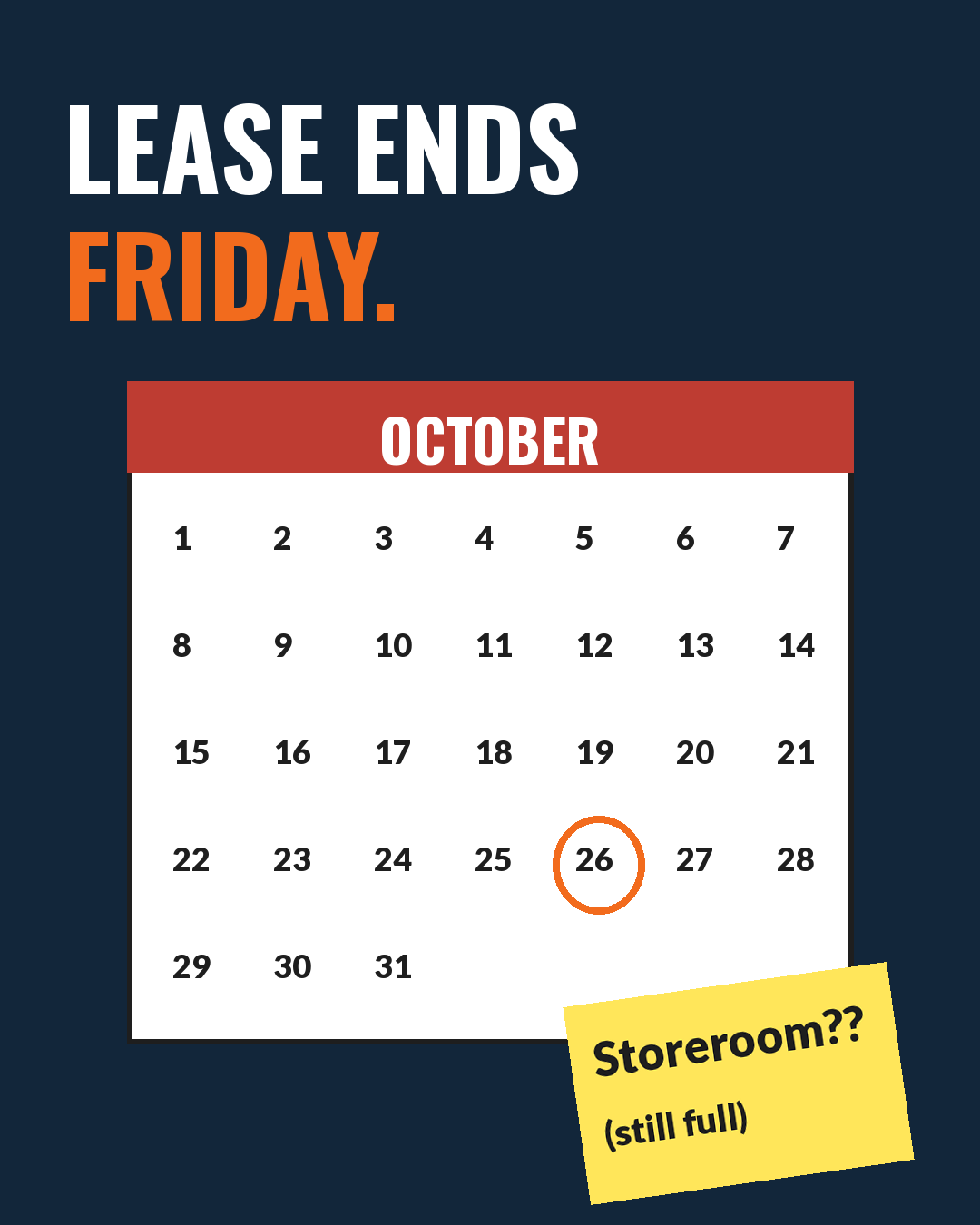
Name one person. In most closures that’s the maintenance manager, the plant controller or the closure project lead. Give them authority to accept an offer without three rounds of sign-off, because every round adds a week the building can’t be returned.
Finance cares about two numbers: what comes in, and how fast the inventory comes off the books. Operations cares about one: whether the aisle is empty by the walkthrough. A single-lot sale is the one option that satisfies both.
Same problem, smaller building. When production moves to another site, the receiving plant rarely wants the old storeroom; it already has its own. Duplicates, spares for equipment that didn’t make the move, and parts for a line that got redesigned during the transfer are all candidates to sell. Our guide to selling an MRO storeroom in one lot covers that version in more detail.
We buy the whole storeroom, as one lot, from plants that are closing or consolidating:
Send photos, get an offer, schedule a pickup around your closure timeline. The person running the wind-down gets one less thing on the punch list, and the storeroom number on the balance sheet goes to zero in one move.
Production machines are usually moved, sold to dealers or auctioned. Spare parts and MRO inventory are often left for last, and they’re best sold as one lot to a surplus buyer before the building is handed back.
Yes, and it’s usually better. The spares don’t depend on the machines leaving first.
No. Photos of the aisles are enough to start. When a manufacturing plant closes, nobody has time to count every box, and you shouldn’t have to.
A closing plant has a hundred deadlines. The storeroom doesn’t have to be the one that slips.
Ready to sell industrial MRO parts? Make it easy. → Sell Your Parts



Our team can locate, cross-reference, and source all parts.
Our team can locate, cross-reference, and source all parts.