
Surplus resellers buy surplus circuit boards and PCBs outright, usually by the lot, from plants, OEMs and integrators. If the boards are new, unused and still labeled, you can sell surplus circuit boards with a spreadsheet or a few photos and be paid within a week.
Boards are the part of the storeroom nobody wants to deal with. They’re small, they all look alike and the part numbers are long. That’s exactly why they sit for years.
Almost every industrial board has a buyer somewhere, because somebody is still running the machine it came out of:
Spares bought for machines that left years ago are the most common lot we see.
Boards are the hardest items for a plant to sell on its own. They need exact part numbers and revision levels, careful handling and someone who knows which machines they fit. Nobody on a maintenance team has time to research forty FANUC part numbers, list them and ship them one by one.
Meanwhile, they take up shelf space, get counted every year and get older. Electronics don’t improve in a box, and the buyer pool shrinks as old machines retire.
Small lots. There’s no minimum. A drawer of boards is fine.
Mixed brands. Boards from five manufacturers in one lot is normal. So are electromechanical parts, PLCs and drives in the same shipment.
Knowing what they’re worth. That’s the buyer’s job. Yours is to get them out of the building.
Central Surplus has been buying surplus for 16 years, with 2,000+ lots from 750+ sellers. References are available on request. We purchase from Manufacturers, Distributors, OEMs, End-Users, Manufacturing Plants, Factories and Builders, and any industrial inventory owner where we can verify the source and origin of the products.
Clearing boards as part of a bigger cleanout? When a manufacturing plant closes and PLC spares after a migration cover the situations where boards usually pile up.
“Some of these are really old.” That’s normal. Old boards are often exactly what someone running an old machine is hunting for. Send them anyway.
“We don’t know what half of them go to.” You don’t have to. Part numbers and photos are enough for a buyer to identify them.
“A few have been opened.” Note it, keep them separate if you can, and include them. The buyer decides; you don’t have to pre-sort.
“We also have the PLCs and drives they came out of.” Good. One lot is simpler than three. Mixed shipments of boards, drives, PLC modules and electrical parts are the norm.
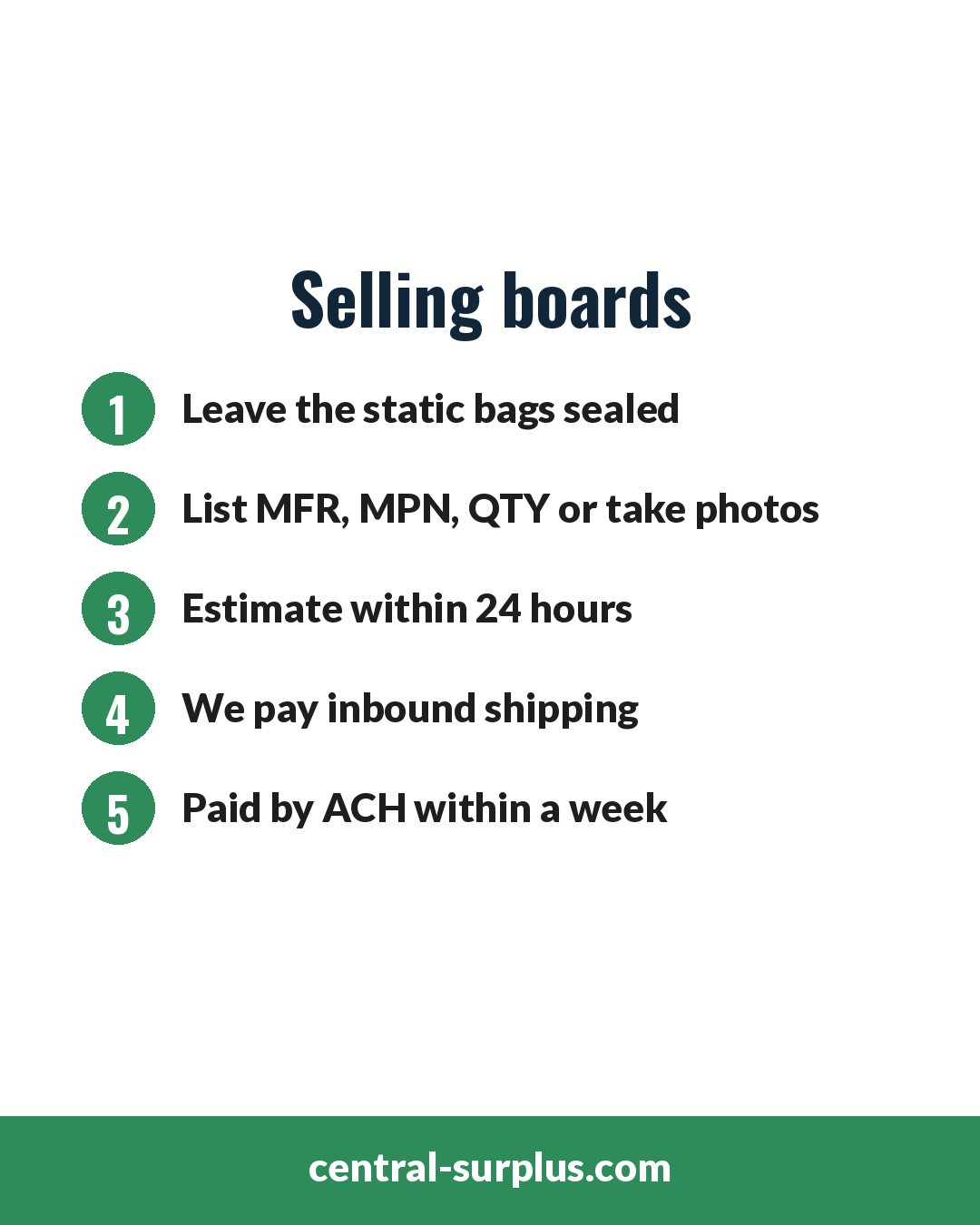
Keep them in their static bags and boxes. Don’t stack heavy items on them. If they’re loose on a shelf, put them in a box with some padding; a buyer can repackage, but a cracked board stays cracked. That’s about all the prep it takes to sell surplus circuit boards. If you can sell surplus circuit boards in one lot instead of a dozen small sales, you save weeks of follow-up.
The usual reason boards sit is that nobody is sure whether the machine they belong to will need them. Ask the one question that settles it: is that machine still running here? If it left the building, the boards protect nothing. If it’s still running but has three spares of the same board, keep one and sell the rest.
Every year the boards stay, they cost shelf space, count labor and insurance, and the pool of plants still running those machines gets smaller. A drawer of boards that clears this month is a drawer that never gets counted again.
Surplus resellers like Central Surplus buy new, unused industrial circuit boards and PCBs from plants, OEMs and integrators, usually as a lot.
No. A list with manufacturer, part number and quantity is ideal, but shelf photos with readable labels are enough for an estimate.
No. Leave factory packaging sealed. It protects the board and is part of what the buyer is paying for.
No. Central Surplus buys lots of any size, from a drawer of boards to multiple pallets.
Ready to sell industrial MRO parts? Make it easy. Sell Your Parts


Our team can locate, cross-reference, and source all parts.
Our team can locate, cross-reference, and source all parts.