

When a VFD fails, confirm it’s actually the drive, write down the full model number and fault code, then decide between an exact replacement and a cross-reference. That order saves the most downtime, because most bad VFD replacement orders come from skipping the first two steps.
Drives fail at the worst time, usually with a production manager standing behind you. Here’s the sequence that gets the line back fastest.
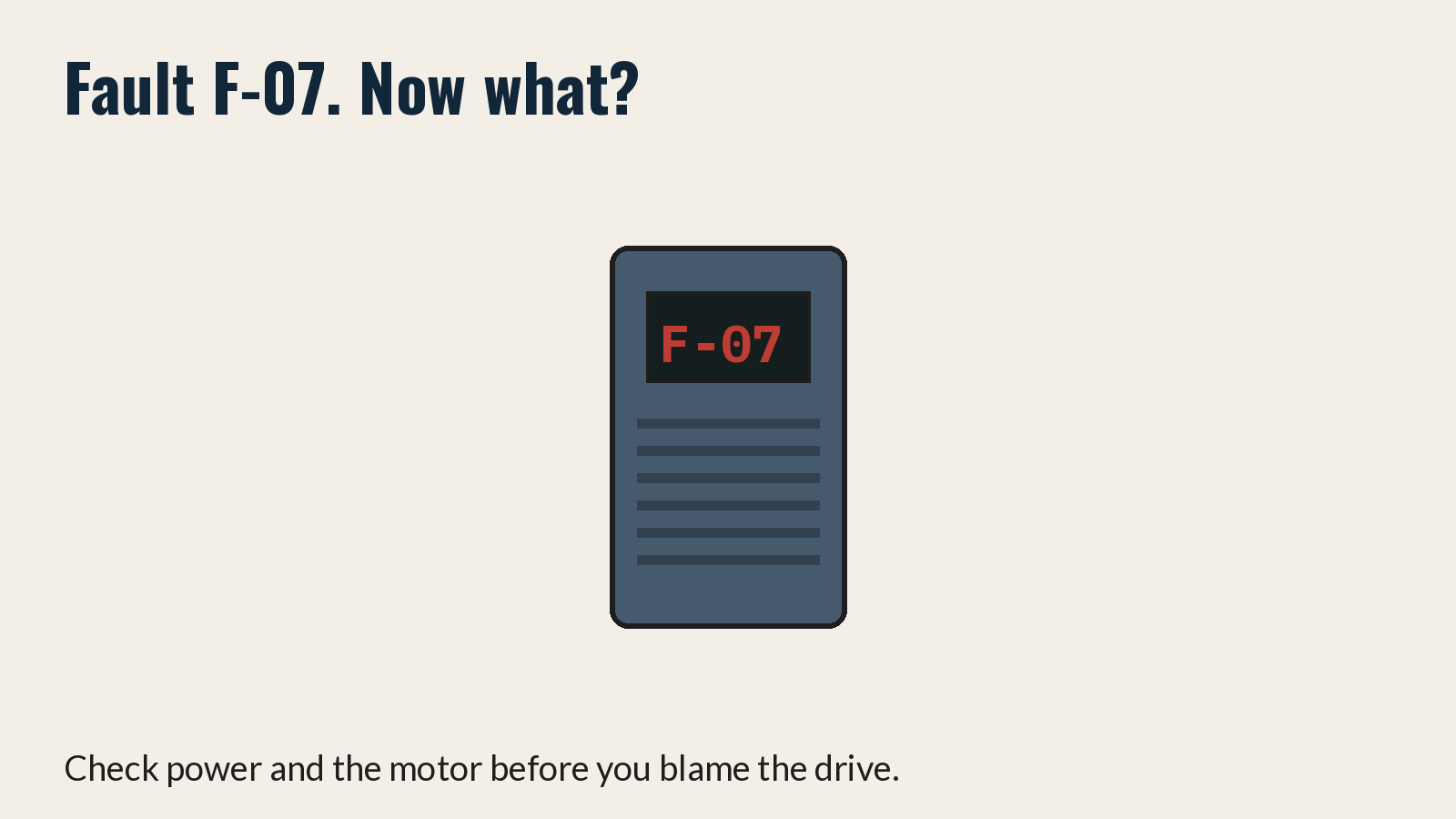
A dark keypad or a fault code doesn’t always mean a dead drive. Check the obvious first:
Ordering a drive for a motor problem is a two-day mistake.
The full model number is the whole game. Two drives from the same family can differ in voltage, horsepower, enclosure, braking and communication options, all buried in the suffix. Photograph the nameplate. Write down the input voltage, rated current, horsepower or kW, and any option cards installed.
Our guide to reading industrial automation part numbers explains how to decode the suffix.
If the keypad still talks, back up the parameters to the keypad, a laptop or even a phone photo of each screen. A new drive with blank parameters is a new commissioning job. A new drive with your old settings loaded is a swap.
An exact match is the fastest VFD replacement. Same footprint, same wiring, same parameters. If the drive is still made, or a new surplus unit is on someone’s shelf, that’s the move.
If the model is discontinued or the exact unit isn’t available, a cross-reference works: a newer model from the same family or another brand with matching voltage, current and features. It may need new mounting, a different keypad or reprogramming, so factor that in. Central Surplus cross-references drives for free. Send the nameplate photo and we’ll tell you what fits.
Lead times on new drives can run months. Surplus stock ships now. Central Surplus keeps drives and starters and drives and amplifiers on its own shelves. Orders placed before 6 PM ET ship the same day with free US shipping, and most arrive in 1–3 business days.
Wrong guess on the model? Every item comes with free returns within 30 days of delivery, no restocking fee, and Central Surplus pays return shipping. Refunds go out within 24 hours of the return arriving, as long as the drive is unused and in original packaging.
If the drive’s partner on the line is a servo system, our servo amplifier replacement guide covers the same logic, and you can browse electromechanical parts on the shelf now.

Once the line is running, order a second drive for the shelf. Drives that ran ten years tend to fail together, and the next one will pick an equally bad moment. One sealed spare costs far less than another afternoon of downtime.
Running older drives on legacy controls too? Our PLC spares piece covers keeping the rest of the panel alive.
Matching horsepower only. Two drives rated at the same horsepower can have different current ratings, especially for heavy-duty or constant-torque loads. Match the rated output current to the motor’s full-load amps, not just the horsepower on the label.
Ignoring the input voltage. A 480 V drive won’t help a 230 V panel. Single-phase input to a three-phase drive usually means derating. Check what’s coming in, not just what’s going out.
Forgetting the options. Communication cards, encoder feedback, braking resistors and safe torque off wiring all have to carry over. A drive that runs the motor but can’t talk to the PLC is still a down line.
Skipping the enclosure. An open-chassis drive in a washdown area won’t last. Match the enclosure rating to the environment, or confirm the cabinet protects it.
Not checking the dimensions. A newer model can be taller or deeper than the one it replaces. Measure the space and check the mounting holes before the drive arrives.
Get those right and a VFD replacement is a wiring job, not a project.
Check incoming power, the motor and the fault log first. Overcurrent and ground faults often point to the motor or cable, not the drive.
Yes, if the voltage, current rating and features match your application. A cross-reference may need new mounting or reprogramming, so confirm before ordering.
The full model number from the nameplate, input voltage, rated current, horsepower or kW, and any option cards. A nameplate photo covers most of it.
Central Surplus ships in-stock orders placed before 6 PM ET the same day with free US shipping. Most arrive in 1–3 business days.
Drive down? Make it easy. Shop Drives & Starters


Our team can locate, cross-reference, and source all parts.
Our team can locate, cross-reference, and source all parts.