
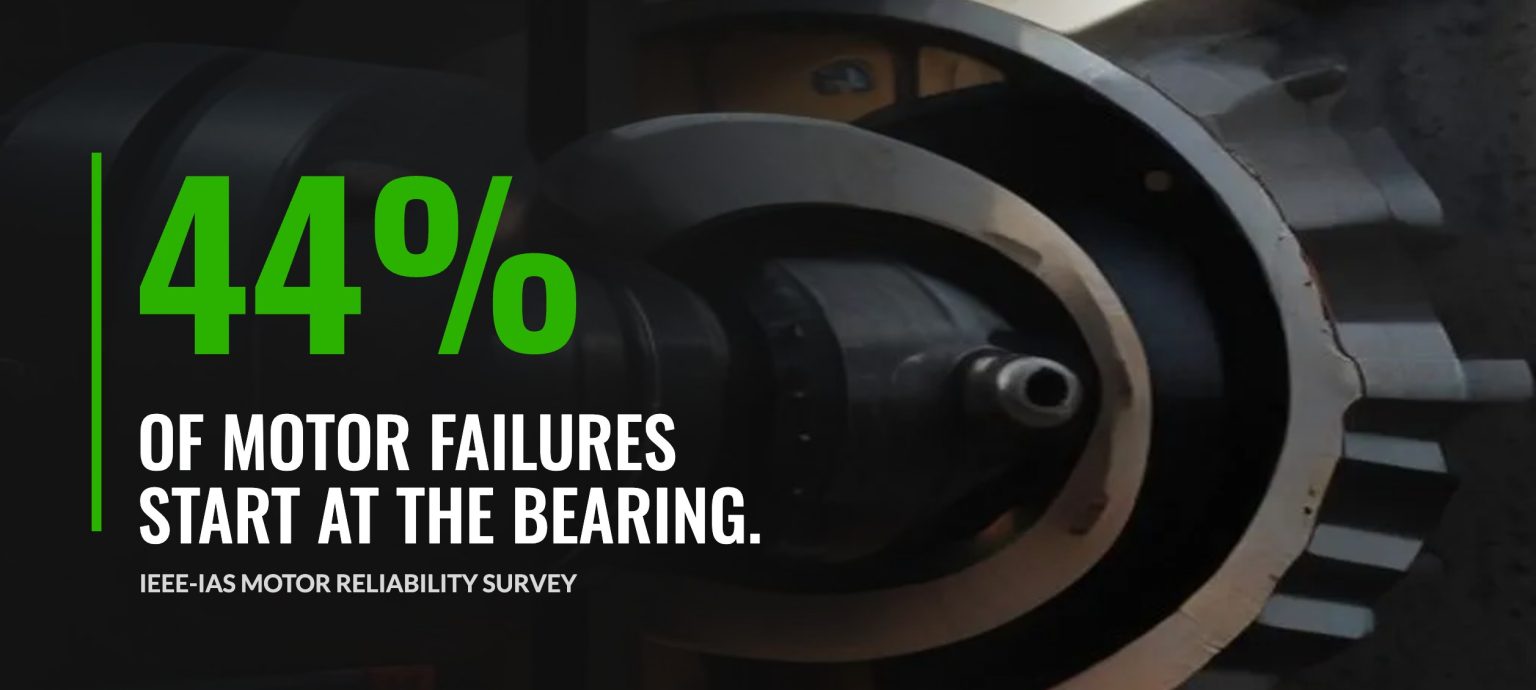
When a motor quits, the windings get the blame and the bearings usually did it. Two of the most-cited reliability studies agree: an IEEE industrial survey traced 44% of motor failures to bearings, and an EPRI utility study put it at 41%, ahead of windings in both (ReliaMag summary of the IEEE-IAS and EPRI data).
Electric motor bearings hold the rotor shaft centered in the housing, carry radial and axial load, and keep the rotor off the stator. Lose one and the shaft walks, the air gap closes, and a cheap part turns into a rewind. If you run industrial motors, the bearing is the part you will replace most. Here is how to pick the right one and get it fast.
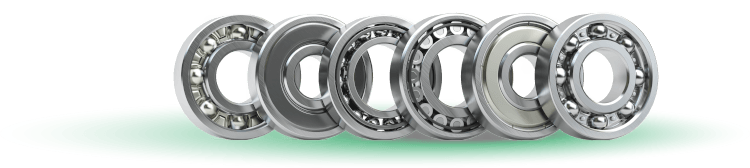
Motor size, load and speed decide the design. In the field, it comes down to three. For the wider family, see our guide to bearing types.
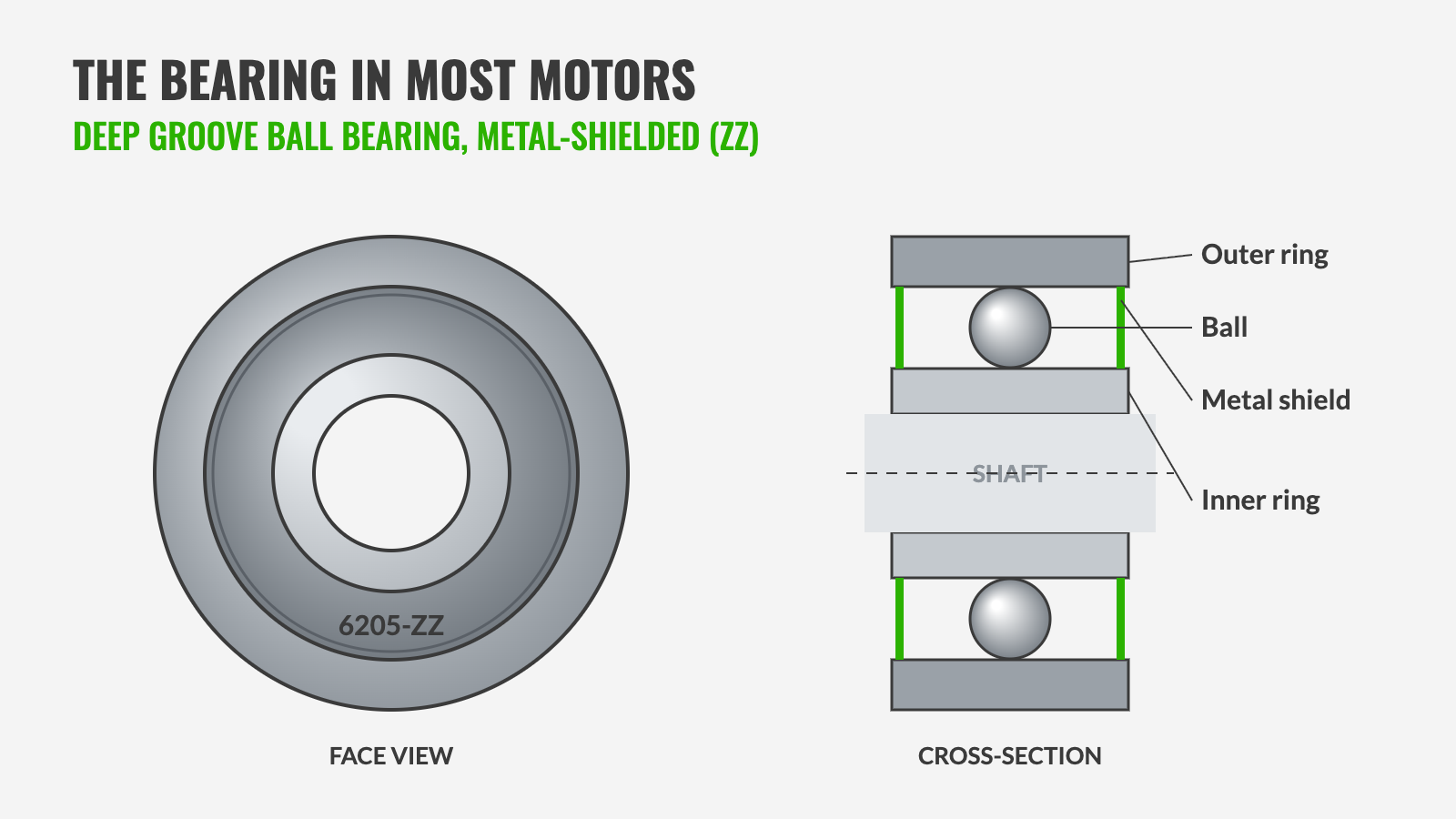
The default in fractional and integral horsepower motors: fans, pumps, conveyors. They handle moderate radial load plus some thrust, run quiet at speed and cost little. Open most small and mid-sized motors and this is what you’ll find: a 62- or 63-series on each end, usually metal-shielded (ZZ). Shields keep chips and dust off the balls while letting grease in the housing reach them, which suits most motor duty.
Cylindrical rollers show up on the drive end of larger motors driving belts or heavy radial load. Line contact carries more load than a ball’s point contact, but a cylindrical roller takes little or no thrust, so it is usually paired with a ball bearing on the opposite end. Tapered rollers are rarer inside motors and more common on the driven equipment.
No rolling elements, just a sleeve riding on a film of oil. You’ll see them in HVAC blowers, older specialty motors and very large machines. Quiet and simple, but unforgiving of a lube failure.
Bearings rarely die without warning. They complain first:
One symptom is a watch item. Two at once is a work order.
Normal wear is rarely the cause. Something specific usually is.
Variable frequency drives can put voltage on the shaft. It discharges through the bearing and etches the races into a washboard pattern called fluting. Once it starts, it accelerates. Shaft grounding rings and insulated bearings are the standard fixes on drive-fed motors, so check for both before you reorder the same bearing.
Contamination wears a premium bearing as fast as a cheap one. Misalignment to the driven load does the same through uneven loading. Good seals, clean hands at install and a real alignment job prevent both.
Nameplate worn off, part number discontinued, motor older than the tech? Replacement comes down to specs.
Most electric motor bearings run polyurea or lithium-complex grease built for motor heat and speed. Mixing incompatible greases can break both down, so check what is already in there. The motor’s lube plate, when it survives, lists the grease and interval.
Intervals run from a few months on hot, heavy-duty motors to years on light duty. Sealed bearings are greased for life and not meant to be regreased. Over-greasing kills almost as many bearings as under-greasing.
SKF, NSK, Timken and NTN each number parts their own way. Interchange charts map equivalents across brands by dimension and design, and our bearing cross-reference covers the common ones.
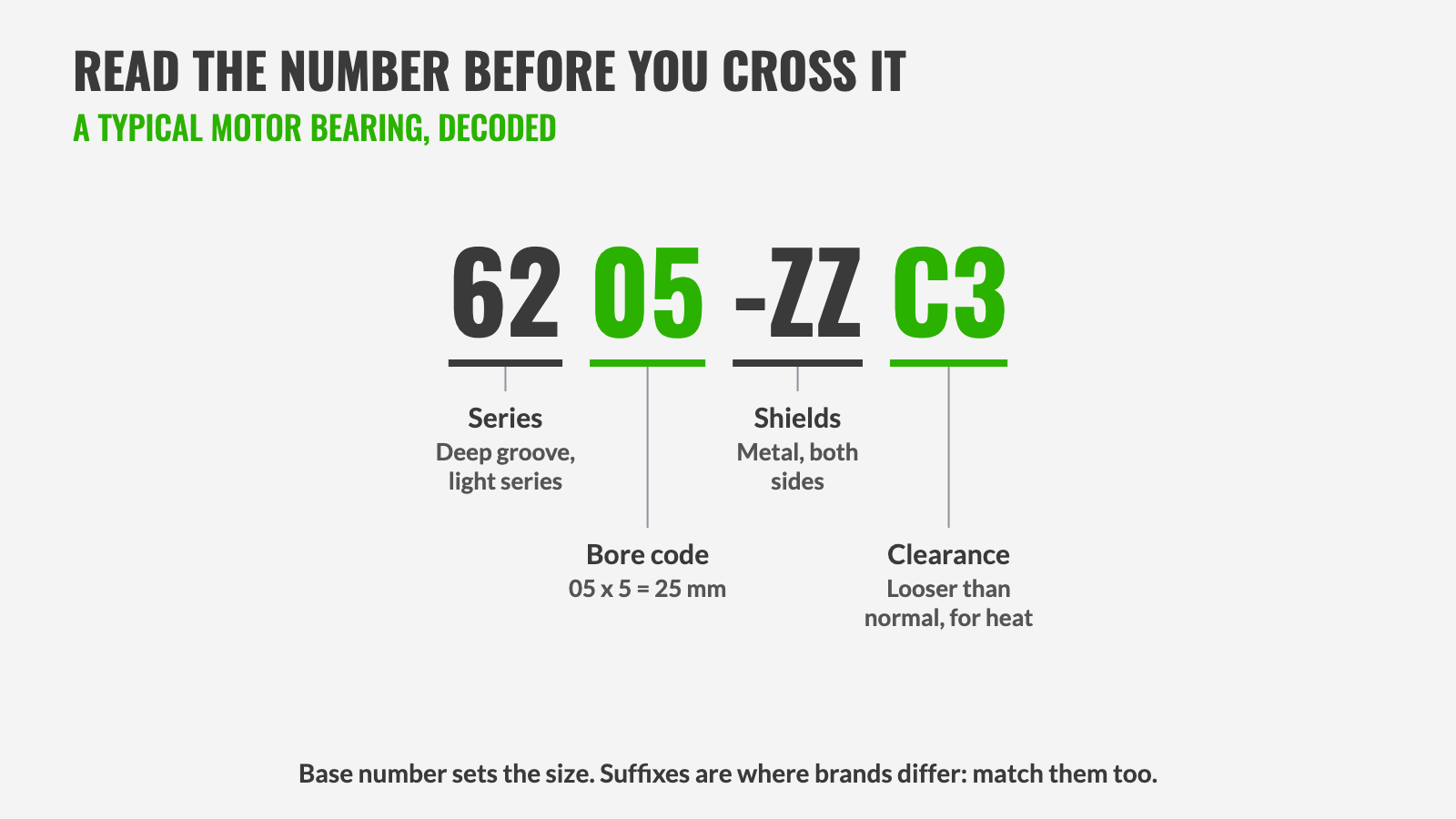
Close isn’t the same as interchangeable. Two bearings with near-identical numbers can differ in seal type, clearance or precision class. Check all four specs above before you install, especially on an imported or orphaned motor.
Bearings. Major IEEE and EPRI surveys put bearings at roughly 41–44% of motor failures, ahead of windings.
Yes, if bore, OD, width, seal type, clearance and precision class all match.
Greater-than-standard internal clearance, which leaves room for the shaft to grow as the motor heats up. Many motors specify it.
There is no single number. Load, speed, alignment, contamination and grease practice decide it. A clean, aligned, properly greased bearing can outlast the motor’s first rewind. A misaligned or over-greased one may not see its second year. Trend vibration and temperature instead of guessing.
No. Sealed bearings are lubricated for life. Replace them when they wear out.
A down motor doesn’t care about lead times. Central Surplus stocks industrial bearings in deep groove, roller and specialty designs and ships same day on orders placed before 6:00 p.m. Eastern, typically priced below the big distributors. Send a part number, a set of dimensions or a whole parts list, and we’ll cross-reference it and quote it. No part number? Send the specs or a photo of what’s left of the old one.
Need a bearing? Make it easy. Shop Bearings

Our team can locate, cross-reference, and source all parts.
Our team can locate, cross-reference, and source all parts.