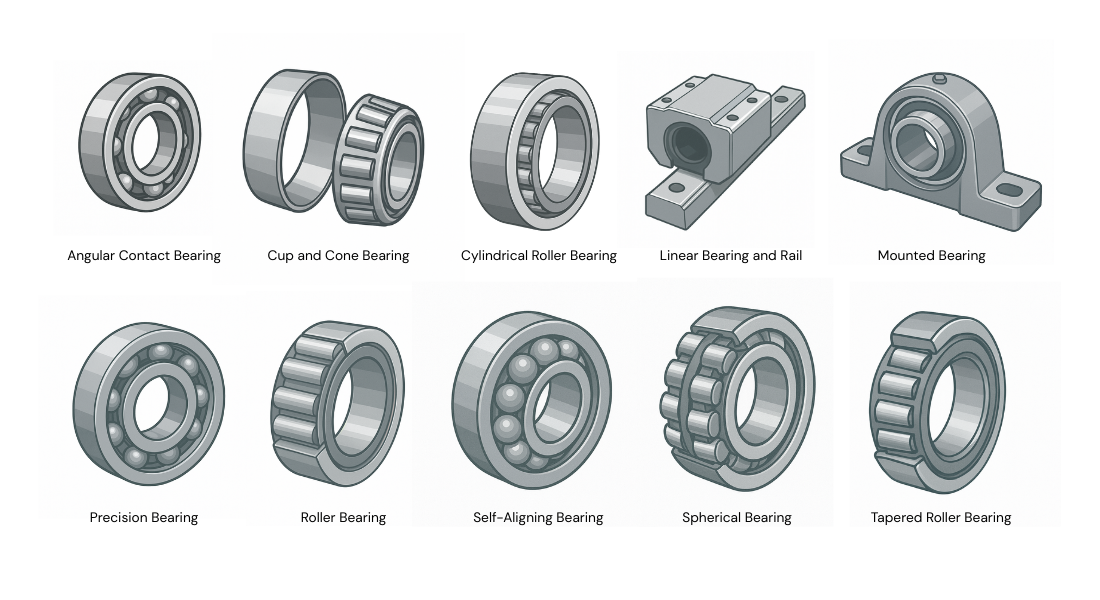
When you think about what keeps machinery humming – whether it’s in a wind turbine, your car’s wheels, or an industrial conveyor belt – the unsung heroes are often bearings. These crucial components play a key role in reducing friction, handling heavy loads, and keeping motion smooth and efficient.
In fact, there are dozens of types of bearings, each designed for a specific load, motion, or application. Some are built to withstand high radial loads, others thrive under axial forces, and a few can handle both. If you’re sourcing bearings for manufacturing, energy, or marine equipment, choosing the right one is essential—not just for performance, but for safety, durability, and cost-efficiency.
In this guide, we’ll break down 23 essential bearing types, highlighting their strengths, limitations, and ideal use cases. Along the way, you’ll see why sourcing from a knowledgeable partner like Central Surplus helps ensure precision, longevity, and smart cost savings.
The right bearing does more than just reduce friction — it protects your machinery, improves efficiency, and prevents catastrophic failures. Bearings operate at the heart of mechanical systems, supporting radial and axial loads while maintaining alignment and motion. When a bearing is mismatched or poorly made, it can lead to increased wear, vibration, and early failure — often damaging adjacent components in the process.
Why does this matter to your business?
Because downtime is expensive. Whether you’re running electric motors, conveyors, or precision machining tools, a failed bearing can mean halted production, delayed shipments, or costly emergency repairs.
Choosing a properly sized and well-manufactured bearing isn’t just about fit — it’s about performance, safety, and long-term value.
There’s also the question of matching the load type to the bearing design. Some applications require bearings that can handle heavy radial loads, while others need to accommodate high axial forces or even combined loads. Overlooking these factors can compromise not just the bearing, but your entire operation.
That’s why sourcing from a reputable partner like Central Surplus matters. Not only do they offer industrial-grade bearings at competitive pricing, they also ensure you’re getting components that meet stringent performance standards — and fit right the first time.

Bearings are everywhere — from the machines that build our cities to the tools that power our homes. Their ability to manage rotational and linear motion makes them essential to virtually every major industrial sector. And while the function of a bearing might be simple, its role is anything but small.
Every one of these industries depends on the right type of bearing to minimize downtime and ensure safe, smooth operation.
Now let’s talk about the 23 bearing types, and break them down in detail…
Thrust bearings are designed to support axial loads — the type of force that acts parallel to the shaft. Unlike radial bearings, which manage side-to-side movement, thrust bearings specialize in handling high axial loads that push or pull along the shaft’s axis.
They’re commonly used in systems where components must rotate while resisting forward or backward movement. Because of their design, these bearings are ideal for low-to moderate-speed applications and can come in ball or roller configurations depending on load and performance needs.
| Pros | Excellent for axial load support | Available in ball and roller types | Compact and cost-effective |
|---|---|---|---|
| Cons | Not suited for radial load applications | May require frequent lubrication | Not ideal for high-speed environments |
| Ideal Applications | Automotive steering systems | Marine propulsion systems | Vertical shafts and spindles |
Linear bearings are built for motion in a straight line — no spinning, no twisting. Whether it’s a 3D printer rail or an automated tool slide, these bearings help machinery glide with minimal resistance and pinpoint accuracy. They’re a quiet force behind high-precision systems that rely on repeatable, smooth travel.
| Pros | Enables accurate linear motion | Quiet and smooth operation | Reduces wear on guide rails |
|---|---|---|---|
| Cons | Doesn’t handle rotational loads | Sensitive to dust and contamination | Requires routine lubrication |
| Ideal Applications | CNC machines and automation systems | 3D printers and pick-and-place robotics | Sliding assemblies and medical equipment |

Pilot bearings are small, but they have a big job. They support the transmission input shaft, allowing it to stay stable and spin freely when the clutch is disengaged. In manual drivetrains, a worn-out pilot bearing can lead to rough shifts, vibration, and gear misalignment.
| Pros | Stabilizes input shaft alignment | Reduces friction during clutch operation | Helps maintain smooth gear changes |
|---|---|---|---|
| Cons | Can fail under heat or poor lubrication | Limited to axial support | Small and easy to overlook during maintenance |
| Ideal Applications | Manual transmissions | Engine crankshafts | Light trucks and sports cars |
Needle bearings pack a lot of performance into a compact frame. Their long, narrow rollers increase the contact area without adding bulk, which is perfect for tight mechanical spaces. Despite their size, they can take on surprisingly heavy radial loads with ease.
| Pros | Extremely compact design | Excellent load capacity for their size | Lightweight and easy to install |
|---|---|---|---|
| Cons | Limited to radial load support | Less forgiving of shaft misalignment | Shorter lifespan under axial forces |
| Ideal Applications | Automotive transmissions | Two-stroke engines and power tools | Gear box and motor assemblies |
Flange bearings are the go-to solution when a shaft needs secure, stable support at a fixed point. Mounted directly to a surface, they’re used in systems where shaft alignment is critical and misalignment could spell failure. Their flanged design simplifies both installation and long-term maintenance.
| Pros | Provides rigid mounting support | Easy to align during installation | Helps reduce vibration at support points |
|---|---|---|---|
| Cons | Can take up more space than other bearings | Not ideal for mobile components | Typically supports only radial loads |
| Ideal Applications | Conveyor systems and material handling | Packaging and bottling lines | HVAC systems and light machinery |
Need a specific bearing fast — without overpaying? Our eBay store is stocked with thousands of premium, name-brand bearings at liquidation pricing. Whether you’re sourcing a needle bearing for agricultural machinery or a flange unit for a conveyor line, there’s a good chance you’ll find it here — and at a better price than anywhere else online.
Plus, every listing includes clear part numbers, detailed specs, and real photos, so you can buy with confidence. Orders ship out the same day, and customer service is just a message away if you need help cross-referencing or confirming fit.
Browse the eBay Store now to find the part you need — before someone else grabs it.
Pillow block bearings come ready to mount, with the bearing already housed in a supportive block. They’re a favorite in industrial settings because they simplify shaft alignment and reduce the time needed for installation. If you’re dealing with long shafts or uneven loads, these mounted units are a practical and stable solution.
| Pros | Pre-mounted for quick installation | Helps align shaft easily | Available in multiple housing materials |
|---|---|---|---|
| Cons | Takes up more space than standalone bearings | May not suit compact equipment designs | Limited adjustment once installed |
| Ideal Applications | Conveyor systems and material handlers | Agricultural and industrial machinery | HVAC units and belt-driven machines |

Roller bearings excel when you need serious load-handling capacity. Their cylindrical rolling elements reduce deformation under stress, keeping things turning even under massive pressure. These are built for longevity and strength, not lightweight finesse.
| Pros | Great for heavy radial loads | Long lifespan in tough conditions | Handles vibration and shock well |
|---|---|---|---|
| Cons | Less efficient at high RPMs | Not ideal for axial loads | Requires larger housing than ball bearings |
| Ideal Applications | Crushers and conveyors | Large mechanical gear systems | Steel mills and mining equipment |
Ball bearings are fundamental mechanical components that reduce friction between moving parts by using small, hardened steel balls that roll between inner and outer rings (races). Their design enables smooth rotational motion while supporting both radial and axial loads. Ball bearings are manufactured in standardized sizes and configurations, making them widely available for numerous applications across various industries.
| Pros | Low friction for high efficiency | Handles both radial and thrust loads | Standardized for easy replacement |
|---|---|---|---|
| Cons | Less resistant to shock loads | Vulnerable to contamination | Noisier at high speeds |
| Ideal Applications | Electric motors and appliances | Automotive components | Precision equipment |
Sealed bearings take the guesswork out of lubrication. With built-in seals to keep grease in and contaminants out, they’re perfect for systems where routine maintenance is tough or time-consuming. This self-contained approach ensures long-term performance with minimal attention.
| Pros | No need for external lubrication | Keeps out dust, dirt, and moisture | Consistent performance over time |
|---|---|---|---|
| Cons | Not serviceable or re-lubricatable | Higher cost than open bearings | Limited lifespan after seal breakdown |
| Ideal Applications | Power tools and small motors | HVAC blowers and conveyor rollers | Washing machines and outdoor equipment |
Bearing races are the unsung foundation of any rolling-element bearing. These rings provide the smooth track on which balls or rollers move, and they must be exceptionally hard and precisely machined. A flawed race can ruin even the highest-quality bearing in no time.
| Pros | Provides stable, low-friction surface | Built to handle high-speed rotation | Precision-ground for durability |
|---|---|---|---|
| Cons | Must be perfectly paired with bearing elements | Can deform under improper installation | Replacement often requires full disassembly |
| Ideal Applications | All ball and roller bearing assemblies | Automotive wheels and spindle housings | Electric motors and gearboxes |
Spherical bearings are made for movement — not just rotation, but flex and misalignment, too. Their inner ring rotates within a spherical outer ring, giving them freedom to pivot as needed without compromising load support. This makes them ideal for equipment that doesn’t always play by the rules.
| Pros | Self-aligns under dynamic conditions | Handles radial and moderate axial loads | Reduces stress from shaft deflection |
|---|---|---|---|
| Cons | More expensive than traditional bearings | Not for ultra-high-speed systems | Requires proper housing alignment |
| Ideal Applications | Off-road vehicles and agricultural arms | Construction and lifting equipment | Suspension systems |
These bearings are the multitaskers of the rotation world. Their angled rollers allow them to handle combined loads — both radial and axial — making them incredibly versatile. You’ll often find them in applications where speed meets stress, like vehicle axles.
| Pros | Supports radial and axial forces | Offers high load-carrying capability | Great for tapered shaft systems |
|---|---|---|---|
| Cons | Generates more friction than ball bearings | Needs careful installation and preload setup | May require frequent maintenance |
| Ideal Applications | Automotive hubs and speed reducers | Gearboxes and agricultural equipment | Industrial and commercial machinery |
With a larger contact surface than ball bearings, cylindrical rollers excel at handling weight head-on. They’re built for radial load domination, especially in high-speed, high-power applications. Their modular design also allows for axial movement in select configurations.
| Pros | Handles heavy radial loads with ease | Performs well at high RPMs | Offers low friction operation |
|---|---|---|---|
| Cons | Not suitable for axial loading | Sensitive to shaft misalignment | Requires exacting fits for optimal function |
| Ideal Applications | Electric motors and gear reducers | Blowers and compressors | Generators and turbine assemblies |

Unlike standard ball bearings, angular contact bearings support both axial and radial loads — in singles, pairs or sets. . That directional strength makes them excellent for setups where high-speed precision matters. You’ll often see them in machine tools, spindles, and performance engines.
| Pros | Excellent for combined load scenarios | Performs well at high speeds | Low friction and high precision |
|---|---|---|---|
| Cons | Directional load handling can be limiting | Must be installed in pairs for bidirectional loads | Alignment critical during setup |
| Ideal Applications | Milling machines and lathes | Precision spindles and race engines | Ball screw supports and robotics systems |
Spherical bearings are designed for high-load, low-speed environments where misalignment and shock are expected. These bearings won’t flinch under pressure — perfect for rugged, unforgiving applications.
| Pros | Self-aligns under load and shaft deflection | Excellent for heavy radial and axial loads | Resilient to shock and contamination |
|---|---|---|---|
| Cons | Bulky compared to other bearing types | Not optimized for precision motion | Requires ample housing space |
| Ideal Applications | Vibrating shaker screens and rock crushers | Pulp mills and industrial conveyors | Mining, steel, and aggregate machinery |
With more than 10,000 listings live on our eBay store — and new inventory added daily — Central Surplus is your one-stop source for hard-to-find, high-performance bearings. From spherical roller bearings to linear motion systems, we stock trusted brands like Timken, SKF, NTN, and FAG — all at fair prices.
No middlemen. No inflated markups. Just genuine industrial bearings shipped the same day, often with faster delivery than the big-name suppliers. Whether you’re maintaining factory equipment or rebuilding a gearbox, we’ve got the part you need — and we can get it to you fast.
Linear bearings, blocks and rails enable smooth, guided motion in a straight line—unlike radial bearings, which support rotation. These systems use rolling elements such as balls or rollers that travel along a track, typically mounted on a rail or shaft. They’re engineered to reduce friction during linear movement and are a go-to solution in environments that demand precision and repeatability.
| Pros | Ultra-low friction in straight-line applications | High precision and repeatability | Ideal for automated machinery & motion systems |
|---|---|---|---|
| Cons | Not suitable for rotational loads | Requires alignment & cleanliness for long-term performance | Higher initial cost compared to simpler bushings |
| Ideal Applications | CNC routers & milling machines | Medical imaging equipment | Automated robotic arms |
Precision bearings are built for high-speed and high-tolerance environments. They’re manufactured with tight dimensional control and finish to minimize vibration and maximize performance. You’ll find them in places where perfection isn’t optional — like aerospace, robotics, or spindle assemblies.
| Pros | Ultra-low friction and tight tolerances | Excellent for high-speed rotation | Long lifespan with proper care |
|---|---|---|---|
| Cons | More expensive than general-purpose bearings | Less forgiving of shaft misalignment | Requires precise mounting |
| Ideal Applications | High speed rotating machinery | Machine spindles and surgical devices | Semiconductor and metrology systems |
These bearings solve a critical issue: shaft misalignment. Their internal ball arrangement adjusts automatically to minor angular errors, which helps avoid wear and reduces noise. They’re perfect when installation isn’t perfect — but performance still needs to be.
| Pros | Compensates for shaft misalignment | Smooth operation in dynamic conditions | Extends lifespan of connected components |
|---|---|---|---|
| Cons | Not ideal for very high radial loads | Less rigid than fixed bearings | May require additional housing clearance |
| Ideal Applications | Textile machinery and HVAC systems | Agricultural equipment | Conveyor systems and fans |
Commonly used in bicycles and automotive hubs, this bearing design features interfacing conical components to distribute both radial and axial loads. The cup is the outer ring; the cone includes the inner race and rolling elements. Their adjustability allows fine-tuning of resistance and play.
| Pros | Adjustable preload for tight performance | Handles combined axial and radial loads | Simple design with few parts |
|---|---|---|---|
| Cons | Requires manual adjustment | Can be tricky to lubricate consistently | More sensitive to contamination |
| Ideal Applications | Heavy machinery and equipment | Agricultural machinery and transport systems | Low-speed wheels, hubs and axles |
Radial bearings are designed specifically to support loads that press perpendicular to the shaft. They’re among the most common bearing types, found in everything from household fans to industrial motors. Simple, versatile, and reliable — they’re often the default choice for rotating systems.
| Pros | Ideal for perpendicular (radial) loads | High efficiency and long service life | Easy to source and install |
|---|---|---|---|
| Cons | Not designed for significant axial forces | Can wear prematurely with misalignment | Lower load capacity than specialized bearings |
| Ideal Applications | Electric motors and gearmotors | Pumps, generators, and HVAC systems | Household appliances and conveyor rollers |

Slide bearings allow one surface to move over another with a thin film of lubrication in between — no rolling elements involved. They’re incredibly simple and work well in systems where linear motion must be supported over large surfaces. Think of them as low-tech, high-reliability solutions.
| Pros | Simple design with no rolling elements | Great for large surface area load support | Quiet, low-maintenance operation |
|---|---|---|---|
| Cons | Higher friction than ball or roller bearings | Requires constant lubrication for smooth motion | Limited to low-speed environments |
| Ideal Applications | Bridges and structural supports | Steam pipes and expansion joints | Architectural supports and sliding plates |
Take-up bearings are mounted in frames that allow movement along a guide to manage tension in belts or chains. They’re perfect for situations where alignment or load path can shift over time. This design lets you adjust and secure tension on the fly without major disassembly.
| Pros | Adjusts to maintain belt or chain tension | Easy to align and re-tighten | Accommodates thermal expansion and movement |
|---|---|---|---|
| Cons | Requires manual readjustment over time | May not handle high-speed loads well | Larger footprint than fixed-position bearings |
| Ideal Applications | Conveyor systems and belt drives | Material handling and mining equipment | Agricultural processing lines |
Shaft bearings are the core component that supports rotating or oscillating shafts, ensuring smooth motion while minimizing friction. Their form can vary — from pillow blocks to self-aligning units — but their purpose is always consistent. If something rotates, a shaft bearing is likely involved.
| Pros | Central to all rotating machinery | Available in many configurations | Supports steady, efficient motion |
|---|---|---|---|
| Cons | Wear depends on alignment and lubrication | Not one-size-fits-all — needs proper spec match | Prone to failure under overload |
| Ideal Applications | Fans, motors, pumps, and turbines | Manufacturing lines and drive shafts | HVAC, marine, and power transmission systems |
Choosing the right bearing isn’t always straightforward — especially when you’re balancing performance, price, and compatibility. Here are answers to five of the most common questions buyers ask before making a decision:
1. What’s the difference between radial and axial loads in bearings?
Radial loads push perpendicular to the shaft, while axial loads push parallel along the shaft’s axis. Most bearings are designed to handle one type better than the other, though some (like tapered or angular contact bearings) can manage both. Knowing your load direction is key to choosing the right bearing.
2. How do I know if I need a self-aligning bearing?
If your system is prone to shaft misalignment — due to mounting challenges, thermal expansion, or vibration — a self-aligning bearing can help maintain performance and reduce wear. These bearings adjust automatically to minor angular deviations, making them a smart choice for less-than-perfect setups.
3. Can I use sealed bearings instead of open ones to avoid maintenance?
Yes — sealed bearings are great for environments where access is difficult or frequent lubrication isn’t practical. They’re pre-lubricated and protected against contaminants, but keep in mind they can’t be relubricated, so once the seal fails, the bearing must be replaced.
4. Why are precision bearings more expensive?
Precision bearings are manufactured with extremely tight tolerances, surface finishes, and balance to perform at high speeds with minimal vibration. That extra cost translates to longer life, smoother motion, and better accuracy in demanding applications like high speed machinery , robotics, or CNC spindles.
5. What’s the benefit of buying from Central Surplus vs another distributor?
Central Surplus offers premium industrial bearings from brands like Timken, SKF, and NTN — but at accessible prices. We ship the same-day, support part cross-referencing, and keep most products in stock. When downtime costs money, Central Surplus helps you move fast without overpaying.

Whether you’re replacing a common ball bearing or sourcing a hard-to-find flange unit, choosing the right type of bearing is only part of the equation. The other part? Working with a supplier who knows what they’re doing — and stocks what you need.
At Central Surplus, we combine deep product knowledge, trusted brands, and fair pricing to help you get the best bearing for the job — fast. With same-day shipping, helpful customer support, and one of the largest bearing inventories on eBay, we’re ready to keep your operation moving.
Browse the Central Surplus eBay Store (or reach out to our customer service team) and find the perfect fit — before your downtime costs you more.
Our team can locate, cross-reference, and source all parts.
Our team can locate, cross-reference, and source all parts.