

Global Industrial, one of the bigger names in industrial distribution, posted a 35.5% gross margin for 2025, according to Modern Distribution Management. That’s a well-run broadline operation, with buying power most independents will never have (averaging 30%) fighting for every tenth of a point.
Now look at your own no-bid pile. The RFQ line for a discontinued drive. The bearing the manufacturer stopped making in 2017. The PLC module your customer’s maintenance manager needs by Thursday and your OEM rep can’t even quote. Every one of those is a customer asking you for something, and you saying no.
That’s where surplus MRO parts for distributors earn their keep. The ability to interchange industrial parts is extremely valuable.
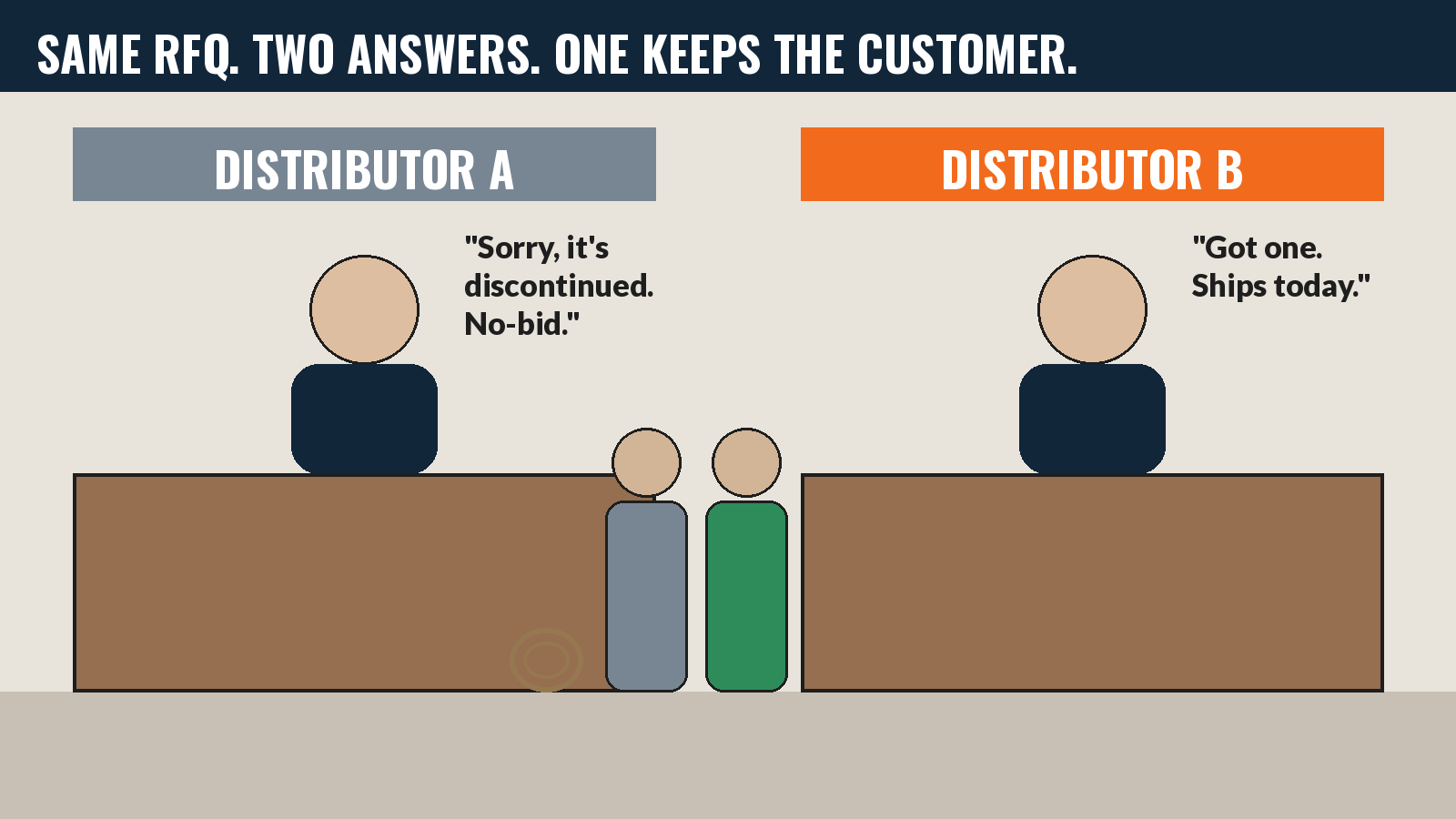
A no-bid looks free. It isn’t.
The line you don’t quote goes to whoever does. Sometimes that’s a broker your customer found on page one of a search. Sometimes it’s a competitor who had a surplus source on speed dial. Either way, the customer just learned that someone else solves problems you don’t, and the next RFQ, the one with the easy, in-catalog items on it, has a reason to go there too.
Discontinued and hard-to-find parts are also the lines where your customer is least sensitive to price. A plant with a down line isn’t comparing three quotes on a legacy servo amplifier. They’re asking who has it. The distributor or wholesale supplier who answers “we do” sets the terms.
New, in-catalog product comes with a price everyone can look up. Your customer knows list. Your competitors know list. It’s all over the internet. Your margin lives in whatever discount the manufacturer gives you, and you don’t control that.
Surplus works differently. A discontinued part has no current list price to anchor against, and the alternatives your customer is weighing are a retrofit, a redesign, or a long wait. Against those, a fairly priced surplus part looks cheap, and the spread between your cost and your sell price is yours to set sensibly.
And you never carry it. Surplus MRO parts for distributors work best as a drop-in source: you quote, you mark it up, the part ships. No stock on your shelf, no slow movers on your books, no annual count of things you bought for one customer in 2021.
As a quote-filler. Run every no-bid line past a surplus source before you send the RFQ back. Most distributors who start using surplus MRO parts for distributors this way are surprised how many “impossible” lines come back with a price.
As an emergency desk. Give your inside sales team one number to call when a customer’s line is down. The faster they can say “it ships today,” the less the customer cares about anything else on the invoice.
As a quiet assortment extension. Some distributors list surplus parts in their own catalog, sourcing only once an order lands. Your catalog gets deeper, and your warehouse doesn’t get any bigger.
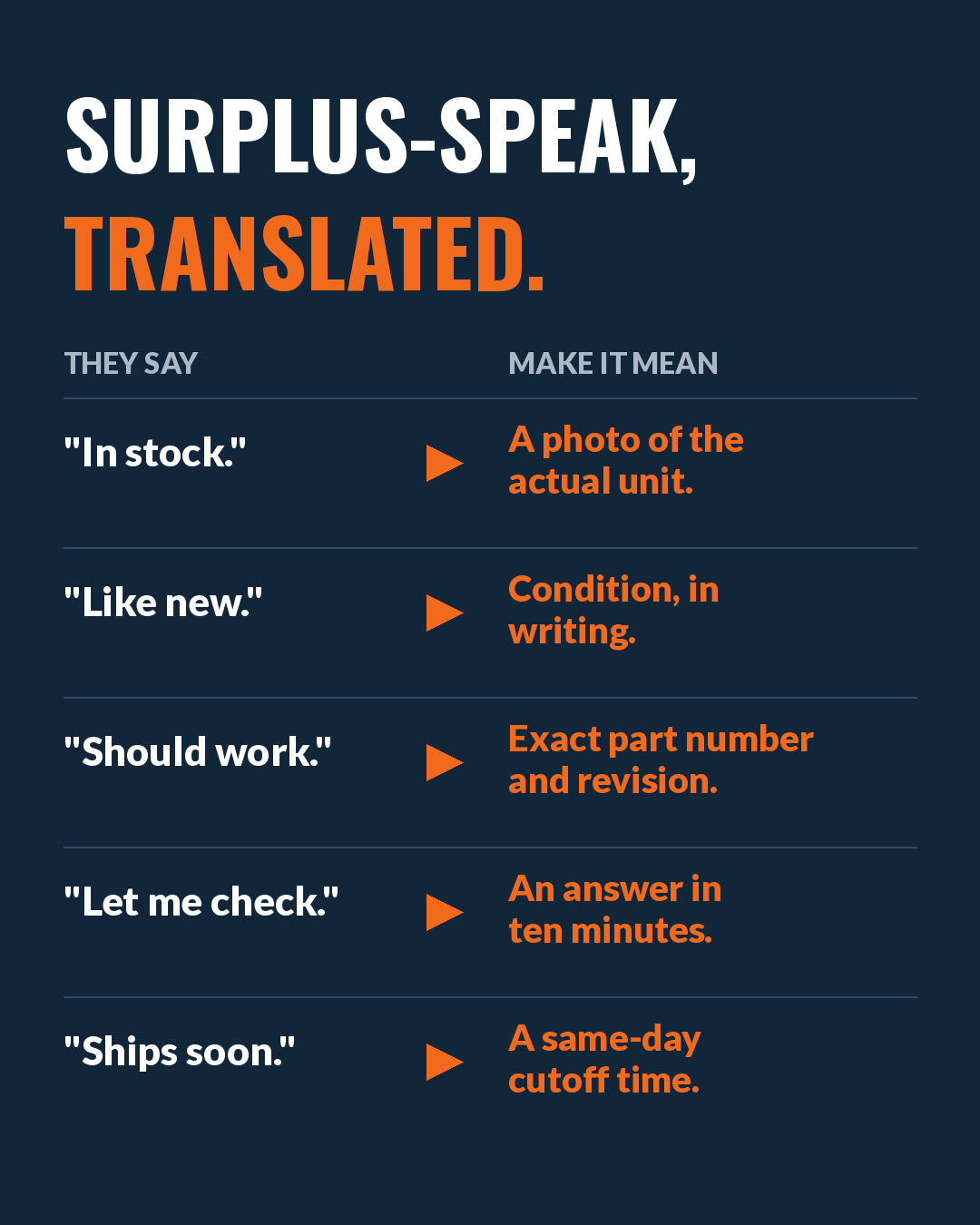
Here’s the catch. The surplus market has plenty of sellers whose “in stock” means “we think we can find one” or it’s drop-shipped from who knows where. Spend an hour on any controls forum and you’ll read the same complaints: lead times that appear after payment, refurbished units sold as new, the wrong firmware revision, a CPU that shows up without its battery or connectors. When that happens, it’s your name on the invoice, not theirs.
So hold a surplus source to these, every time:
Surplus isn’t for every line on an RFQ. Contracts that require new-from-manufacturer product with full OEM warranty should stay that way. So should anything where your customer’s quality system demands traceability surplus can’t provide.
Everywhere else, the fit is obvious:
Used this way, surplus MRO parts for distributors expand your assortment without expanding your inventory. You quote more lines, close more orders, and turn the no-bid pile into the most profitable part of the RFQ.
Usually, yes. For discontinued parts, yes; there isn’t a new option. Tell them up front what condition it is. Surprises are what lose customers, not surplus.
Against the alternative, not against a list price that no longer exists. What would a retrofit, a redesign or three weeks of downtime cost your customer? Price fairly below that and you’ll win the line and keep the customer.
No. The point of sourcing surplus MRO parts for distributors on demand is that you never hold them. The point of a good surplus partner is that their shelf becomes yours, on demand. Next-Day air shipping exists for a reason.

Central Surplus supplies surplus MRO parts for distributors every day, with a heavy focus on automation: PLCs, PCBs, drives and servo amplifiers, plus bearings, motors and power transmission. Search the store. You’ll get a fast answer on what we have, photos of the actual units, condition in writing, and a ship date you can give your customer with a straight face.
Your customer doesn’t need to know where it came from. They need to know you were the one who had it.
Quoting a hard-to-find part? Make it easy. → Shop Industrial Automation



Our team can locate, cross-reference, and source all parts.
Our team can locate, cross-reference, and source all parts.