
New Inventory Daily | Same Day Free Shipping
12,984 ratings on eBay See our eBay feedback →

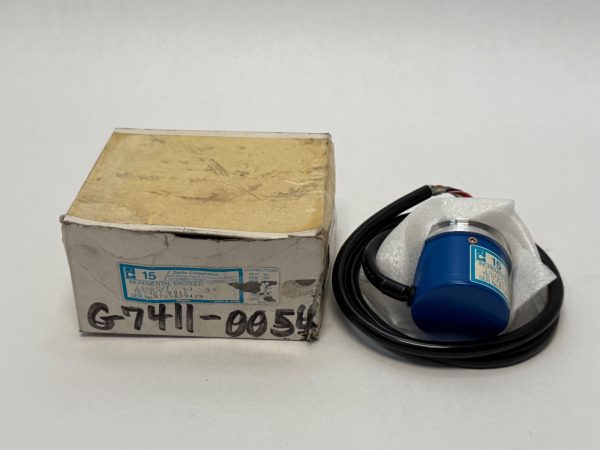
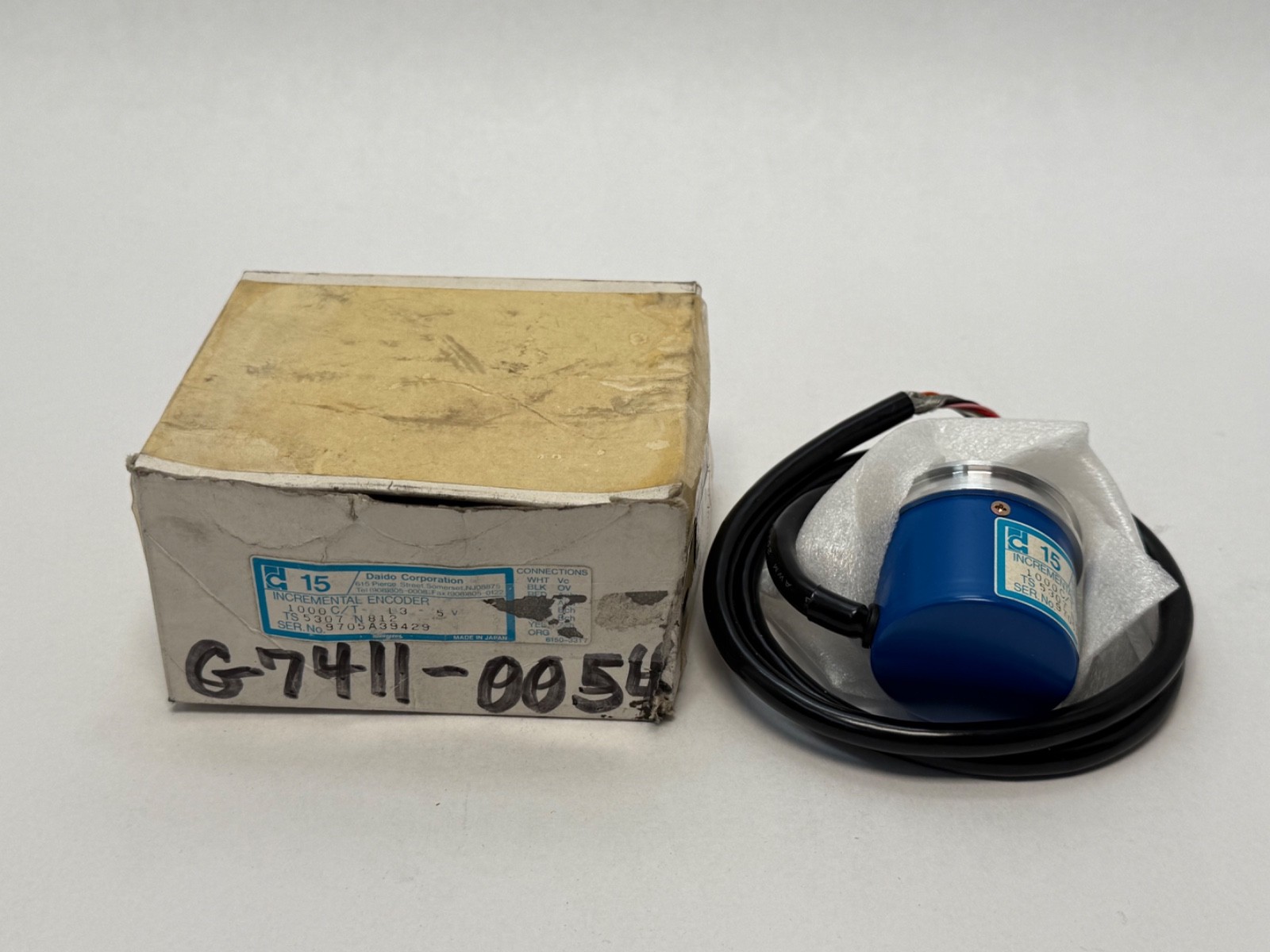
Daido1000C/T-L3-5VIncremental Rotary Encoder — 1000 Counts Per Turn, 5 V DC Supply, Encoder Only (No Coupling, Connector or Bracket)

Condition: New – Open box
Condition Note: Made In USA, New Old Stock

Availability:

2 in stock

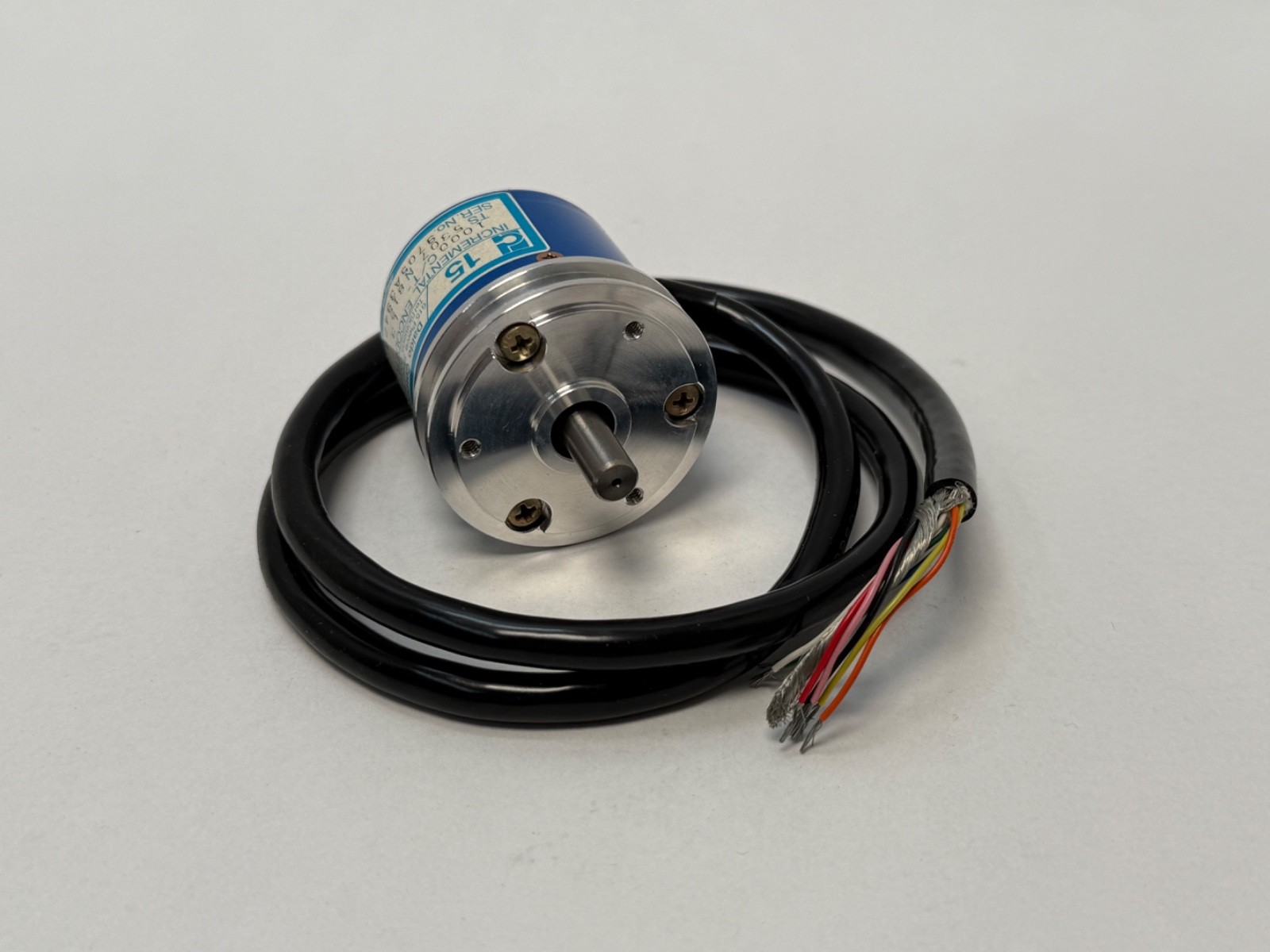
Incremental rotary encoder with a resolution of 1000 counts per turn, running on a 5 V DC supply. The order code reads directly: 1000C/T is the resolution, 5V is the supply. Those two figures decide most of the fit question — the counts per turn sets the positional resolution your controller sees, and a 5 V encoder must be fed a regulated 5 V and read by a card expecting 5 V logic. Two units in stock. Encoder only — no shaft coupling, no mating connector or cordset, no mounting flange or bracket.

List Price

$84.12

2 in stock

Availability

2 in stock

On the Shelf & Ready to Ship

Free Shipping

On all orders

Free Returns

No Risk, No Hassle

Also Available From:

Specifications

Key Specifications

MFR / BrandDaido
MPN1000C/T-L3-5V

Technical Specifications

ConditionNew – Open box
Base Number1000C/T
Industry Termsincremental rotary encoder; shaft encoder; pulse generator; rotary pulse generator; RPG; quadrature encoder; 1000 PPR encoder; 1000 C/T encoder
Application TypesMachine axis position and speed feedback; leadscrew and spindle position sensing; conveyor and web length measurement; motor speed feedback
Condition NoteMade In USA, New Old Stock
Output TypeIncremental Encoder
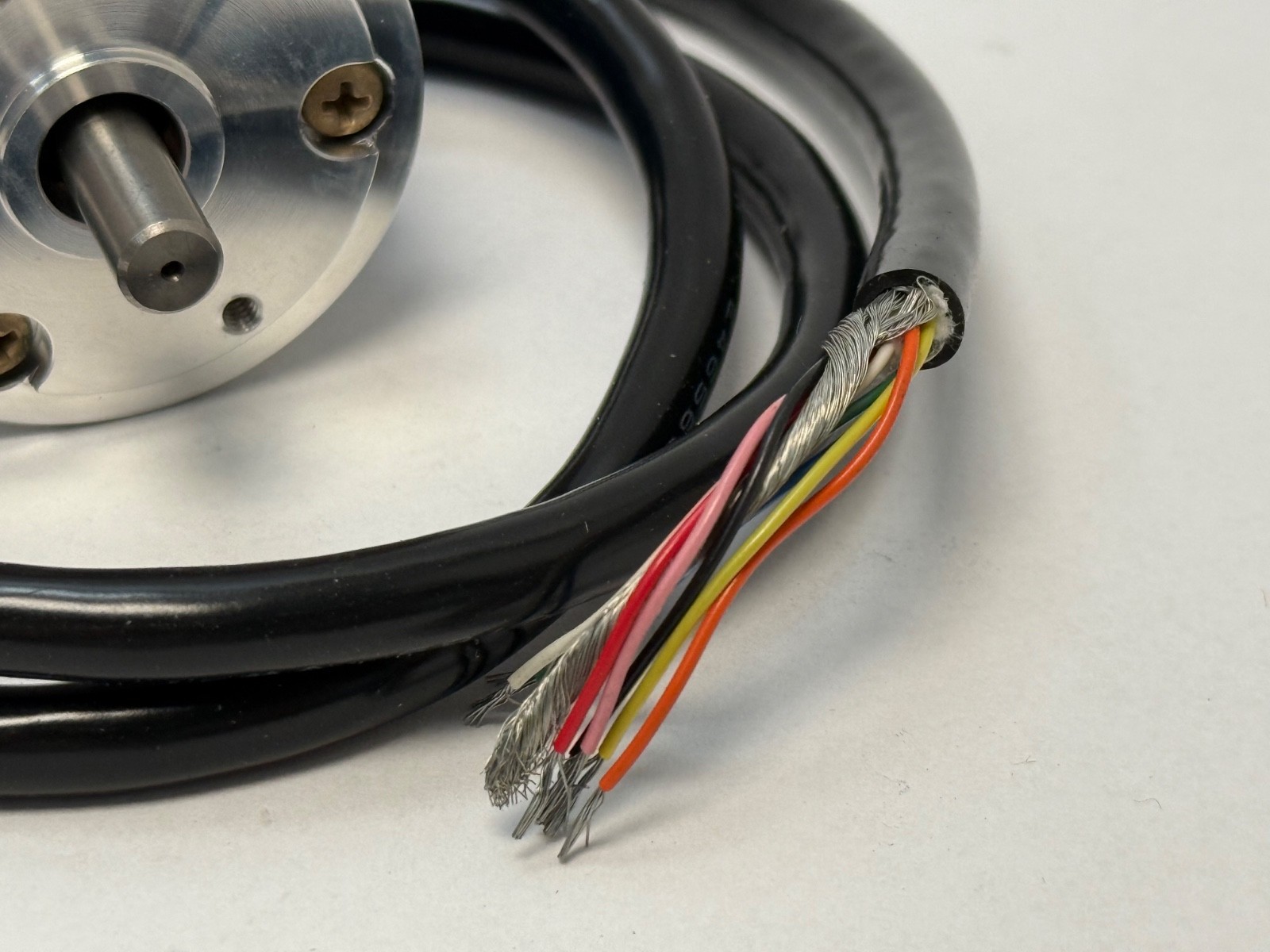
Connector StyleNot published — connector or cable type not documented; see the listing photographs for the cable/connector exit
Encoding TypeIncremental
Shaft TypeNot published — shaft diameter and shaft-vs-hollow-shaft type are NOT documented and must be measured. Ask us and we will measure the actual unit.
Mpn Variants1000C/T-L3-5V; 1000CT-L3-5V; 1000C/TL35V; 1000CT L3 5V; 1000C/T L3 5V; 1000CTL35V; Daido 1000C/T
Distributor Stock NumbersSB Industrial Supply (Daido C/T incremental encoder family); Tamagawa Seiki and Autonics catalogues used as comparators only
Arrangement ConfigurationEncoder only — shaft coupling (a flexible coupling is essential), mating connector or cordset, mounting flange, bracket or servo clamps, 5 V power supply and counter/interface card are all separate
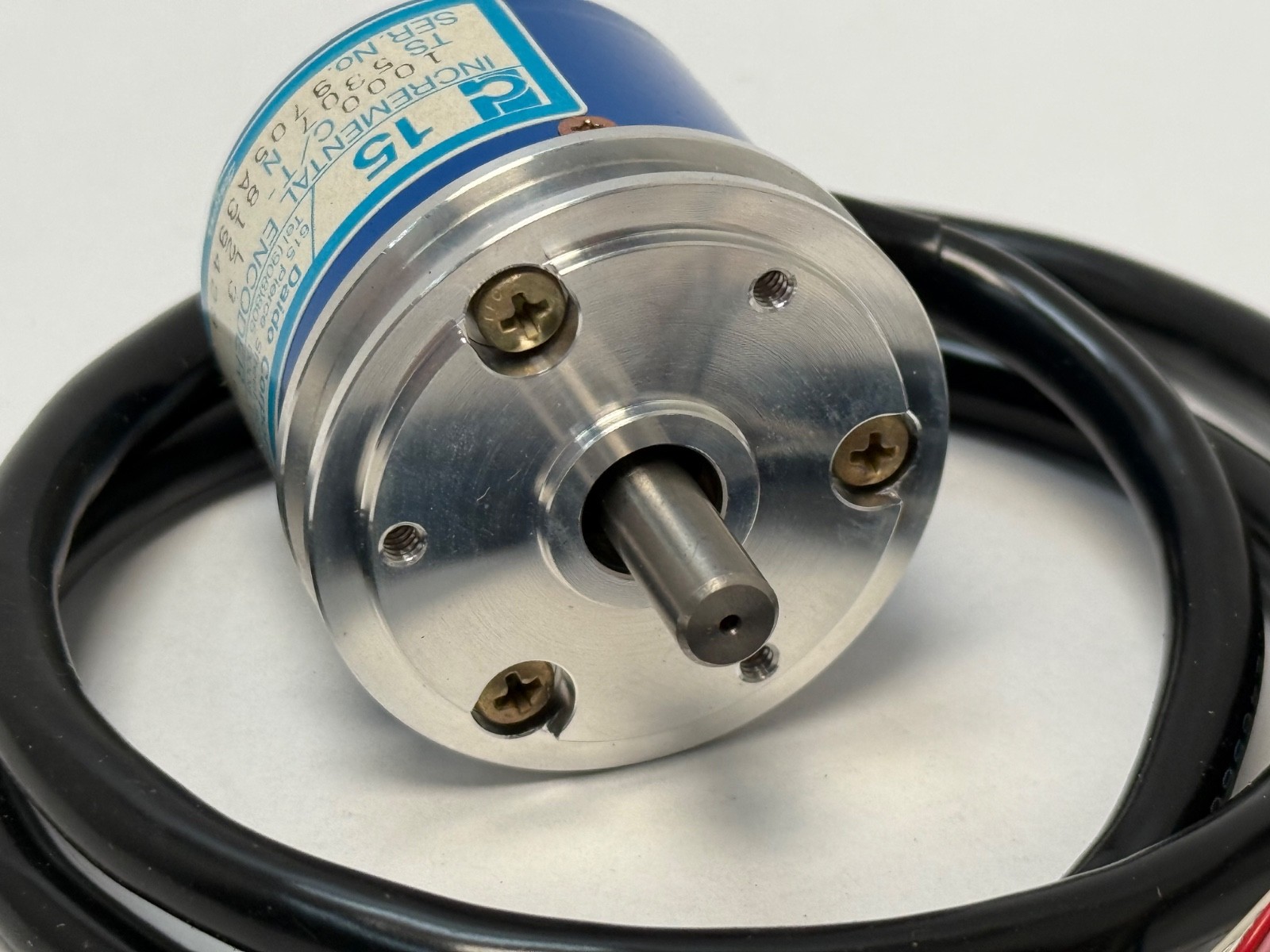
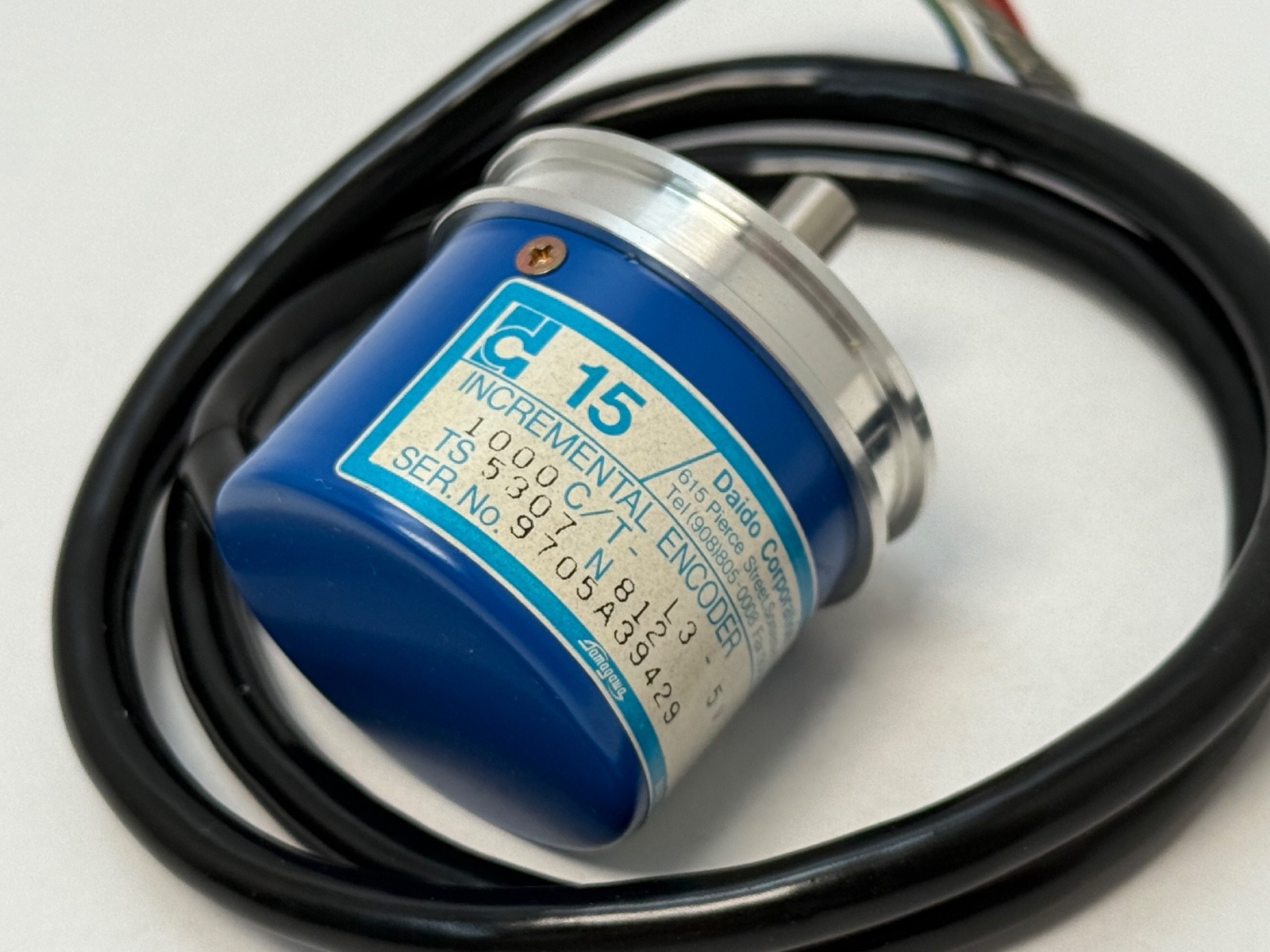
Additional AttributesORDER CODE: 1000C/T = 1000 counts per turn (C/T is the standard Japanese-market abbreviation for counts per turn). 5V = 5 V DC supply. L3 IS UNDECODED — no published Daido decoder table exists. In the wider encoder market a letter in that position typically selects output form (line driver, open collector, totem pole, voltage) or the phase set, and L most often denotes a line driver, but that is NOT asserted here because guessing an output stage is how a buyer receives an encoder their input card cannot read. Match L3 against your machine's parts list. OUTPUT FREQUENCY: at 1000 C/T a shaft at 3000 rpm gives 50 kHz per channel, at 6000 rpm 100 kHz — check your counter card's maximum input frequency and allow for cable capacitance on long runs. INSTALLATION: always use a flexible coupling; encoder bearings are small and a rigid coupling drives misalignment and shaft runout straight into them. On a 5 V encoder, cable voltage drop is a genuine fault mode with almost no margin — measure the supply AT THE ENCODER, use screened cable, earth the screen at one end only. NOT published and deliberately blank: shaft diameter, shaft or hollow-shaft type, output phases (A/B or A/B/Z index), output form, current consumption, maximum response frequency, maximum allowable rotation, starting torque, allowable radial and axial shaft load, protection rating, operating temperature, connector and cable type, housing diameter, weight. Shaft diameter and the presence of a Z index channel are the two decisive unknowns and both are physically checkable — ask. ORIGIN: no country of origin is claimed. Daido is a Japanese company, so the prior listing's claim of US manufacture is not supportable and has been removed; the marking on the unit is the authority.
Nominal Rated Input Voltage5 V DC (fixed, not a range — requires a regulated 5 V feed and outputs 5 V logic levels)
Part Number1000C/T-L3-5V
Running Accuracy Radial And Axial RunoutResolution 1000 counts per turn = 0.36° per count raw; 4000 counts per revolution = 0.09° with quadrature edge counting

Cross-References

Cross Reference 15507 812 / 5507812 (secondary marking, probable OEM or order reference)
Cross Reference 2Tamagawa Seiki TS5x incremental series (1000 C/T comparator — NOT a verified drop-in)
Cross Reference 3Autonics ENA-1000-3-T-5 (1000 P/R, 5 VDC comparator — NOT a verified drop-in)
Cross Reference 4Omron / Koyo / Nemicon 1000 PPR 5 V incremental encoders (comparators only)
Seller Part Number: B-AG2B4#SWQZZ8

Product Description

What this part is

An incremental rotary encoder, order code 1000C/T-L3-5V, carrying the secondary marking 5507 812. An incremental encoder produces a pulse train as its shaft turns; the controller counts those pulses to derive position, speed and direction. Unlike an absolute encoder it has no knowledge of position at power-up, which is why machines using incremental feedback have to reference or home an axis after switching on.

Decoding the order code

Two of the three fields decode cleanly, and they are the two that matter most:

1000C/T — 1000 counts per turn. C/T is the standard Japanese-market abbreviation for counts (or cycles) per turn, used across the rotary-encoder industry — Tamagawa Seiki, for example, specifies its incremental encoder resolutions in C/T. This is the encoder’s resolution: 1000 output cycles per shaft revolution.5V — a 5 V DC supply. This is a fixed characteristic, not a range: the encoder wants a regulated 5 V feed and it will output 5 V logic levels.L3 — undecoded. No published Daido decoder table for this field exists in any source we could find. In the general encoder market a letter in this position typically selects output form (line driver, open collector, totem pole, voltage output) or the output phase set, and an L in that role most often denotes a line driver output — but we are not stating that as fact, because guessing an output stage is exactly how a buyer ends up with an encoder their input card cannot read. Treat L3 as an unresolved configuration code and match it against your machine’s parts list.5507 812 — a secondary marking, most likely an OEM, order or serial reference rather than a Daido catalogue field. Retained as a search term, not decoded.

What 1000 counts per turn actually buys you

Worth putting in practical terms, because it is the number that decides whether the encoder suits the job.

1000 C/T gives 0.36° of shaft rotation per count on the raw signal. If your controller does quadrature edge counting — which most position controllers do, using both A and B channels — you get 4000 counts per revolution, or 0.09°. On a leadscrew that translates directly: a 5 mm pitch screw with a 1000 C/T encoder gives 5 µm per count raw, or 1.25 µm with quadrature.

The counterpart consideration is output frequency. At 1000 C/T, a shaft turning at 3000 rpm produces 50,000 pulses per second per channel; at 6000 rpm, 100,000. Both are within the response capability of typical encoders in this class, but your counter card also has a maximum input frequency, and cable capacitance over a long run degrades fast edges. If you are running high speed or a long cable, check the counter’s maximum input frequency and the encoder’s output form together — which is another reason the undecoded L3 field matters.

Correcting the source data

Our previous description said this encoder was “made by the reputable brand Daido in the United States.” Daido is a Japanese company, so a claim of US design and manufacture is not one we can support and we have removed it. Our condition record carries “Made In USA” and we have echoed that field unchanged rather than edit it — but we are making no country-of-origin claim on this page until the marking on the actual unit is read. If origin matters to you, ask and we will read the label.

The old copy also described the encoder as providing “accurate and consistent readings” with an “incremental encoding and output type,” which is filler — it names the category and no specification. That has been replaced with the decode above.

What is not published — and what to check before ordering:
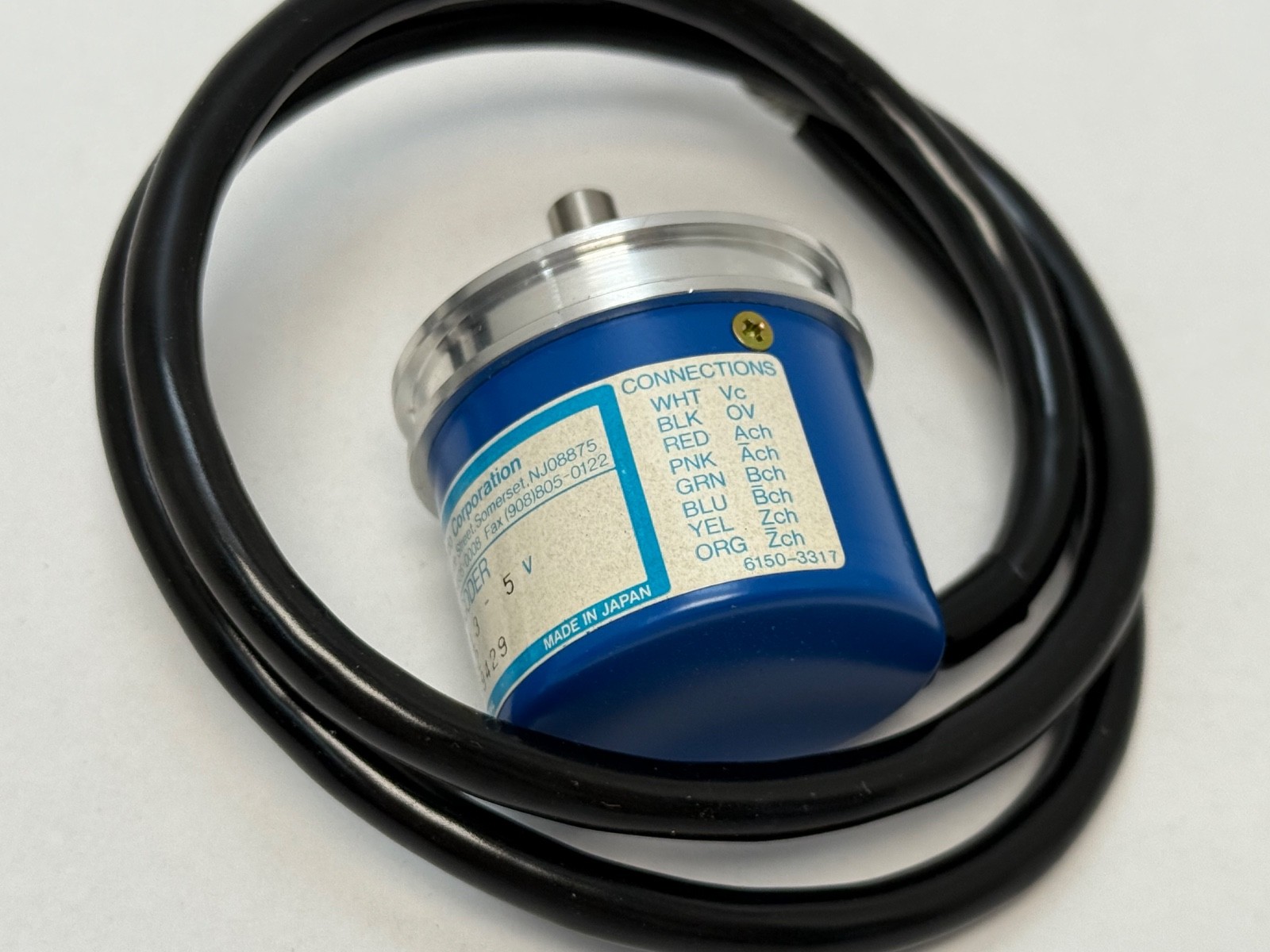
No Daido datasheet for the 1000C/T series is in public circulation. The following are therefore blank rather than estimated: shaft diameter, whether it is a shaft or hollow-shaft type, output phases (A/B only, or A/B/Z with an index marker), output form, current consumption, maximum response frequency, maximum allowable rotational speed, starting torque, allowable radial and axial shaft load, protection rating, operating temperature range, connector or cable type, housing diameter and weight.

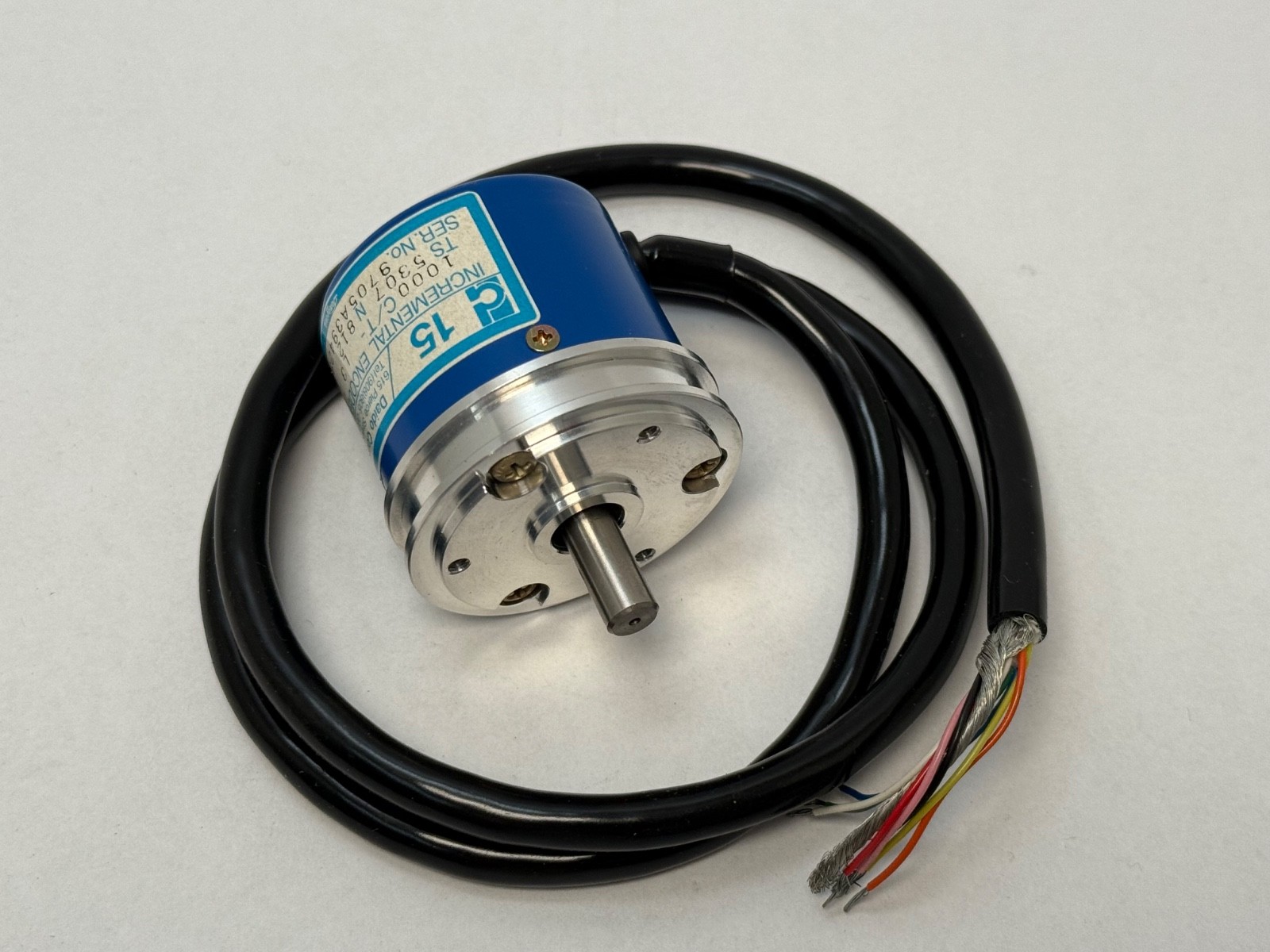
Two of those are usually decisive and both are visible on the item: shaft diameter and whether there is a Z (index) channel. The photographs on this listing show the encoder body, its shaft and its cable or connector exit — use them, and ask us to measure the shaft and read the full nameplate before you order. On an encoder, a wrong shaft diameter is a non-starter and a missing index channel breaks homing.

What is not included

Encoder only. Not included: the shaft coupling (a flexible or bellows coupling is essential — see below), the mating connector or cordset, any mounting flange, bracket or servo clamps, the 5 V power supply, and the counter or interface card.

Installation notes

Two points that account for most premature encoder failures. First, always use a flexible coupling between the driven shaft and the encoder shaft. Encoder bearings are small and lightly loaded by design; a rigid coupling transmits every bit of misalignment and shaft runout straight into them and they fail in months rather than years. Second, on a 5 V encoder, voltage drop down the cable is a real fault mode. A 5 V supply has very little margin, and a long or thin cable run can drop enough that the encoder sees under 4.75 V and produces marginal or intermittent output — a fault that looks like a failing encoder and is actually a wiring problem. Measure the supply at the encoder, not at the panel, and use screened cable with the screen earthed at one end only.

Quantity and interchange guidance

Two units in stock, sold individually — one to fit and one to hold, or a matched pair from the same batch for a two-axis machine.

Search forms include 1000C/T-L3-5V, 1000CT-L3-5V, 1000C/TL35V, 1000CT L3 5V, 1000C/T L3 5V, Daido 1000C/T, 5507 812 and 5507812. Other Daido incremental encoders appear in the surplus market at different resolutions in the same C/T notation, so the family is real even though the catalogue is not public.

Same-envelope 1000 pulse-per-revolution 5 V incremental encoders are catalogued by Tamagawa Seiki (TS5x series, 100 to 5000 C/T), Autonics (ENA-1000-3-T-5 and similar), Omron, Koyo and Nemicon. Do not treat any of them as a drop-in without checking shaft diameter, output form, phase set and mounting pattern — resolution and supply voltage matching is only the start, and the physical and electrical interfaces are not standardised across makers.

You May Also Like

Daido 1000C/T-L3-5V Incremental Encoder 5507 812
1000C/T-L3-5V

$76.47

1 in stock

Add to cart

Need help finding the right part?

Our team can locate, cross-reference, and source all parts.
News

Bearing Price Increases Stacked Deep In 2026

Nine bearing and power transmission manufacturers raised list prices this

MRO Spare Parts: Why Your Storeroom Is Full yet Still Short

Maintenance is now 65% Slower, but it’s not a labor

Additional Resources

Need help finding the right part?

Our team can locate, cross-reference, and source all parts.
Get In Touch

Sort

Brand

Price

MPN

Categories