
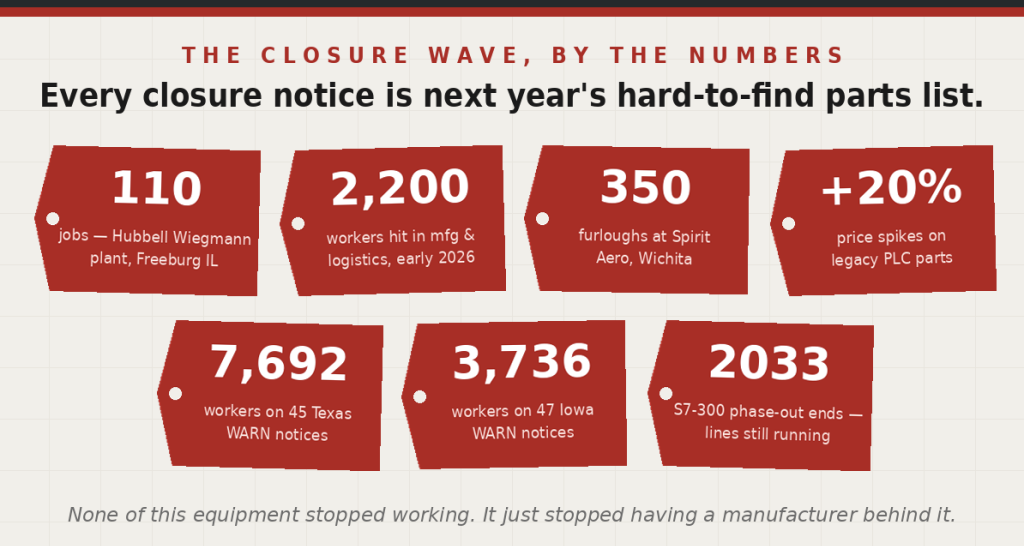
Hubbell is closing its Wiegmann enclosure plant in Freeburg, Illinois — 110 jobs, with production splitting between Aurora, Illinois and Juarez, Mexico.
Briggs & Stratton is shuttering two Billy Goat facilities in Missouri. GM made the same roundup. Spirit AeroSystems is furloughing up to 350 people in Wichita — because it built too many thrust reversers.
Closing plants for making too little. Furloughing plants for making too much. It’s been that kind of year.
Manufacturing and logistics closures hit 2,200 workers in the opening weeks of 2026 alone. The pace hasn’t let up since.
The headlines cover the jobs. We hear it in every Fed report nowadays.Fair enough — that’s the human cost.
But if you run maintenance, procurement, or a storeroom, there’s a second story in every one of those announcements.
You’ve probably got at least one machine on your floor whose manufacturer no longer makes the parts for it. Most plants have a dozen. Some warehouses have hundreds.
Here’s the part nobody’s talking about: every one of those plants leaves behind an installed base of equipment — and a storeroom full of parts — that doesn’t retire just because the factory did.
That’s the real story.
When a manufacturer closes a plant or kills a product line, the press release and the purchase order tell two different stories.
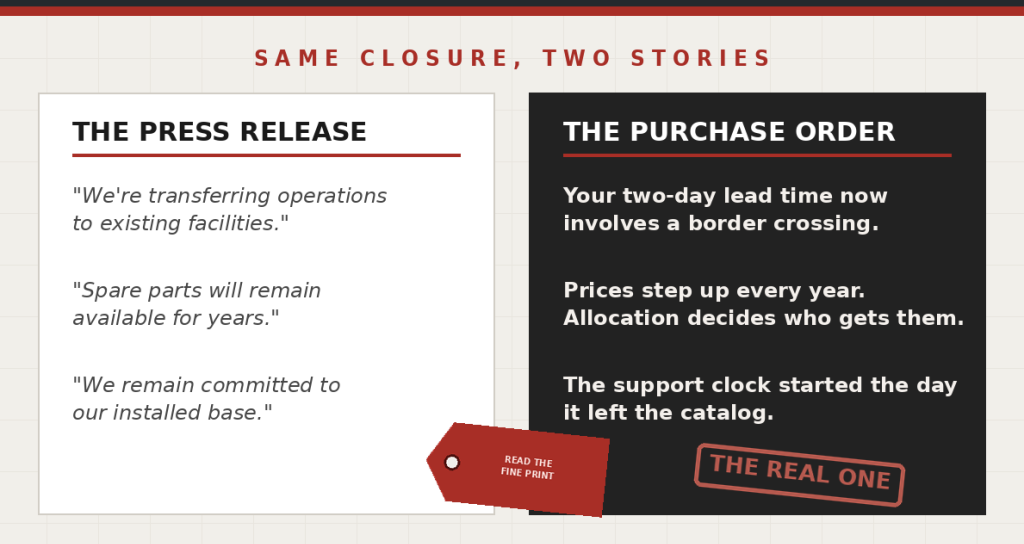
The bottom line: none of this equipment stopped working. It just stopped having a manufacturer behind it.
The installed base always outlives the factory that made it.
None of this requires a crystal ball. It requires a walk-through and a list.
It’s time to profit from your Discontinued Industrial Parts
1. Map your orphaned-equipment exposure.
2. Build your secondary-market bench now — not during the outage.
3. If you’re the one consolidating — sell the storeroom, don’t scrap it.
That storeroom you’re about to write off? Somebody is searching for exactly what’s in it right now.
Phase-out lists get longer every quarter. Plants keep consolidating. And the equipment keeps running anyway.
The S7-300 phase-out alone stretches to 2033 — on a platform still running assembly lines, water plants, and offshore rigs. Hubbell’s enclosure lines will have installed product in the field for decades.
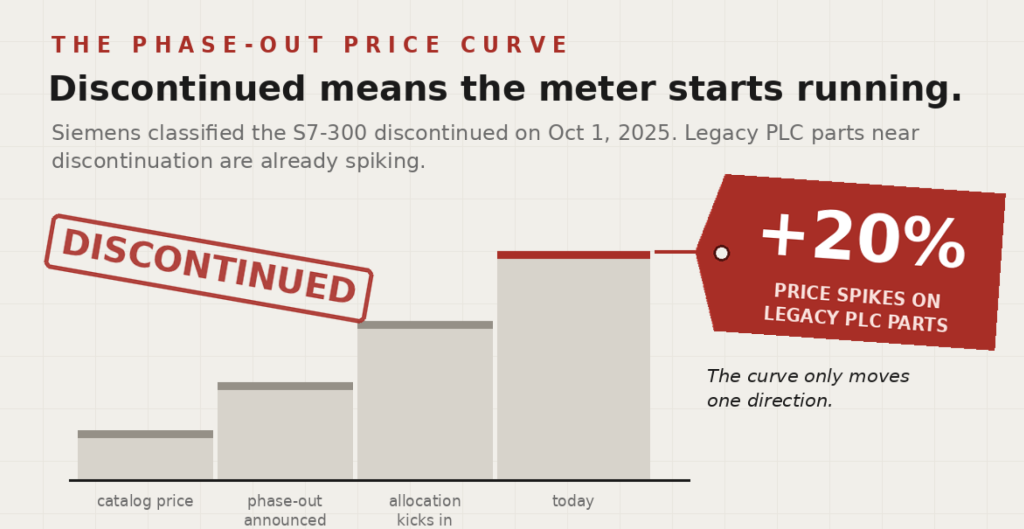
None of this is a crisis if you see it coming. Legacy equipment that’s paid for and running well is an asset — as long as the parts pipeline behind it is real.
For everyone still running that equipment, the surplus and secondary market isn’t a fallback anymore — it’s the supply chain.
The operators who win this cycle are the ones who audit the storeroom before the phase-out list does it for them.
Buyers lock in spares early.
Sellers turn dead plants into working capital.
Audit your installed base this month. Don’t wait for the outage.
What to watch: the next wave of WARN filings — every closure notice is next year’s hard-to-find parts list.



Our team can locate, cross-reference, and source all parts.
Our team can locate, cross-reference, and source all parts.