

New plants don’t run themselves — and the American Manufacturing MRO opportunity inside this reshoring wave is hiding in plain sight.
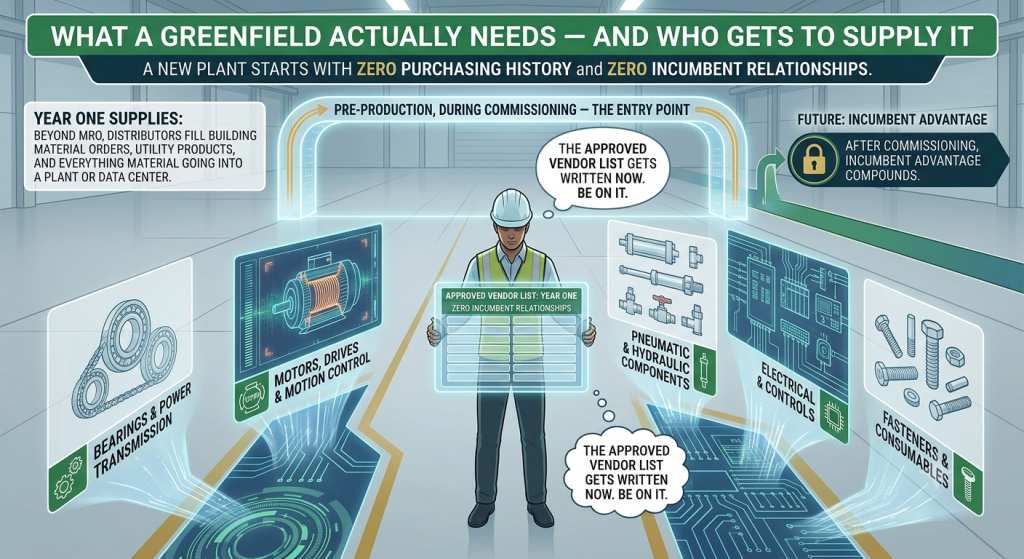
$1.765 trillion in announced private-sector manufacturing commitments since January 2025 — 160 companies, 37 states.
This is real capital allocation.
Apple is putting in $600 billion. Micron committed $200 billion across fabs in New York and Idaho. TSMC broke ground on its third Arizona facility. Johnson & Johnson, AstraZeneca, Roche — all in the ground.
The semiconductor names get the headlines. But the construction pipeline is broader: advanced manufacturing, pharmaceuticals, EVs, defense supply chain. Every sector is running some version of the same play.
Here’s the part most distributors are sleeping on:
Every one of those facilities needs MRO. From day one. For decades.
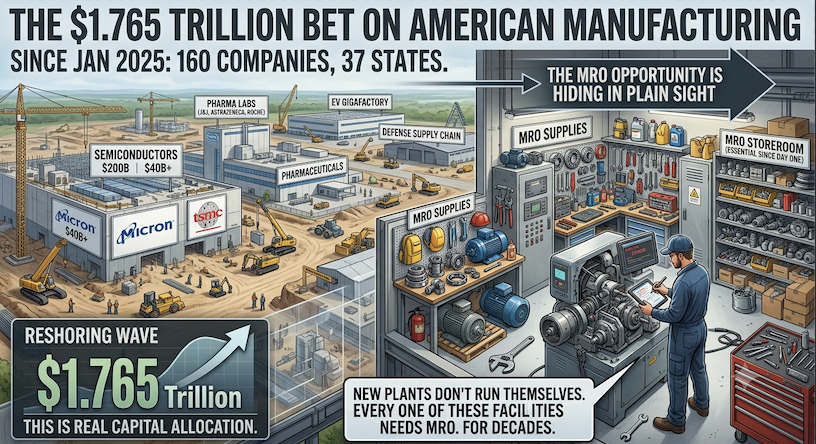
A new plant starts with zero purchasing history and zero incumbent relationships.
No preferred vendor list. No legacy distributor contracts. No entrenched supplier who’s been in the storeroom since 1998. Just a facilities manager, a maintenance budget, and a blank approved vendor list that’s about to get filled.
You should get on that list.
That window — pre-production, during commissioning — is the entry point. And it’s the same window for everyone.
Here’s what a greenfield buys in year one:
And beyond MRO, distributors will be filling building and construction orders, utility products and every hard material going into a manufacturing plant or data center.
The approved vendor list gets written during commissioning. After that, the incumbent has a structural advantage that compounds every single year.
That’s the real story. That could be you.
Three distributor moves you get your share of this American Manufacturing Oppourtunity
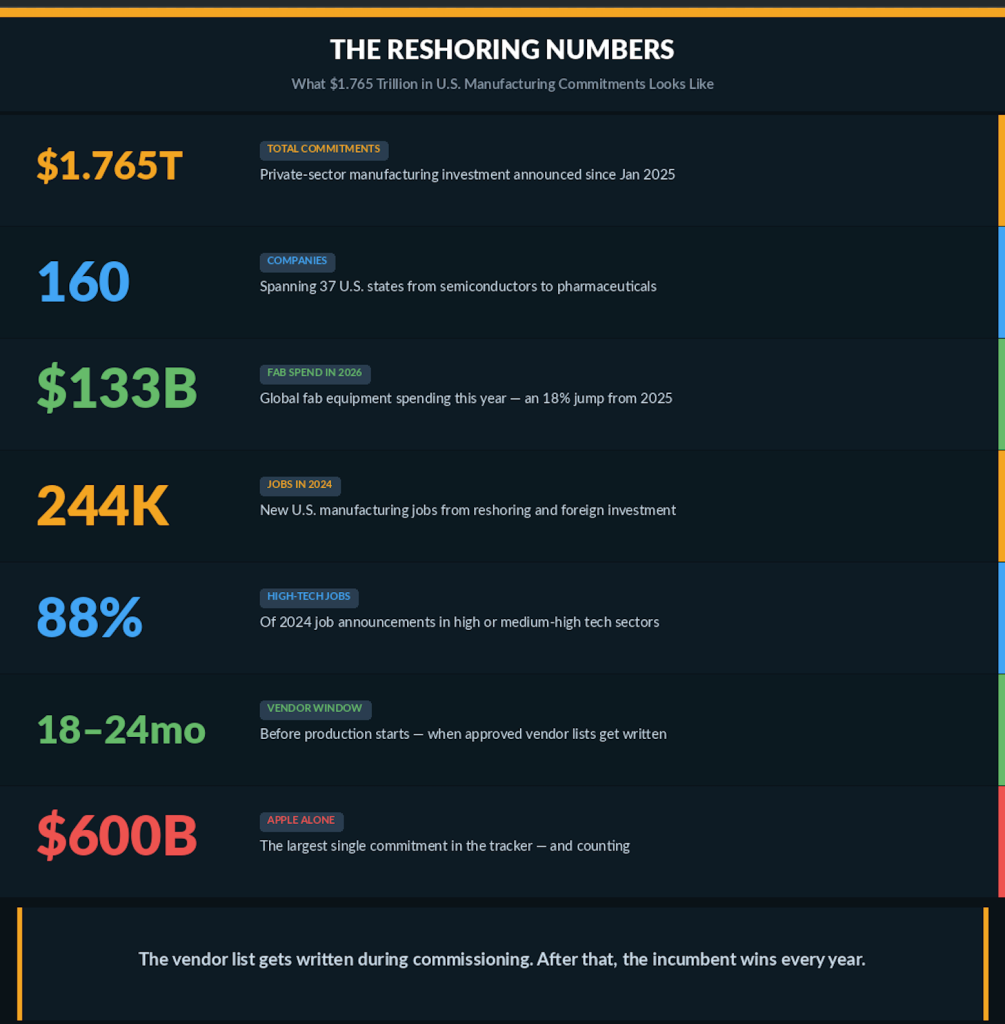
TSMC’s Fab 21 Phase 2 in Arizona begins equipment installation this quarter. Micron’s New York fab broke ground in January. Dozens more facilities across pharma, EV, and advanced manufacturing are moving from announcement to shovel right now.
That’s 244,000 manufacturing jobs announced in 2024 alone — with the 2026 pipeline tracking higher. Every one of those jobs lives in a facility. Every facility has a maintenance budget. And for most of them, the MRO vendor hasn’t been selected yet.
The window is here, but the American Manufacturing Oppourtunity is finite.
The distributors winning this cycle aren’t the ones who saw the headline and cheered. They’re the ones who already had a conversation started by the time the equipment hit the floor.
Don’t sleep on this.
What to watch: TSMC Fab 21 Phase 2 equipment install (Q3 2026), Micron New York ramp timeline, and the state-level manufacturing investment tracker for projects entering construction in your region this fall.
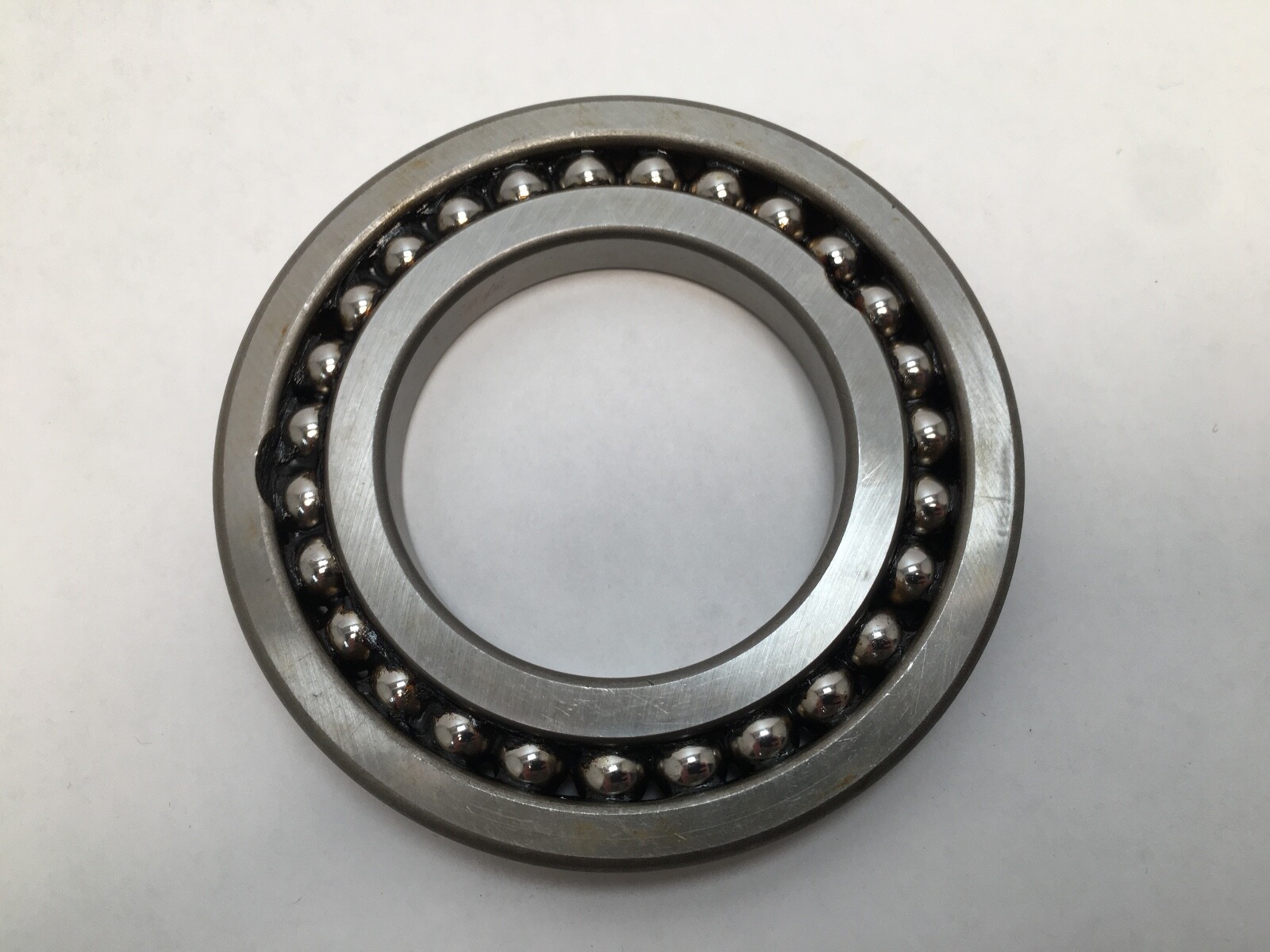


Our team can locate, cross-reference, and source all parts.
Our team can locate, cross-reference, and source all parts.