
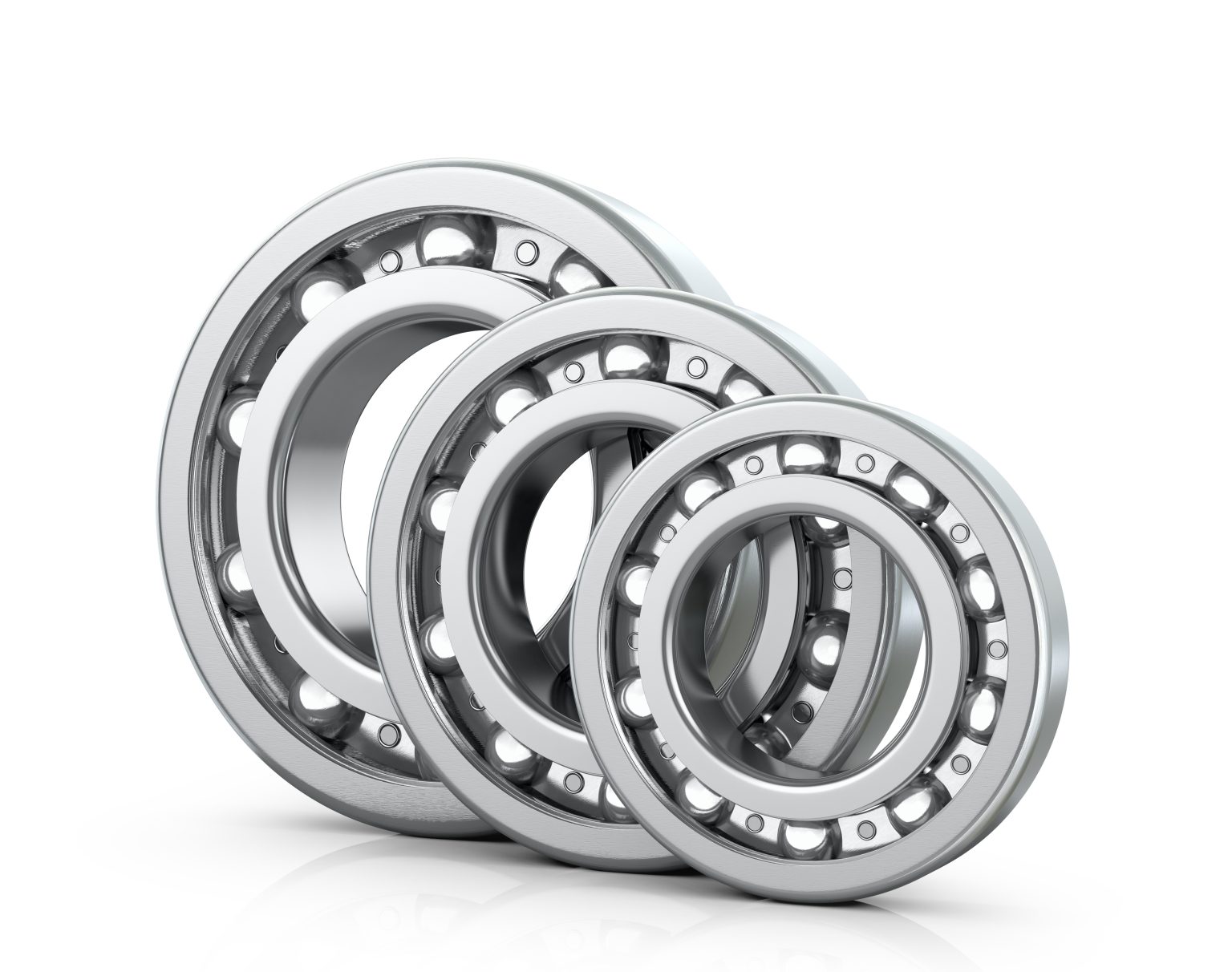
If you pulled a bearing off general industrial equipment at random, there’s a good chance it’s a deep groove ball bearing. It’s the default choice across MRO and OEM applications, and for most jobs, it’s the right one.
This post explains why the deep-groove ball bearing, sometimes called radial or conrad bearing,is widely used and outlines the specific conditions in which an alternative bearing is more appropriate.
A deep groove ball bearing features a deep, continuous raceway groove, allowing it to support radial loads and moderate axial loads in both directions (typically up to 50% of the static radial load capacity) within a compact, straightforward design. This versatility is its main advantage.
For general-purpose equipment, motors, pumps, fans, gearboxes, and other applications with moderate, predictable loads, a deep-groove ball bearing performs reliably without requiring specialized engineering. This reliability makes it the default choice when no unique demands are present.
However, the same design that provides versatility also limits its suitability when load conditions exceed moderate levels. The following are situations where it is not the best option.
Ball bearings make point contact with the raceway, which limits their load capacity compared to roller bearings that provide line contact over a larger area. For heavy radial loads, a cylindrical or spherical roller bearing will significantly outlast a deep groove ball bearing of the same size.
While a deep groove ball bearing can handle moderate axial loads, high combined radial and axial loads require a tapered roller bearing, or an angular contact ball bearing which is designed for such conditions. Using a deep groove ball bearing in these situations often leads to premature wear on one side of the raceway, due to ball contact riding up on the raceway shoulder, resulting in quick failure
Deep groove ball bearings have very limited tolerance for shaft misalignment (typically 2 to 10 arcminutes maximum depending on internal radial clearance) between the shaft and housing. For applications with misalignment due to thermal expansion, structural deflection, or imprecise mounting, a self-aligning ball bearing, spherical roller bearing is a better solution. And depending on your application, mounted unit bearing (such as a pillow block or flange housing) with a spherical ring diameter can accommodate initial static misalignment.
Standard deep groove ball bearings perform well at high speeds in general applications. However, machine tool spindles and other precision high-speed equipment require precision-class (ISO P4/P2 or ABEC 7/9) angular contact bearings precision-class (ISO P4/P2 or ABEC 7/9, typically mounted in matched sets and engineered for specific speed and axial preload requirements.
Point contact bearings are more susceptible to brinelling, or permanent deformation of the raceway, under shock loads than line-contact roller bearings. Applications with repeated impact, such as crushing or heavy material handling equipment, are typically better suited to roller bearing designs.
| Condition | Better Choice Than Deep Groove Ball |
| Heavy radial load alone | Cylindrical roller bearing |
| Heavy combined radial and axial load | Tapered roller bearing / Angular contact ball bearing |
| Significant shaft or housing misalignment | Spherical roller bearing / Self-aligning ball bearing |
| High speed with precision positioning | Angular contact bearing (ISO P4 / ABEC 7+) |
| Severe shock or impact loading | Cylindrical or spherical roller bearing |
| Very compact radial space with high load | Needle roller bearing |
Deep-groove ball bearings follow the standardized numbering system (ISO 15 / ANSI/ABMA standard) used across most of the bearing industry. The most common series (6000 [extra light], 6200 [light], 6300 [medium]) differ primarily in cross-sectional size for a given bore. A 6205 has the same 25mm bore as a 6305 (bore code 05 multiplied by 5 = 25mm), but the 6300 series has a heavier cross-section with larger balls for higher load capacity at the same bore size.
For a full breakdown of how to decode part numbers and cross-reference between manufacturers, see our bearing cross-reference guide.
Engineering Tip: Don’t Overlook Internal Radial Clearance
When replacing deep groove ball bearings in motor or pump applications, check the clearance suffix (e.g., C3). A C3 clearance bearing has greater internal radial play than standard (CN) bearings to accommodate thermal expansion as shafts heat up. Installing a standard bearing where C3 is required can lead to thermal preloading and premature bearing failure.
Quick Suffix Guide: Shields vs. Seals
Cross-Reference Note: While basic dimensions (bore, OD, width) for standard series (e.g., 6205) are identical across manufacturers under ISO/ANSI standards, seal and clearance codes vary by brand. For instance, SKF’s 2RS1 equivalent in NTN is LLU, and NSK is DDU. Always verify suffix codes when cross-referencing.
| Central Surplus Deep Groove Ball Bearing Inventory We stock deep groove ball bearings in the 6000, 6200, and 6300 series, in both metric and inch bore sizes, from SKF, Timken, FAG, NTN, and other leading manufacturers. Search by part number or contact our team for cross-reference support. |
Browse our full bearing inventory or contact us with your part number or application requirements.
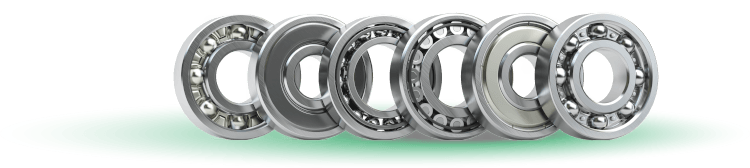
Our team can locate, cross-reference, and source all parts.
Our team can locate, cross-reference, and source all parts.


