If you have ever watched a machine glide smoothly back and forth, tracing a perfect line, you have seen a linear guide at work. This is the system that lets a part move in a straight path, with just the right amount of precision and almost no friction. If you have read our guide on linear actuators, you know that actuators are the muscle, generating the force. The linear guide is the backbone, supporting and steering that motion, making sure everything stays on track.
In this guide, I will walk you through how linear guide systems are put together, the different ways they can be configured, and what you should look for if you ever need to choose or replace one.
Linear guide systems have two main parts: the rail, sometimes called a guideway, and one or more carriages, AKA linear blocks, blocking or trucks, that glide along that rail.
Picture the rail as a hardened steel bar, its surface carefully ground to create smooth tracks called raceways. The carriage is packed with tiny ball bearings or rollers (or cylindrical rollers for ultra-heavy duty setups) that move along these tracks, letting the carriage glide effortlessly. This setup is strong enough to handle forces from above, from the sides, and even some twisting moment loads, depending on how the carriage is built.
As the carriage moves, the internal rolling elements recirculate. They roll along the loaded section of the raceway, then cycle back through a return channel inside the carriage body to the start of the loaded section again. This recirculation is what allows linear guides to support continuous travel over long distances without the carriage running out of rolling elements.
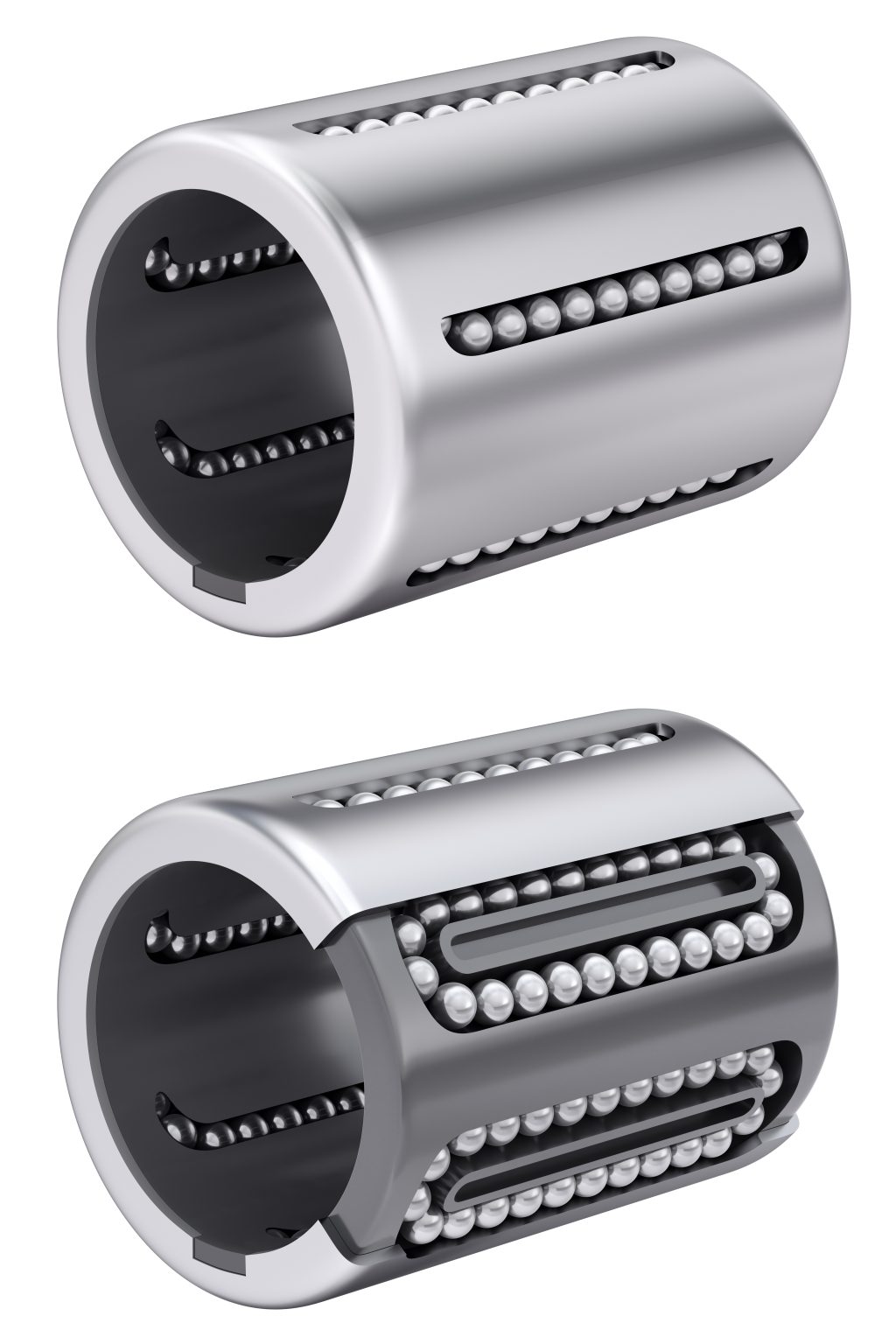
These terms get used loosely, and the distinction matters when you’re sourcing a replacement. A linear bearing (or bushing) typically refers to a simpler system: a cylindrical bearing that rides on a round, smooth shaft, supporting load primarily in the radial direction while offering no resistance to rotation around the shaft axis.
A linear guide, in the profiled-rail sense covered in this post, uses a rail with a specific cross-sectional profile featuring precision ground raceways, and a carriage engineered to grip that profile from multiple sides. This allows profiled rail guides to carry loads in more directions (downward, reverse-radial, and lateral shear) with greater rigidity than a simple round-shaft linear bearing.
Rail Size
Rail size is typically specified by width in millimeters (common sizes range from 15mm to 45mm and up). Larger rails carry higher loads and offer more rigidity but require more mounting space and add weight and cost.
Carriage Length and Type
Carriages come in standard and long (extended) lengths. A longer carriage distributes the load over more of the rail’s raceway, increasing load capacity and rigidity at the cost of a larger footprint. Flanged carriages allow mounting from the side or bottom, depending on the machine design.
Load Ratings
Like bearings, linear guides publish both a dynamic load rating (load capacity over the rated travel life) and a static load rating (maximum load without permanent deformation). Because linear guides typically support a moving mass under acceleration and deceleration, the actual load includes not just the static weight but the dynamic forces from starting, stopping, and any cantilevered load offset from the rail centerline.
Accuracy Class
Linear guide manufacturers publish accuracy classes (commonly Normal, High, Precision, and Super Precision, though naming varies by manufacturer) that specify parallelism and running-accuracy tolerances. Standard industrial automation typically uses Normal or High accuracy classes. Precision machine tools and metrology equipment require Precision or Super Precision classes.
Preload
Preload is an internal load applied to the rolling elements during manufacturing (by sizing the internal balls or rollers slightly larger than the raceway gap) to eliminate internal clearance. Higher preload increases rigidity and reduces backlash deflection under load but also increases friction, drive torque requirements, and can reduce service life if set too high.
If you need to replace a linear guide that has worn out or failed, here is helpful info to have on hand:
Note: Unlike round shafts, profiled linear rails and carriages from different manufacturers are rarely interchangeable; swapping a single damaged component usually requires staying within the exact same brand and series.
The quickest way to find an exact match is to look for the part number stamped right on the rail or carriage. If you have that, you are set. If not, just gather the details above and reach out to Central Surplus, and we can help you track down the right part.
At Central Surplus, we keep a wide range of linear guide rails, carriages, and other motion components from top manufacturers in stock. You can search by part number, or just let us know your rail size, carriage type, and accuracy needs; we are here to help.
Take a look through our automation and motion control inventory, or get in touch if you need help finding the right part.
Our team can locate, cross-reference, and source all parts.
Our team can locate, cross-reference, and source all parts.