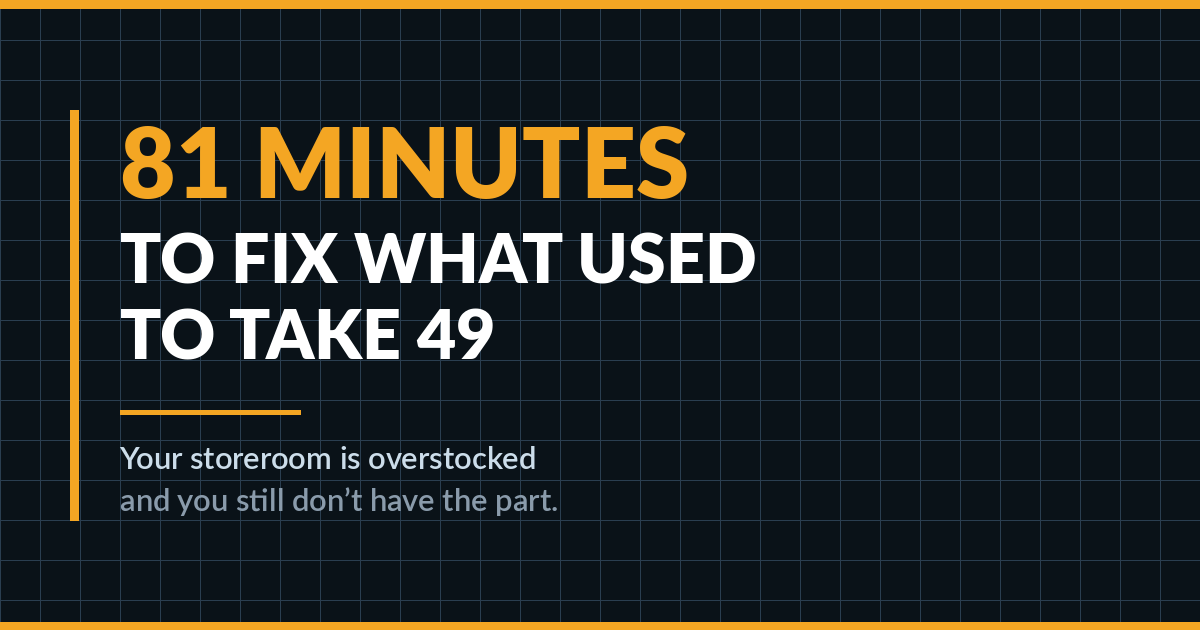
Maintenance is now 65% Slower, but it’s not a labor problem, it’s a MRO spares / parts problem.
Your crib is overstocked and you still don’t have the part. Both things are true, and the MRO spare parts market is why.
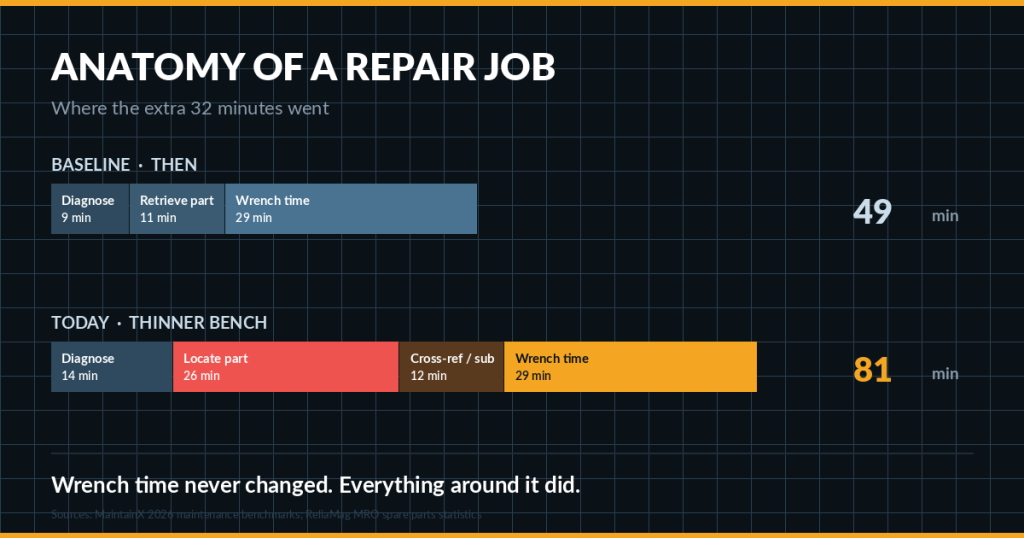
Mean time to repair across US manufacturing has climbed from 49 minutes to 81 minutes.
Same machines. Same failure modes. The clock just runs longer now.
The average plant eats roughly 25 unplanned downtime incidents a month — about 326 hours a year of assets sitting dark.
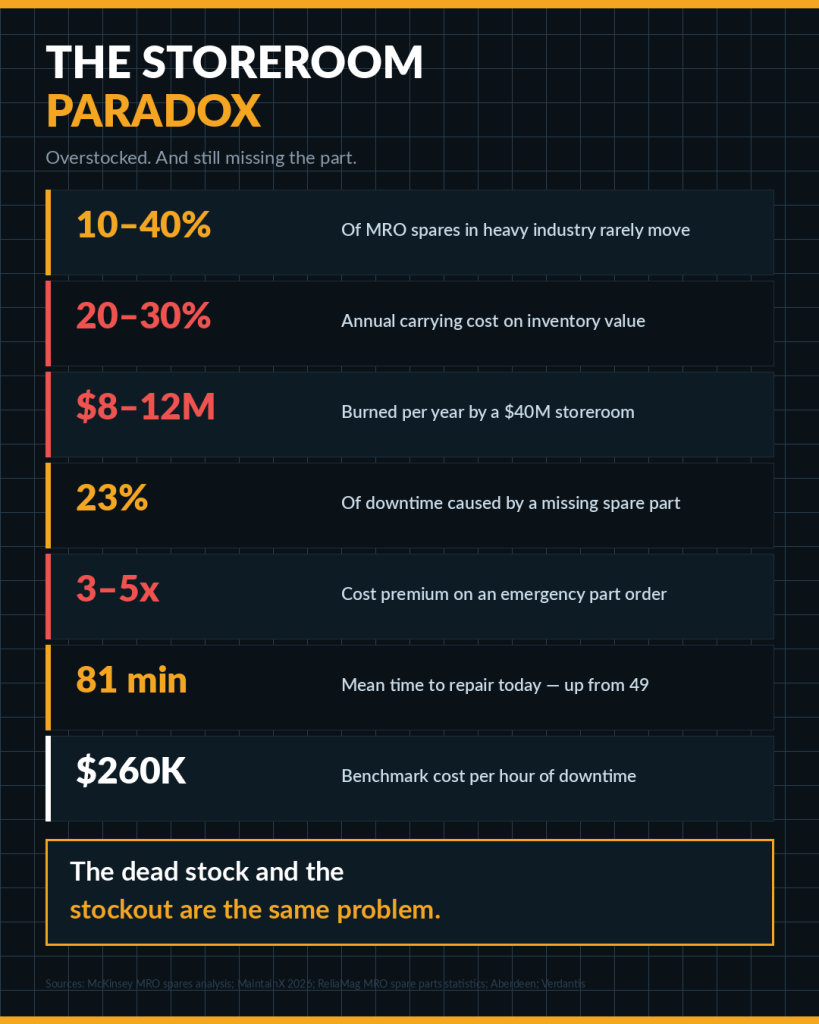
Here’s the catch. The extra 32 minutes is not a technician skill problem. Roughly 23% of unplanned downtime traces to MRO spare parts that weren’t on the shelf when the tech opened the panel.
That plant almost certainly had eight-figures of inventory in the building at the time.
Eight Figures Of MRO Spare Parts And Nothing You Need
The MRO spare parts paradox is the most expensive open secret in manufacturing.
- McKinsey pegs more than 40% of MRO spares in heavy industry as slow-moving and rarely consumed. (we see a much higher percentage visiting industrial plants)
- Carrying cost runs 20% to 30%+ of inventory value every year once you add space, insurance, shrinkage, and obsolescence write-offs. A $40 million storeroom quietly burns $8–12 million a year sitting still.
- Emergency-sourcing the part you didn’t stock costs 3x to 5x the planned price — before the production loss.
- Aberdeen benchmarks downtime near $260,000 per hour in manufacturing. Automotive clears $2.3 million.
- And the bench keeps thinning — roughly 20 skilled trade openings for every one new worker through 2032.
Now the floor. Watch what the language does when a plant finally confronts the crib
- Strategic reserve — “We hold safety stock on critical assets” is what the floor manager tells you. “We’ve called it insurance for nine years and it has never once been the part that failed” is what the finance team tells you, and is correct.
- Inventory disposition — “We’re writing off obsolete stock” is the clean version. “We’re paying a scrapper to haul away new-in-box material somebody would have written us a check for” is the real version.
- Cross-training — “We’re building bench depth” is the joke you’re told. “One guy retired and took forty years of undocumented tribal knowledge with him” is how serious it actually is.
Here’s the part nobody says out loud. Your dead MRO spare parts are not your safety net — they are the wrong parts.
Different assets, different vintage, different failure. The bin that’s been sitting untouched since 2014 has never once matched the panel that opened at 2 a.m.
So you pay twice. Once to store material that will never save you, and again at 5x to expedite the material that would have.
Spares only pay off when you can actually use them in an emergency, otherwise you’re paying higher rent fees and taking up room. Don’t let Bob fool you.

Three Moves Before The Next Write-Off Cycle
- Rank the crib by consequence, not by turns.
- Pull every SKU that has moved zero times in 24 months. In most plants that’s a third of the storeroom.
- For each, answer one question: if this fails tomorrow and it’s not here, what stops?
- Anything that stops a line, a permit-critical system, or a customer commitment stays — regardless of turns. Everything else is not a spare. It’s stored cash.
- Multiply the affected line’s hourly contribution margin by a realistic 30-day sourcing window. Put a dollar figure on it. That’s what you’re actually protecting, and it’s the only number that should drive the keep list.
- Move the rest in one lot, not one line at a time.
- The leftover pile is the real money — new-in-box bearings and power transmission, PLCs and drives, electromechanical and controls, general industrial supplies. Full truckloads of it in most legacy plants.
- Piecemealing takes bandwidth you don’t have. A single buyer taking the whole lot converts it in one transaction — that’s what the surplus and obsolete market is for, and it prices against extended value rather than scrap weight.
- Get the offer against extended value before you accept a scrap bid. The delta may suprise you.
- Stop treating the OEM as the only place a part comes from.
- Run your critical spares against live manufacturer catalogs. Flag every part marked end-of-life, last-time-buy, or “contact factory.”
- For those, the OEM has already told you the answer is no. The part still exists — it’s sitting new-in-box in somebody else’s crib, and it’s about to get scrapped. (they thought it would be useful at some point too)
- Build the secondary-market relationship before the failure, not during it. Sourcing a discontinued servo motor during a weekend 2nd shift is a different conversation than sourcing it on a Tuesday at 9 am. Who can you order from at anytime and know the part is going to arrive the next day?
- Every hour you take out of MTTR this way costs you nothing in headcount. You cannot hire a technician in 30 days. You can find a part in one.

Somebody Is Already Storing Your Next Emergency Part
Every plant in America is sitting on MRO spare parts it will never consume, and expediting the ones it actually needs at 5x.
Nobody solves that inside their own four walls. The material only moves when it gets sold, and the part you need only shows up because somebody else sold theirs, and its usually the secondary market.
Two camps are forming around that.
One is scrapping the dead stock, keeping the write-off quiet, and continuing to pay expedite premiums on the other end. Tidy on the balance sheet. Expensive everywhere else.
The other has figured out that the secondary market functions as a shared storeroom for the entire industry — and that being an active participant on both ends turns a carrying-cost line item into a source of supply.
There is your opening.
And the leverage is asymmetric right now. Unplanned downtime already costs the world’s 500 largest companies around $1.4 trillion a year, up from $864 billion in 2019–2020. With 2.1 million manufacturing jobs projected unfilled by 2030, availability is the only lever left that moves in under a year.
Sort the crib. Sell the dead weight while it’s still new-in-box and worth a check instead of a scrap ticket. Don’t sleep on this.
What to watch: Q3 MTTR benchmarks — if the 81-minute figure clears 90, parts availability has permanently outrun hiring as the uptime lever.
But for now, the data shows us parts are going to continue giving industrial manufacturers the hard time.