
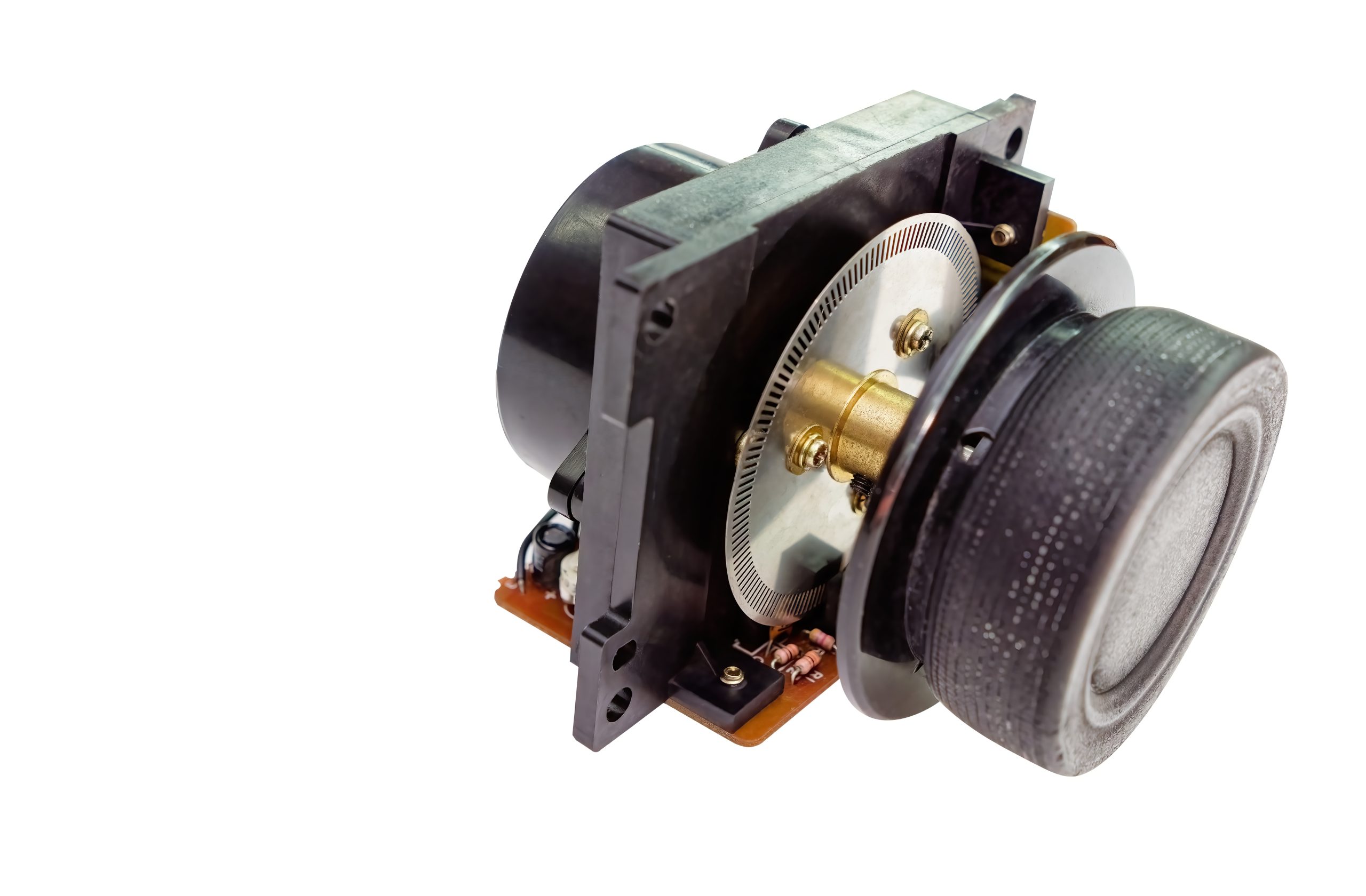
A rotary encoder converts shaft rotation into an electrical signal. This signal tells a control system how far the shaft has turned, how fast it spins, or its position at any moment. Without that feedback, precision motion control is impossible. Rotary encoders are essential in CNC machines, servo systems, robotics, and industrial automation. When maintaining, replacing, or specifying a new system, understanding the right rotary encoder types is critical. Selecting the wrong encoder can lead to poor performance or equipment failure. Central Surplus offers motion control components, including encoders from leading manufacturers.
A rotary encoder monitors the angular position and motion of a rotating shaft and outputs that information as an electrical signal to a controller or drive.
That feedback is used for:
This is the most important distinction in encoder selection. These two types solve fundamentally different problems.
An incremental encoder outputs a pulse for every rotation increment. The controller counts those pulses to track position and speed. The encoder itself has no memory; it simply generates pulses during motion, leaving it to the controller to track how far it has moved from its last reference point.
If power is lost or the system loses count, the encoder cannot determine its position. It must locate a reference (home) position before accurate operation can resume. Most incremental encoders provide a separate index pulse (Z channel) once per revolution to help the controller re-establish a reference point.
Incremental encoders are the right choice for applications where speed measurement and relative position tracking are the primary needs, and where homing on startup is acceptable.
An absolute encoder assigns a unique digital code to every shaft position within its range. The encoder always knows its exact position, even after a power loss or system restart—no homing required.
Single-turn absolute encoders track position within a single 360-degree rotation. Multi-turn absolute encoders track position over thousands of revolutions, using either a mechanical gear train or electronic turn counters powered by a battery or an energy-harvesting sensor.
Absolute encoders are preferred when retaining position data during power interruptions is essential. They are ideal for robotic arms, medical equipment, gantry systems, and any application where homing on startup poses safety or productivity concerns.
| Feature | Incremental vs. Absolute |
| Position memory after power loss | Incremental: No; must re-home. Absolute: Yes; retains position. |
| Output type | Incremental: Pulse train (A/B/Z). Absolute: Digital code (binary, Gray code, SSI, etc.) |
| Cost | Incremental: Lower. Absolute: Higher, especially multi-turn. |
| Best use case | Incremental: Speed control, relative positioning. Absolute: Safety-critical or no-home applications. |
| Complexity | Incremental: Simpler wiring and interface. Absolute: More interface options and protocol variety. |
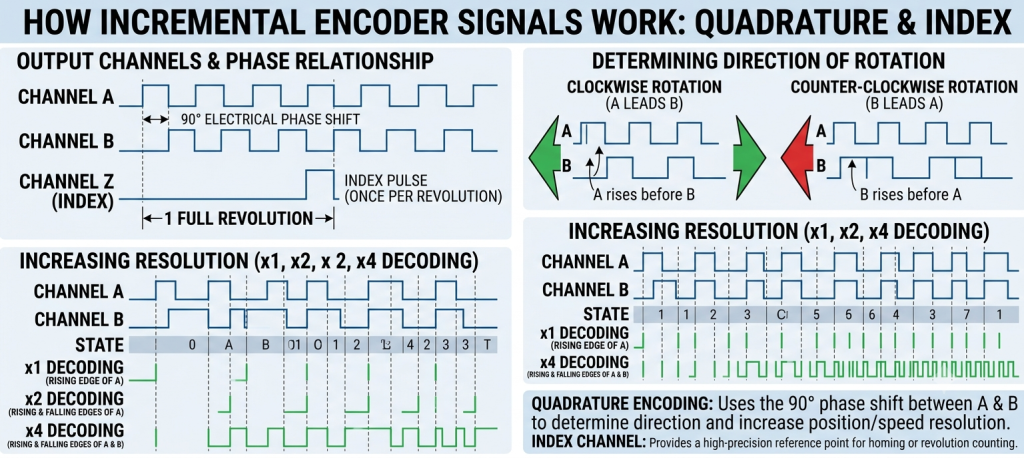
Most incremental encoders output two square-wave signals (A and B channels) that are 90 degrees out of phase. This configuration is called quadrature encoding.
By reading which channel leads the other, the controller determines direction. By counting rising and falling edges on both channels (x4 decoding), the controller achieves four times the base resolution. A 1,000 PPR (pulses per revolution) encoder can resolve 4,000 counts per revolution in x4 mode.
The Z (index) channel produces one pulse per full revolution and is used for homing or revolution counting.
Resolution in incremental encoders is measured in PPR (pulses per revolution) or CPR (counts per revolution). In absolute encoders, resolution is measured in bits. A 12-bit absolute encoder resolves 4,096 unique positions per revolution.
Higher resolution gives finer position feedback, but it also means the control system has to process more data. For most industrial motion control applications, 1,000 to 5,000 PPR is common. Precision machine tools and high-performance servo systems may use 10,000 PPR or higher.
Matching encoder resolution to the drive and controller matters. If the controller’s input frequency limit can’t handle the encoder’s pulse rate at maximum speed, signals will be missed, and positioning will be inaccurate.
Optical encoders use a light source (typically an LED) and a photodetector array to read a patterned disc (code wheel). A transparent disc with etched lines passes between the light source and the detector, interrupting the beam and generating pulses.
Optical encoders provide the highest resolution and maintain accuracy at high speeds. However, they are sensitive to contamination; oil, dust, and moisture can affect signal integrity. They are best suited for clean, controlled environments such as CNC machines, laboratory equipment, and precision instruments.
Magnetic encoders use a magnetized target wheel and a Hall-effect or magnetoresistive sensor to detect position: no disc, no optics, no contamination sensitivity.
Magnetic encoders are more robust in harsh environments: dust, oil mist, vibration, and humidity. Resolution is lower than optical at the high end, but modern magnetic encoders offer resolution adequate for most industrial servo applications.
For maintenance environments, aggressive industrial applications, or anywhere contamination is a real concern, magnetic encoders are the practical choice.
| Encoder Type SummaryClean environment, high precision: optical incremental or absolute. Harsh environment, maintenance-friendly: magnetic. Safety-critical, no homing allowed: absolute (single or multi-turn). Speed feedback, simple systems: incremental. |
If you’re replacing a failed encoder, match these specs from the original unit or the equipment documentation:
If you have the part number, contact Central Surplus for sourcing and cross-reference support. We carry motion control and automation components from leading manufacturers and can help identify compatible replacements when the original isn’t available.
Central Surplus stocks servo drives, motors, and automation components from major industrial manufacturers. Search by part number or reach out for sourcing help on hard-to-find items.


Our team can locate, cross-reference, and source all parts.