Flange Bearings: Types, Selection, and Mounting Guide
Bearings, Resources
If you’ve ever stood in front of a machine, squinting at a worn-out bearing and debating between a pillow block or a flange unit, you’re not alone. The answer usually comes down to one thing: the direction the shaft runs compared to your mounting surface. When the shaft runs parallel to a flat base, a pillow block is your go-to. If it passes straight through a wall or frame, you’re looking for a flange bearing. Get this mixed up, or match the right housing to the wrong bolt pattern, and you might find yourself dealing with the wrong part, early bearing failure or downtime.
This kind of confusion usually crops up when you’re handed a repair job on equipment you didn’t choose, or you’re piecing things together from half-missing manuals. Maybe you’re just trying to match what’s already bolted in place. Both pillow blocks and flange bearings use the same self-aligning inserts, so at a glance, they can look almost interchangeable. But the shape of the housing is what makes all the difference.
What Is a Flange Bearing
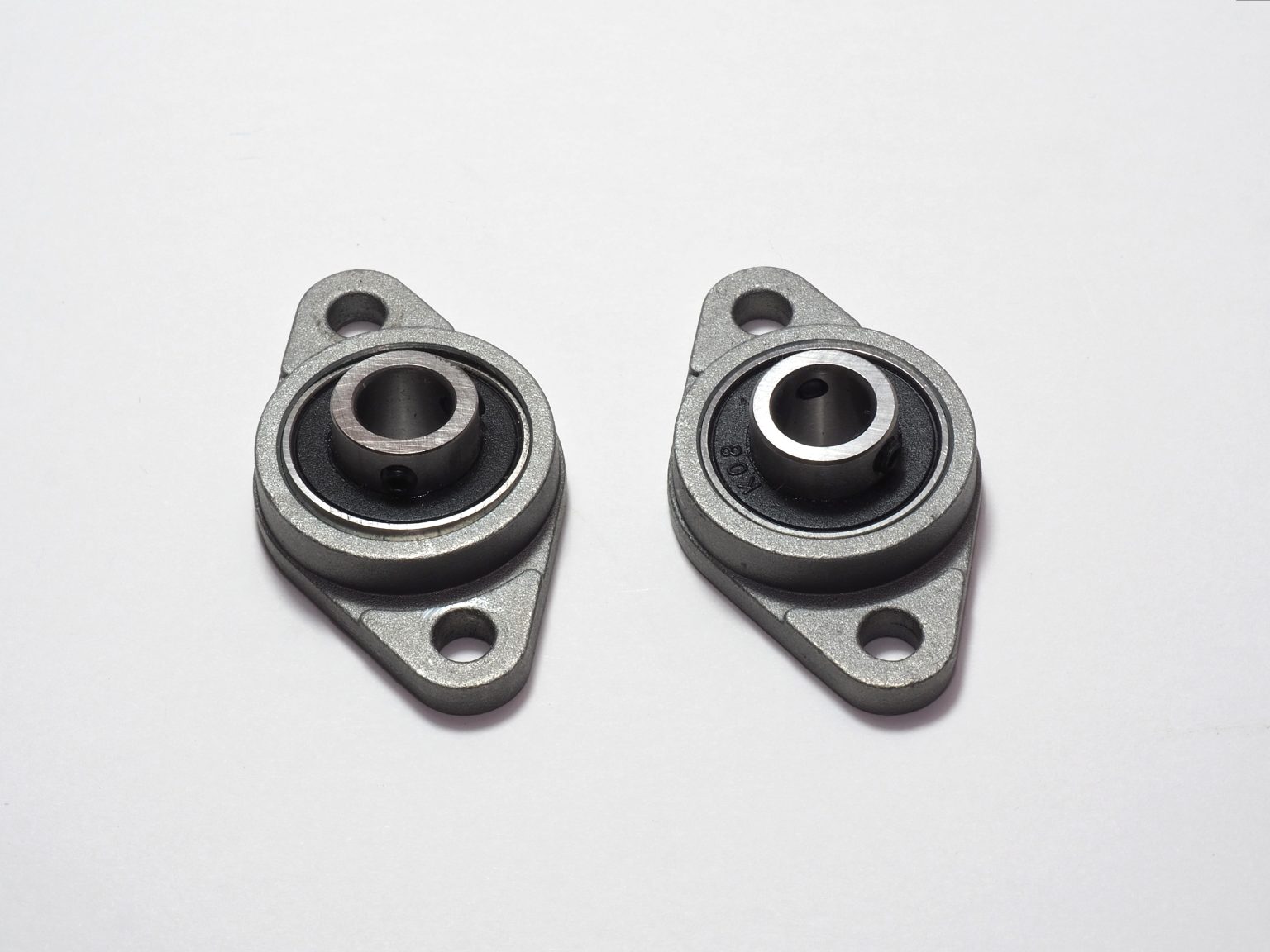
A flange bearing is a mounted bearing unit with a housing shaped like a plate or disc, drilled with bolt holes around its perimeter. The housing bolts flush against a vertical or perpendicular surface, and the shaft passes straight through the center, perpendicular to the mounting face.
Just like pillow blocks, most flange bearings feature a spherical outer ring inside a matching housing seat. This allows the bearing insert to self-align during installation (typically up to ±2∘), compensating for mounting surfaces that aren’t perfectly square or frame variations.
Flange vs. Pillow Block: The Deciding Factor Is Orientation
If your application involves…
Use…
A shaft running parallel to a flat base or floor
Pillow block
A shaft passing through a wall, end plate, or frame face
Flange bearing
Primarily radial load (belt, pulley, or gear weight pressing down on the shaft)
Pillow block, typically rated for higher radial capacity at a given bore size
Primarily axial/thrust load (screw conveyor end thrust, helical gear thrust)
Flange bearing, since the mounting flange sits perpendicular to the shaft and can brace directly against thrust
Flange bearing, since the flat mounting plate braces directly against perpendicular frame walls to absorb axial thrust (Note: Heavy pure-thrust loads require specialized tapered or thrust roller bearing inserts).
These are general tendencies rather than hard-and-fast rules; always check the specific load rating and bolt pattern rather than deciding on orientation alone.
Flange Bearing Configurations
Flange bearings come in a handful of standard bolt patterns, and matching that pattern to your mounting surface is just as important as getting the bore size right.
2-bolt flange: two mounting holes, typically on opposite sides. Common on smaller shafts and lighter-duty applications where the mounting surface has limited space.
4-bolt flange: four mounting holes for more even load distribution and a more secure mount. The standard choice for most industrial applications.
Round (piloted) flange: circular housing with a raised, machined center shoulder (pilot) that fits directly into a recessed bore in the frame. This delivers precise concentricity while transferring heavy radial loads directly to the structure rather than relying solely on the mounting bolts.
Square flange: four bolt holes arranged in a square pattern rather than the more common rectangular 4-bolt layout. Common on certain OEM equipment with specific mounting plate designs.
Specifying a Flange Bearing Replacement
Shaft diameter (bore size)
Load type and magnitude: radial or combined radial and axial
Speed requirements, RPM rating
Environment: standard, washdown, corrosive, high temperature, etc…
Bolt pattern: 2-bolt, 3-bolt, 4-bolt, round, or square, matched to the existing mounting holes
If you have the part number from the old bearing, you’re already halfway there. Central Surplus can help cross-reference between brands if the original isn’t available, so you don’t have to start from scratch.
At Central Surplus, you’ll find flange bearings in 2-bolt, 3-bolt, 4-bolt, and round styles from trusted names like SKF, Timken, Rex, Link-Belt, NTN, Dodge, Fafnir and more in both inch and metric bore sizes. If you have a part number, bore size, or just the bolt pattern, let us know, and we’ll help you track down the right bearing.