
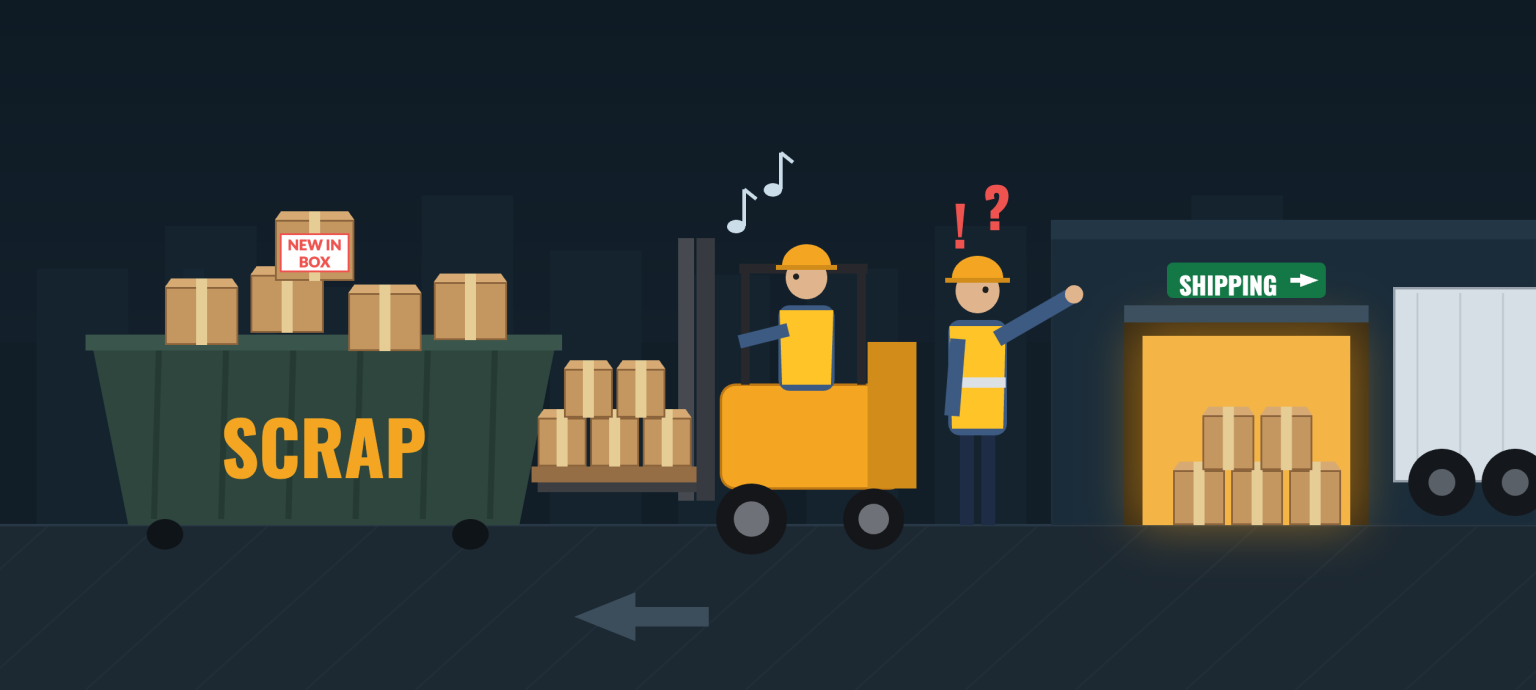
Excess MRO inventory leaves the shop floor one way or another. The only question is whether it leaves on a scale ticket or a purchase order. Smart money knows this, it’s just harder to see from inside the plant.
When you liquidate excess MRO inventory, the exit you pick decides whether anybody writes you a check.
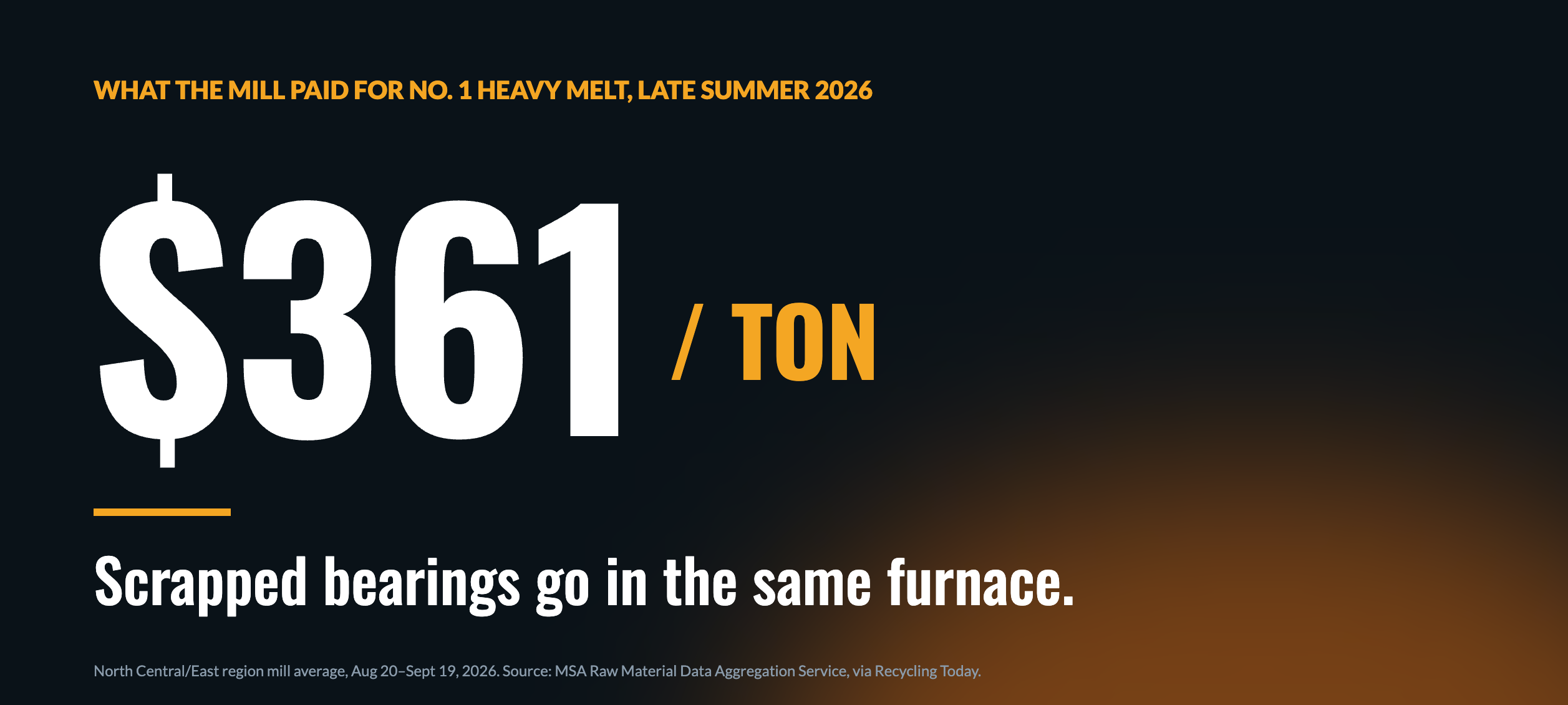
Mills in the North Central and East region paid an average of $361 a ton for No. 1 heavy melting steel between late August and mid-September.
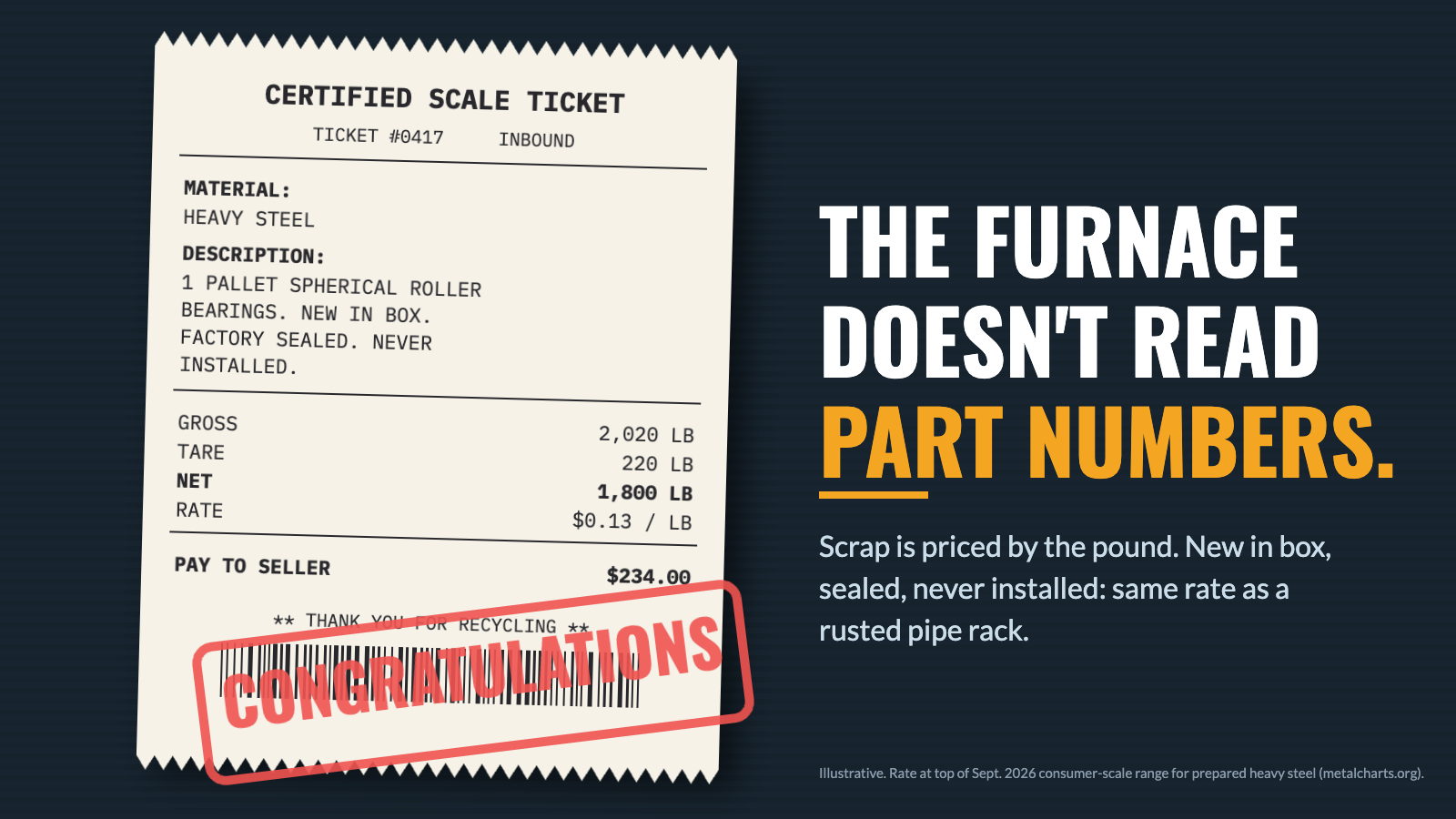
That is under 20 cents a pound. At the mill. Before the yard takes its cut.
It is also the price of a sealed case of spherical roller bearings once it goes into a roll-off.
Bearings, gear reducers, couplings and shafts are mostly carbon and chrome steel. So that’s the rate they get.
The furnace doesn’t read part numbers.
Most plants that decide to liquidate excess MRO inventory never actually pick an exit. They drift into one. Usually the cheapest one.
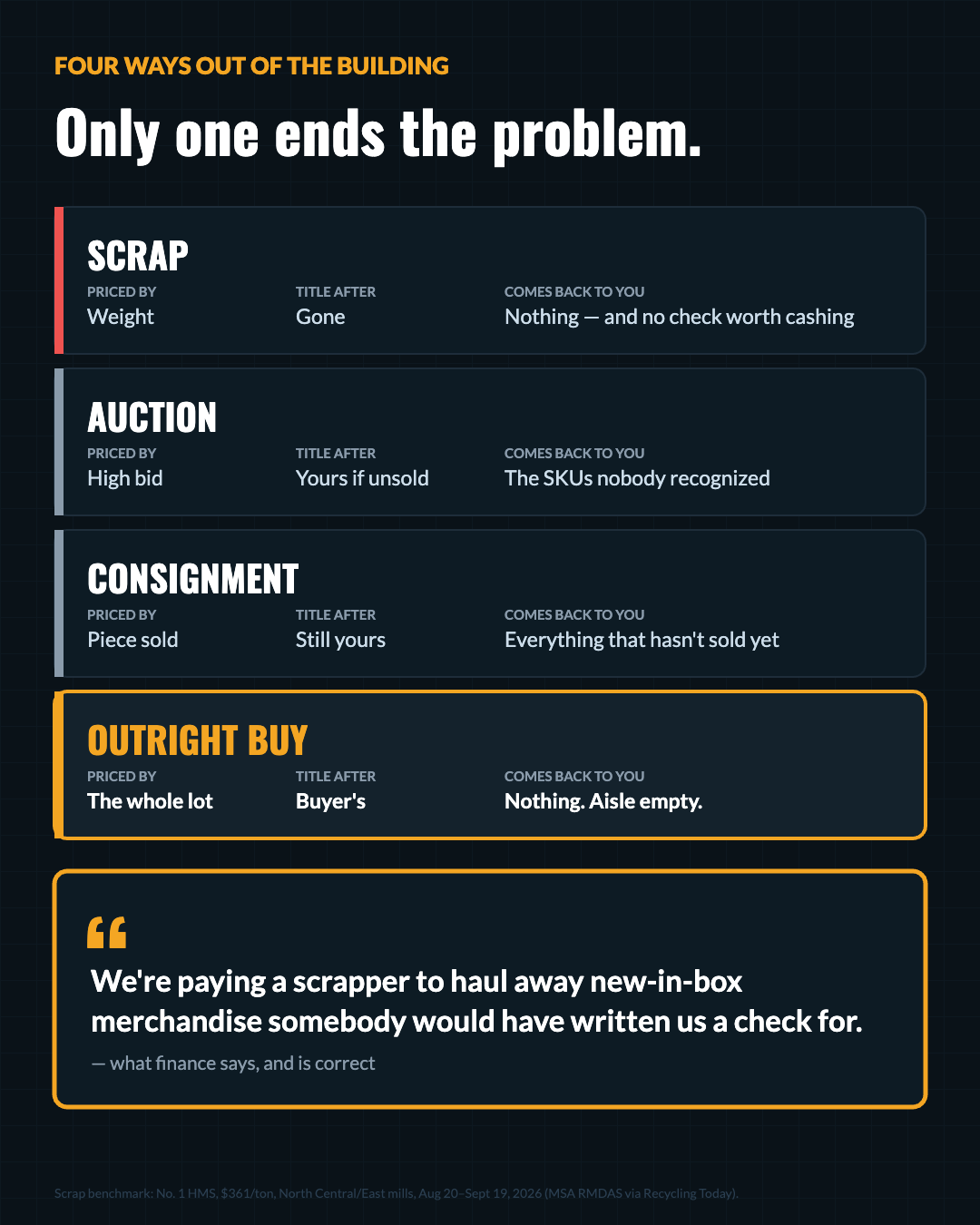
There are four ways out of the building. Each one has a polite name and an honest one.
The fourth exit is an outright buy. One buyer, one offer, the whole lot, gone.
That’s the one nobody writes about, because it’s the one that actually ends the problem.
An outright buyer prices the lot as merchandise, takes the title, and takes the problem with it. Your count drops to zero the day the truck pulls out.
Consignment can’t say that. Neither can an auction house holding your unsold lots in its back warehouse.
If you’re going to liquidate excess MRO inventory at all, the exit is the whole decision.
Here’s the catch with the first three:
Bottom line: three of the four exits leave you holding most of the problem.
(We see it on almost every plant walk: a scrap hopper with a sealed box sitting right on top.)
Three moves. None of them require a consultant or a new software license.
That part is already decided.
Plants everywhere are running the same exercise right now. Leaner headcount, tighter footprints, fewer people who remember why a pallet of couplings was ordered in 2017.
Every one of those projects ends with somebody standing in the back aisle holding a clipboard and asking what all this is.
Two camps come out of it.
The first camp scraps by default. The roll-off shows up, the aisle gets cleared, and new-in-box merchandise goes out at yard rates.
The second camp treats the aisle as inventory for somebody else. They sort, they sell it as a lot, and they move on.
Where does it go? Not back to the OEM. Most likely overseas, to a plant still running the exact equipment you retired.
The buyer on the other end isn’t guessing. He’s running a line the OEM stopped supporting years ago, and your retired spare is the only one he can find.
That’s why the second camp wins. The part you’ll never use is somebody’s emergency right now.
The plants that liquidate excess MRO inventory on purpose get paid for it. The ones that do it by accident pay the hauler.
Your opening is in the second camp. Don’t sleep on this.
What to watch: year-end physical counts and the Q4 write-off conversation. That’s when finance asks why the aisle is still full.
And if you sell now, you’re not paying for another year of storage and reducing your tax exposure. That’s the real deal.
Ready to sell industrial MRO parts? Make it easy. → Sell Your Parts

Our team can locate, cross-reference, and source all parts.
Our team can locate, cross-reference, and source all parts.