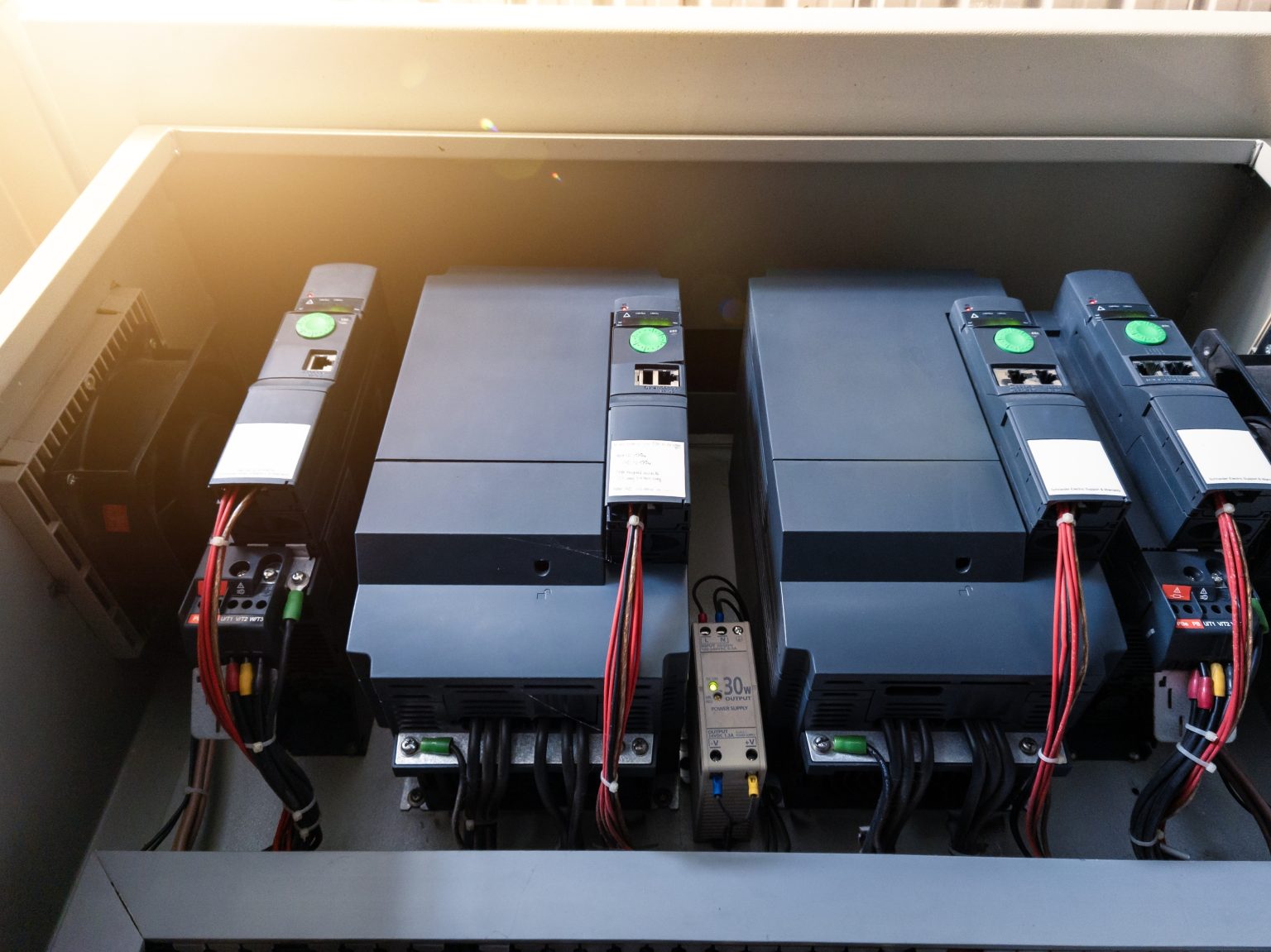
Both variable frequency drives (VFDs) and servo drives control motor speed and torque. While they may appear interchangeable, selecting the wrong type can result in unnecessary costs or a system that does not meet your requirements. The right choice depends on your application’s specific needs. This guide explains how each drive operates, its strengths, and key differences. Central Surplus offers both VFDs vs. servo drives from leading manufacturers.
A variable frequency drive controls an AC induction motor by adjusting the supplied frequency and voltage. Lower frequency reduces speed, while higher frequency increases it. The motor responds accordingly.
VFDs convert incoming AC power to DC, then invert it back to AC at the required frequency. This allows for adjustable motor speed without the mechanical losses associated with gearboxes or fluid couplings.
A VFD does not use position feedback from the motor. It commands speed and assumes the motor follows. In open-loop operation, the drive estimates speed based on output frequency. In closed-loop operation, it uses a tachometer or encoder to verify speed, but position control is not the objective.
A servo drive controls a servo motor using high-speed closed-loop feedback from an encoder mounted on the motor shaft. The encoder reports the actual position to the drive thousands of times per second. The drive continuously compares actual and commanded positions, adjusting output to minimize error.
This is known as a closed-loop position control system. The drive targets an exact shaft position at every moment, not just speed. This enables the precise, high-dynamic motion required by automation equipment such as robots, CNC machines, and packaging lines.
Servo drives also support torque mode, in which the drive targets a specific torque output rather than position or speed. This is used for winding, tension control, and applications requiring a constant force regardless of speed.
A VFD in standard operation is open-loop. It tells the motor what to do and assumes the motor will comply. Under most conditions, this works well. Under conditions that deviate from the drive’s model—heavy load changes, rapid acceleration, high-inertia loads—the motor may slip, lag, or fail to track the command accurately.
A servo drive is always closed loop on position. It verifies what the motor actually did and corrects for any deviation in real time. The result is much higher position accuracy, better dynamic response, and consistent performance regardless of load variation.
The cost of that closed-loop accuracy is complexity and price. Servo systems require servo-specific motors with integrated encoders, control-loop tuning, and a more involved commissioning process.
| Characteristic | VFD vs. Servo Drive |
| Primary control variable | VFD: Speed (frequency). Servo: Position, speed, or torque. |
| Feedback | VFD: Open loop (or basic speed feedback). Servo: High-speed encoder position feedback. |
| Motor type | VFD: Standard AC induction. Servo: Servo-specific (PMSM or brushless DC). |
| Position accuracy | VFD: Low to none in open loop. Servo: High; fractions of a degree. |
| Dynamic response | VFD: Moderate. Servo: Very high; fast acceleration and deceleration. |
| Cost | VFD: Lower purchase and installation cost. Servo: Higher, including motor and feedback. |
| Commissioning | VFD: Simple setup. Servo: Requires loop tuning and parameter setup. |
Variable frequency drives are the correct solution for most industrial motor control applications. If the goal is running a pump, fan, compressor, or conveyor at variable speeds with energy savings and soft starting, a VFD is almost always the right tool.
VFDs shine in these situations:
Central Surplus stocks VFDs from major manufacturers. Search our industrial automation parts inventory or contact us with your voltage, horsepower, and application specs.
Servo drives are the right choice when the application demands precise, dynamic, position-controlled motion, typically in automated manufacturing, assembly, or robotics.
Servo systems are the correct call when:
For servo drives and servo motors, Central Surplus carries components from Fanuc, Siemens, Allen-Bradley, and other manufacturers. Browse our servo drive and motor inventory or contact us for sourcing support.
The line between VFDs and servo drives has blurred somewhat as VFD technology has improved. Many modern VFDs support encoder feedback (vector control with encoder), which allows much tighter speed regulation than open-loop operation.
A closed-loop VFD with encoder feedback is not a servo drive. It provides better speed accuracy than open-loop VFD operation, but it’s still fundamentally a speed controller, not a position controller. The dynamic response is slower, the position accuracy is lower, and the motor lacks the ultra-low rotor inertia and rapid responsiveness of a dedicated servo motor.
For applications that need better-than-open-loop speed accuracy but not true high-dynamic position control, such as a winder, a constant-tension drive, an extruder, or a heavy material hoist, a closed-loop VFD is often the right compromise: better performance than a standard VFD, simpler and cheaper than a full servo system.
Use a VFD if you need to control speed, reduce energy consumption, or soft-start a standard AC motor. Use a servo drive if you need precise, dynamic, position-controlled motion with fast response.
If you’re replacing an existing drive, match the type to the one that was there. A servo system was specified for a reason, and swapping in a VFD will not replicate its motion-control capability. If you’re building a new system and are unsure which applies, describe the required motion profile. If it involves exact stop positions, synchronized axes, or high-cycle-rate motion, it’s a servo application.
Central Surplus stocks drives, motors, and automation components across major brands. Contact us with your part number or application specs for sourcing help.
Our team can locate, cross-reference, and source all parts.
Our team can locate, cross-reference, and source all parts.